The best survey vendors don't just spit out a satisfaction score. They surface exactly where communication breakdowns, weak leadership habits, or cultural misalignment are quietly costing you productivity and good people.
This guide compares the top employee engagement survey vendors of 2026, what makes each one different, and why the data they generate is only half the equation. Collecting scores is easy. Acting on them is where most organizations stall out.
Key Takeaways
- Six standout platforms span lightweight startup tools through enterprise research suites
- Vendor selection hinges on customization, benchmarking depth, anonymity, integrations, and pricing transparency
- Highly engaged business units see 23% higher profitability than disengaged ones, according to Gallup
- Survey data alone rarely drives change; pair it with a structured action-planning framework
Overview of Employee Engagement Survey Vendors in the HR Tech Market
An employee engagement survey vendor isn't a form builder with an HR label slapped on it. Generic tools like Microsoft Forms let you collect responses and chart the results.
Specialized engagement platforms go further. They typically add:
- Validated question sets and workforce benchmarks
- Team-level segmentation and recurring pulse cadences
- Built-in action-planning tools for managers
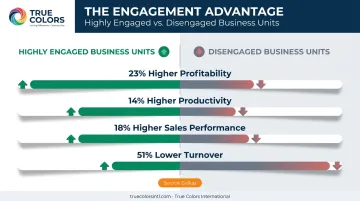
That distinction matters because the stakes are real. Gallup's long-running workplace research found that highly engaged business units post 23% higher profitability, 14% higher productivity, and 18% higher sales performance than their disengaged counterparts. Turnover drops too, as much as 51% lower in low-turnover organizations that prioritize engagement.
Gallup is blunt about one thing, though: engagement doesn't improve just because you ran a survey. It improves when leaders and teams actually act on what the data shows.
Vendors in this space now range from simple pulse tools built for scrappy startups to full research platforms designed for multinational enterprises. The right choice depends on:
- Your workforce size and how distributed it is (office, remote, frontline)
- Whether engagement needs to tie into performance management
- How much internal analyst capacity you have to interpret results
- Which HRIS you're already running
Top Employee Engagement Survey Vendors in 2026
Every vendor below was evaluated against the same lens: survey customization, analytics depth, benchmarking, anonymity controls, and how cleanly it plugs into existing HR systems.
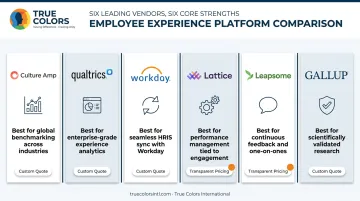
Culture Amp
Founded in 2009, Culture Amp built its reputation as a research-backed employee experience platform and has since expanded into a unified system covering engagement, performance, and development.
Culture Amp's benchmark database draws on more than 1 billion survey responses worldwide, and its templates are grounded in organizational psychology research rather than guesswork. Its AI Comment Summaries feature automatically distills open-text feedback into themes and suggested next steps.
It fits mid-market and enterprise People teams who want context, not just raw scores.
| Category | Details |
|---|---|
| Best For | Mid-market and enterprise teams building people-analytics maturity |
| Key Strength | Research-backed templates with strong benchmark context |
| Pricing Model | Custom quote based on workforce size and modules |
Qualtrics XM
Qualtrics operates at the enterprise end of the spectrum, offering the deepest statistical and text-analytics tooling in the category. It functions as a full experience-management platform, not a standalone survey app.
Its Text iQ engine tags and analyzes open-text comments at scale, running sentiment analysis across thousands of responses simultaneously. On the integration side, Qualtrics connects to roughly 50 different HRIS platforms through its Merge middleware, including Workday, SAP SuccessFactors, and UKG. The tradeoff: this level of configurability typically demands a dedicated admin or analytics team to run it well.
| Category | Details |
|---|---|
| Best For | Large enterprises with dedicated people-analytics teams |
| Key Strength | Advanced statistical tooling and predictive analytics |
| Pricing Model | Custom enterprise pricing (contact sales) |
Workday Peakon Employee Voice
Formerly just "Peakon," this continuous listening platform became part of Workday in 2021 and now lives natively inside the Workday HCM ecosystem.
Worker data, org structures, and demographic attributes sync automatically from Workday HCM into Peakon, with no manual data mapping required. It also uses AI to flag attrition risk before it becomes a resignation letter. Note: Workday does offer Peakon as a standalone product, but its real value shows up when you're already deep into the Workday ecosystem.
| Category | Details |
|---|---|
| Best For | Large enterprises already running Workday HCM |
| Key Strength | Native HRIS integration with no manual data sync |
| Pricing Model | Quoted as part of a Workday contract or standalone |
Lattice
Lattice takes a different angle: it is a performance management platform first, with engagement surveys wired directly into OKRs, reviews, and 1-on-1 conversations.
That wiring is the whole point. Engagement scores don't sit in a separate dashboard collecting dust; they show up right next to the performance conversations managers are already having. Lattice also publishes clearer pricing than most competitors: its Engagement module starts at $4 per seat per month, with a $4,000 annual contract minimum.
| Category | Details |
|---|---|
| Best For | Teams wanting engagement tied to performance and growth |
| Key Strength | Unified engagement + performance workflow |
| Pricing Model | Starts at $4/seat/month, $4,000 annual minimum |
Leapsome
Leapsome bundles engagement surveys, performance reviews, and learning tools into one modular people-enablement platform, letting companies pay only for the pieces they actually use.
Its survey templates are scientifically grounded, and its AI-assisted feedback tools help managers turn rough notes into clearer, more constructive comments (the AI won't write feedback from scratch; managers still own the final call). Leapsome has also run startup-specific pricing programs, offering discounts for companies under 50 employees.
| Category | Details |
|---|---|
| Best For | Companies wanting engagement tied to employee development |
| Key Strength | Continuous feedback model with AI-assisted analysis |
| Pricing Model | Per-user monthly rate, custom quote by module |
Gallup Access
Gallup built the question set nearly every engagement vendor is measured against: the Q12. The interface is plain, but the Q12 remains one of the most validated models in the category.
Gallup's Q12 survey draws on research spanning more than 3.3 million workers across 100,000+ teams. The tradeoff for that pedigree is the product experience: Gallup Access feels less modern than newer platforms, and pricing runs higher. Smaller organizations (under 100 employees) can buy the one-time survey directly for $20 per participant; larger rollouts require a consultative, custom-priced engagement.
| Category | Details |
|---|---|
| Best For | Organizations wanting a rigorously validated engagement model |
| Key Strength | Time-tested question set with deep normative benchmarks |
| Pricing Model | $20/participant (under 100 employees); custom above that |
How We Chose the Best Vendors
Each platform was compared across five criteria:
- Customization depth
- Analytics and benchmarking strength
- Anonymity architecture
- Integration breadth
- Pricing transparency
That last point matters more than most buyers expect. Only Lattice and Gallup publish clear, comparable pricing figures. Culture Amp, Qualtrics, Leapsome, and Workday all require a sales conversation before you see a number.
Features and price still leave a bigger gap: whether the tool reaches your whole workforce. A common buying mistake is picking a vendor on brand recognition or a slick dashboard demo without checking access. An email-only survey tool is nearly useless if a third of your team is frontline or deskless staff with no company email address.
Beyond features, apply the same rigor you'd expect from any assessment tool. Benchmark sample sizes, data reliability standards, and adverse-impact review matter just as much as the feature list, the same way selection tools are checked against standards like the EEOC's 80% Guideline for adverse impact. A vendor with a beautiful UI but a shallow benchmark pool isn't giving you a reliable read on your workforce.
Beyond the Survey: Why Data Alone Won't Fix Engagement
Every vendor above is genuinely good at measurement. None of them are designed to fix what the measurement reveals. That gap is where most engagement initiatives quietly die.
Low scores on collaboration, trust, or leadership questions rarely mean people don't care. More often, they trace back to something simpler: communication breakdowns, misread personality differences, and leadership styles that don't flex to fit the team.
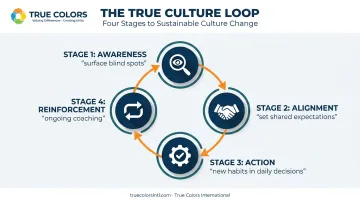
True Colors International closes that gap with the True Culture Loop framework (Awareness, Alignment, Action, Reinforcement). It was built to translate survey findings into sustained behavior change, not another one-off training day.
Here's how the four stages work in practice:
- Awareness — Teams use tools like our Employee Experience Survey and Culture Clarity Assessment to surface blind spots and build shared understanding of how people communicate.
- Alignment — Teams set shared expectations for communication, decision-making, and accountability, cutting the friction low trust scores usually signal.
- Action — New habits move into daily meetings and decisions, with leaders modeling the behaviors they want to see.
- Reinforcement — Ongoing coaching, internal champions, and certified facilitators keep the culture shift alive after the workshop ends.
The assessment methodology behind this framework is ASI-certified, validated against a 10,000-person sample (N=10,000), and reviewed against EEOC 80% Guideline standards for reliability and disparate impact. That rigor helps HR teams diagnose the "why" behind a weak collaboration score, not just the "what."
Organizations including Fortifi Bank, Shortcut Software, and Blue Cross Blue Shield of Oklahoma have used this framework to turn survey feedback into stronger team communication. You can review the full validation findings on our Research Précis page.
Conclusion
The right employee engagement survey vendor in 2026 depends on your workforce size, distribution, and existing HR stack. A platform built for a 50,000-person enterprise running Workday won't serve a 150-person startup well, and vice versa.
When you're evaluating options, weigh data security and benchmarking depth just as heavily as price. Ask one more question before you sign: does this platform support real follow-through, or does it stop at the dashboard?
If your organization already has survey results sitting in a report somewhere, pair them with True Colors International's 45+ years of culture-building expertise. Book a Culture Mapping Call and let's turn those insights into lasting engagement improvements.
Frequently Asked Questions
How much does an employee engagement survey cost?
Pricing varies widely by vendor and scale. Lattice's Engagement module starts at $4 per seat per month, while Gallup's one-time Q12 survey runs $20 per participant for smaller organizations. Enterprise platforms like Qualtrics and Culture Amp require custom quotes.
Are employee engagement surveys worth the investment?
Yes. Gallup's research links highly engaged teams to 23% higher profitability and significantly lower turnover. Surveys catch culture problems while they're still cheap to fix, before they show up as resignations.
Which employee engagement survey vendor works best for small businesses?
Lighter-weight platforms with fast setup and lower cost fit smaller teams better than enterprise research suites. Leapsome's startup program or Gallup's one-time survey for organizations under 100 employees are strong options.
How often should companies run employee engagement surveys?
Run one comprehensive census survey annually to set a benchmark, then supplement it with quarterly or monthly pulse checks to catch problems between the big surveys.
What's the difference between a pulse survey and a full engagement survey?
A pulse survey is short and frequent, tracking a handful of metrics month to month or quarter to quarter. A full engagement survey is a comprehensive annual snapshot with deeper benchmarking and driver analysis.
What should an organization do after receiving employee engagement survey results?
Don't stop at the dashboard. Build a structured action-planning framework, like True Colors' True Culture Loop (Awareness–Alignment–Action–Reinforcement), so scores translate into visible behavior change rather than a forgotten PDF.