That gap isn't just semantic. Only 2% of Fortune 500 CHROs strongly agree that their performance management systems actually inspire employees to improve, according to Gallup's analysis of CHRO sentiment. Something is broken between how leaders talk about performance and how they measure it.
Organizational performance spans financial results, operational efficiency, and — increasingly — culture and communication. This guide breaks down what it actually means, how to measure it across every level of your organization, and what proven levers move the needle.
We'll spend extra time on the human side of the equation. Leadership behavior, communication habits, and culture alignment are often the most overlooked factors in performance conversations. They're also some of the easiest to fix once you know where to look.
Key Takeaways
- Organizational performance spans financial, operational, and strategic goals, not just profit.
- Real measurement blends individual, team, and organization-wide indicators, not one company metric.
- The Balanced Scorecard and Triple Bottom Line's "3 Ps" give leaders a holistic view.
- Communication breakdowns and misaligned culture drain performance, but both are fixable with the right tools.
What Is Organizational Performance?
Organizational performance describes how well a company meets its stated goals and objectives. It's the metric leaders use to measure progress, justify where resources go, and steer strategic decisions. Without it, you're managing on instinct.
Academics draw a useful distinction here: effectiveness versus efficiency. Effectiveness asks whether you hit your target; efficiency asks whether you got there economically and on time.
An organization can hit a goal while burning through resources it shouldn't have, or conserve resources while missing the target entirely. Neither outcome counts as strong performance on its own; you need both.
The Three Traditional Performance Lenses
Business researchers typically evaluate performance through three lenses:
- Financial performance: revenue, ROI, and profit margins. This is the default measure most people mean when they say "performance."
- Product-market performance: sales growth, market share, and cost-to-outcome ratio. Some practitioners call this "operational performance."
- Shareholder return performance: growth in investor value over time. Fixating here risks losing sight of the daily operations that actually drive the number.
No single lens tells the full story. A company can look excellent on paper financially while turnover climbs and top performers walk out the door.
The 3 Ps of Organizational Performance
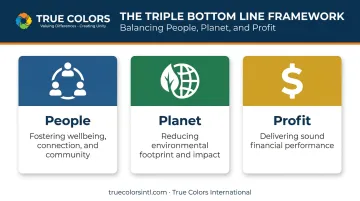
John Elkington's Triple Bottom Line framework, coined in 1994, widens the lens even further. It evaluates performance across three pillars:
- People: social impact, employee wellbeing, community relationships
- Planet: environmental footprint and sustainability practices
- Profit: traditional financial results
The framework's value is in the reminder that profit was never meant to stand alone. A company can be profitable and still be underperforming when you factor in turnover, burnout, or reputational damage.
How to Measure Organizational Performance
Measuring performance well means looking both inward and outward. Internal indicators cover your financial and operational data. External indicators, such as survival and growth, fit with your market environment, and relevance to stakeholders, tell you whether the organization is still solving a problem the world actually cares about.
Individual, Team, and Organizational-Level Metrics
Building on those internal and external indicators, performance measurement breaks down across three organizational levels:
Individual level. Individual performance typically breaks down into four measurable sub-factors:
- Task performance (how well someone does their core job)
- Adaptive performance (how they handle change)
- Contextual performance (how they support the team around them)
- Counterproductive work behavior (actions that actively harm outcomes)
Team level. Look at milestone-based evaluations during training, structured debriefs after major projects, leadership development check-ins, and team retreats. These give you a read on collaboration health that individual metrics miss entirely.
Organizational level. This is where feedback loops matter most: satisfaction surveys, internal and external assessments, and tools like eNPS (Employee Net Promoter Score). eNPS asks how likely employees are to recommend the organization as a place to work, then nets promoters against detractors. It's a strong pulse check, but it doesn't tell you why — pair the score with a structured employee experience survey to capture the context behind it.
Popular Measurement Frameworks
The Balanced Scorecard, introduced by Kaplan and Norton, remains one of the most widely referenced tools for avoiding tunnel vision on financials. It evaluates four perspectives:
| Perspective | Core Question |
|---|---|
| Financial | How do shareholders view us? |
| Customer | How do customers view us? |
| Internal process | What must we excel at internally? |
| Learning & growth | Can we keep improving? |
Whether you use the Balanced Scorecard, OKRs, or a homegrown system, the principle is the same: balance multiple metrics instead of fixating on one number.
Factors That Impact Organizational Performance
Performance doesn't erode in one dramatic moment. It slips through daily friction that leaders often miss.
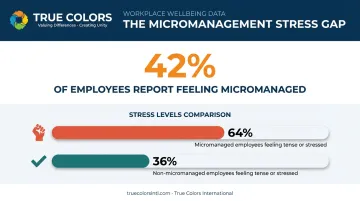
Manager-employee relationships. Micromanagement is a bigger drag than most leaders assume. In an APA Work in America survey of 2,515 U.S. employees, 42% reported feeling micromanaged. Among that group, 64% felt tense or stressed during the workday, compared to just 36% of non-micromanaged workers. Stress that high doesn't stay contained to the manager relationship — it bleeds into output, retention, and morale.
Growth opportunities. When employees can't see a path forward, they leave. Limited career development isn't just an HR complaint; it's a direct hit to retention, and retention is a direct hit to performance. Replacing skilled employees costs time, institutional knowledge, and momentum you can't easily rebuild.
External influences. Political climate, economic conditions, and technology shifts (AI adoption chief among them) all shape performance regardless of internal strategy quality. But adoption doesn't automatically mean value. Even with widespread AI use, a McKinsey survey on the state of AI found most organizations haven't yet seen the enterprise-level financial impact they expected. Deployment and realized value are two different milestones.
How to Improve Organizational Performance
Improving performance means fixing the human systems underneath the numbers, not just adding more dashboards.
Invest in Leadership Development
Engaged managers create engaged teams. Gallup has tracked this pattern for years, and yet only 22% of managers worldwide were engaged at work in 2025, according to Gallup's State of the Global Workplace data.
Compare that to Gallup's best-practice organizations, where manager engagement reaches nearly four times the global average. The gap between average and excellent management is enormous, and it's closeable.
Leadership development that builds real self-awareness (not just theoretical frameworks) tends to move this number faster than generic training.
Build a Shared Language for Communication and Culture
Miscommunication rarely comes from bad intentions. It comes from people with fundamentally different work styles talking past each other without realizing it. Two colleagues can attend the same meeting and walk away with completely different interpretations of what was decided, simply because they process information and prioritize differently.
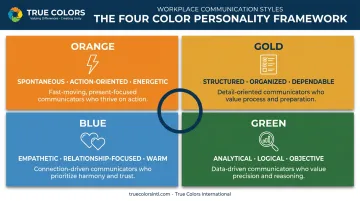
This is where a shared organizational language earns its keep. True Colors International built its methodology around exactly this problem, using a four-color personality-spectrum framework (Orange, Gold, Blue, and Green) that gives teams a common, non-threatening vocabulary for describing how people think, communicate, and make decisions.
Certified facilitators use the framework in workshops to help participants identify their own color spectrum, then apply that awareness to real interactions across hiring conversations, team-building sessions, and leadership development.
Nikki Hanna of Blue Cross/Blue Shield of Oklahoma put it simply: "We now realize it's a good thing we're not all alike... we are stronger and happier as a result." That's the practical payoff of a shared language: less friction, faster alignment, fewer misunderstandings that cost you productivity.
Set Measurable Goals and Track Progress
Transparent KPIs at the company, team, and individual level help employees see how their daily work connects to bigger organizational goals. That connection matters more than most leaders realize: vague goals produce vague effort. Specific, visible goals produce accountability, because people can actually see whether they're winning or losing.
Foster Wellbeing and Recognition
Low-cost tactics compound fast:
- Employee Assistance Programs for mental health support
- Mindfulness resources built into the workday
- Regular peer-to-peer recognition (not just top-down praise)
Wellbeing and productivity are two sides of the same conversation.
The Organizational Performance Management Process
Effective performance management works as an ongoing three-step cycle built into everyday operations, rather than a once-a-year event most employees dread:
- Strategic planning: Clarify goals and align them with the broader mission.
- Appraisal: Track progress through surveys, reviews, and regular check-ins.
- Improvement: Address pain points at the individual, team, or organizational level before they compound.
Some HR practitioners frame this cycle using the "5 C's": clarity, communication, consistency, coaching, and consequences. It's a helpful mnemonic for remembering what a healthy cycle actually requires — more on that below.
Frequently Asked Questions
What is meant by organizational performance?
Organizational performance is a company's ability to meet its goals across financial, operational, and social or cultural dimensions. It spans multiple dimensions rather than a single profit figure.
How do you measure organizational performance?
Performance is measured using internal metrics (financial and operational data) alongside external indicators like survival, growth, and stakeholder relevancy. Look at individual, team, and organizational levels together for a complete assessment.
What are the 3 Ps of organizational performance?
The Triple Bottom Line's People, Planet, and Profit framework broadens performance evaluation beyond financials to include social and environmental impact.
What are the 5 C's of performance management?
Clarity, communication, consistency, coaching, and consequences. Together they describe what an effective, ongoing performance management cycle needs to actually work.
How often should organizations measure performance?
Pair continuous check-ins (monthly or quarterly) with formal annual reviews. Frequent, meaningful feedback keeps employees engaged between the big evaluations.
What role does workplace culture play in organizational performance?
A unified culture cuts miscommunication and turnover, both of which drag down performance when left unmanaged. True Colors International's personality-based communication training helps organizations build that alignment intentionally, not by chance.