Many organizations still treat culture as a one-and-done initiative — a kickoff event, a values workshop, maybe a new mission statement on the website. Then they wonder why disengagement, turnover, and misalignment creep back in six months later.
Gallup's 2025 data shows only 31% of US employees are actively engaged at work today Gallup. That's not a communications problem you fix with a poster. It's a systems problem.
This article breaks down what organizational culture development actually means, the frameworks leaders use to diagnose it, and the concrete steps that build a culture people believe in — not just one they can recite.
Key Takeaways
- Culture development is a continuous, structured process of aligning values, behaviors, and systems—not a one-off HR project
- Frameworks like the 5 Ps, Competing Values Framework, and Greiner's growth stages give leaders shared language to diagnose culture
- Personality-based tools translate abstract values into everyday communication habits
- Sustainable change requires ongoing reinforcement beyond a single awareness workshop
What Is Organizational Culture Development?
Organizational culture development is the deliberate process of shaping shared values, communication norms, and behaviors that guide how work actually gets done. It's the difference between having a culture (every organization does, by default) and actively building the one you want.
Company culture describes a static snapshot: "we're collaborative" or "we move fast." Culture development implies action: measurement, intervention, and iteration over time. It touches:
- Hiring and interview decisions
- Onboarding and early manager conversations
- Leadership behavior and modeling
- Daily communication style
- Recognition and feedback rituals
SHRM describes culture as the organization's "silent code of conduct," the informal rules that hold everything together, separate from what's written in any manual. Generic team-building exercises rarely move that needle. What tends to work is a research-backed, validated methodology applied consistently.
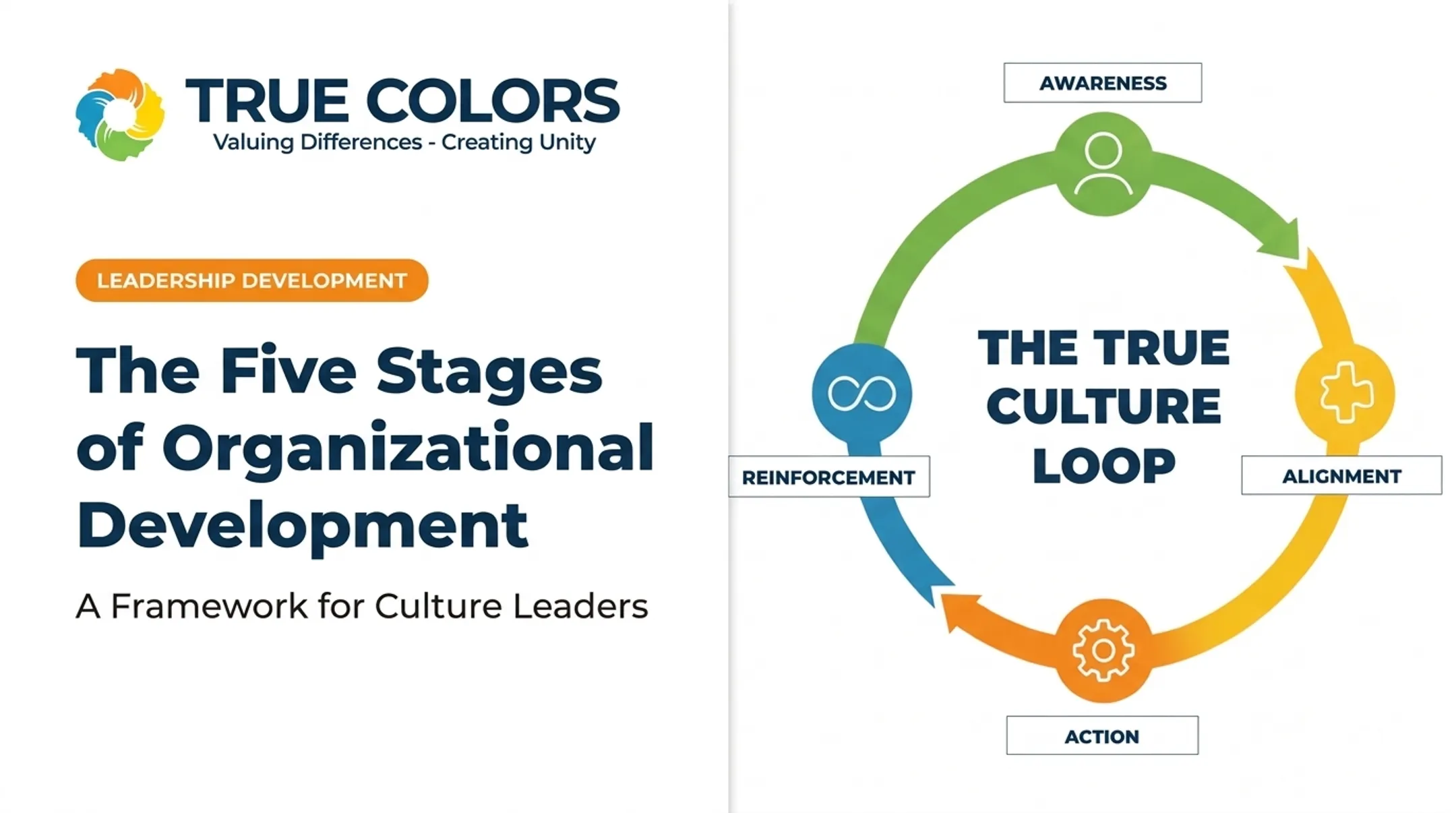
True Colors International structures this as a continuous loop rather than a one-time event. The True Culture Loop moves through four stages:
- Awareness
- Alignment
- Action
- Reinforcement
Each stage feeds the next. Culture work that stops after Awareness rarely sticks.

Key Frameworks for Understanding Organizational Culture
Three models give leaders a shared vocabulary for diagnosing where culture stands today.
The 5 P's of Organizational Culture
This practitioner framework breaks culture into five interlocking elements:
- Purpose – why the organization exists beyond profit
- Philosophy/Principles – the beliefs guiding decisions
- Priorities – what actually gets resourced and rewarded
- Practices – the daily habits and rituals
- People – who gets hired, promoted, and celebrated
Each element shapes daily behavior. When Priorities contradict Purpose (say, a company claims "people first" but rewards burnout), employees notice the gap immediately.
The Competing Values Framework
Developed by Quinn and Rohrbaugh, the Competing Values Framework maps culture along two axes: flexibility versus control, and internal versus external focus. Its four archetypes are Clan, Adhocracy, Market, and Hierarchy.
- Clan cultures value collaboration and mentorship
- Adhocracy cultures reward innovation and risk-taking
- Market cultures focus on competition and results
- Hierarchy cultures prioritize structure and consistency
No organization is purely one type. The framework helps leaders identify which archetype dominates and whether that fits their strategy.
The Growth Stages of Organizational Development
Larry Greiner's classic model outlines five growth phases, each ending in a predictable crisis:
- Creativity ends in a leadership crisis
- Direction ends in an autonomy crisis
- Delegation ends in a control crisis
- Coordination ends in a red-tape crisis
- Collaboration ends in psychological saturation
Why this matters for culture: Interventions that work for a 15-person startup will backfire at a 5,000-person enterprise. Recognizing which stage your organization sits in helps you choose the right culture intervention instead of copying a playbook built for a different growth phase.

Effective Ways to Develop and Improve Organizational Culture
Culture change starts at the top and gets reinforced everywhere else. 1. Align leadership behavior first. Leaders who say one thing and reward another erode trust faster than any single bad policy. McKinsey identifies role modeling as one of the four core mechanisms of lasting change: people mimic what surrounds them, consciously or not. 2. Invest in communication training. This isn't a soft skill nice-to-have. 86% of corporate executives, educators, and employees cite ineffective communication and poor collaboration as reasons for workplace failures. The cost is measurable too: miscommunication costs a 100-person company an average of $420,000 per year, and a 100,000-person company roughly $62.4 million. 3. Embed culture into hiring and onboarding. Gallup found only 12% of employees strongly agree their organization does onboarding well. Yet onboarding shapes the emotional bond tied directly to retention. Programs that connect recruitment promises to day-one experience close that gap. 4. Build reinforcement mechanisms. Recognition programs, regular feedback loops, and manager check-ins keep values visible long after a training session ends. 5. Give teams a shared behavioral language. This is where personality-based frameworks earn their keep. True Colors International's methodology (validated through the Assessment Standards Institute (ASI) with a 10,000-person study sample) is used across corporate, government, healthcare, and education sectors specifically because it gives teams common vocabulary for differences that otherwise cause friction.

The Role of Personality Assessments in Culture Development
Personality and temperament-based assessments reveal communication styles and behavioral tendencies that shape team dynamics. Without a shared vocabulary, differences in pace, decision-making, and communication style read as personal conflict instead of style mismatch.
True Colors uses a four-color model — Gold (organized), Orange (action-oriented), Green (inquisitive), and Blue (relationship-oriented) — to give teams a memorable shorthand for these differences.
That shared "culture language" shows up in:
- Hiring – evaluating how candidates communicate and fit alongside existing team dynamics
- Meetings – recognizing why one colleague wants data before deciding while another wants to talk it through
- Conflict navigation – naming friction as a style clash rather than a character flaw
Research on personality-team performance links shows real effects in field settings but negligible effects in controlled lab studies. These tools work best as a shared language for discussion, not as rigid labels that sort people into boxes.

Programs that pair assessment with training and ongoing leadership coaching sustain culture shifts longer than a single workshop ever will.
Common Challenges in Organizational Culture Development
Most culture initiatives fail for predictable reasons.
- Inconsistent leadership modeling: executives approve values statements they don't personally follow, and employees clock the gap fast
- Treating culture as an event, not a loop: a single all-hands training with no Alignment, Action, or Reinforcement stage fades within months
- No clear benchmarks: without tools like an employee experience survey or a culture diagnostic, leaders can't tell if anything actually changed
Those gaps show up clearly in the data. McKinsey's research on transformation efforts found only 3% success when line managers and frontline employees weren't engaged in the process, compared with 26–28% success when either group was involved from the start. Culture work designed only in the executive suite, without frontline input, is set up to stall.
Frequently Asked Questions
What are effective ways to improve organizational culture?
Start with leadership modeling the behaviors you want reflected across the organization. Back that up with communication training and consistent reinforcement through recognition programs, feedback loops, and manager check-ins that keep values visible day to day.
What are the 5 P's of organizational culture?
Purpose, Philosophy, Priorities, Practices, and People. Together they explain why an organization exists, what it believes, what gets prioritized, how work happens daily, and who gets hired and promoted.
What are the four C's of organizational culture?
Clan, Adhocracy, Market, and Hierarchy: the four archetypes from the Competing Values Framework. Most organizations blend elements of each, with one typically dominant.
What are the 5 stages of organizational development (OD)?
Greiner's model outlines Creativity, Direction, Delegation, Coordination, and Collaboration, each ending in a predictable crisis. Culture needs to shift significantly as an organization moves through these stages.
How long does it take to change organizational culture?
There's no universal timeline supported by research, but meaningful change typically requires one to three years of consistent reinforcement, not a single event. Milestones matter more than a fixed deadline.
Who is responsible for organizational culture development?
Leadership sets the tone and models behavior, but culture development is shared. Managers translate values into daily work, HR builds the systems, and employees provide the feedback that shows what's actually working.