Introduction
Most companies talk about culture. Few actually build one that puts employees first.
Employees who strongly feel connected to their organization's culture are 4.3 times more likely to be engaged and 47% less likely to be job hunting, according to Gallup's ongoing culture research. Yet only 1 in 5 U.S. workers say they feel that connection.
That gap costs companies dearly. Top-down, management-centric cultures breed disengagement and turnover, driving up absenteeism while draining budgets and morale.
This guide breaks down what an employee-centric culture looks like, why it pays off financially, and a step-by-step framework for building one that lasts.
Key Takeaways
- Employees who feel connected to their culture are significantly less likely to leave, driving stronger engagement.
- Top-down management models correlate with higher turnover and lower productivity.
- Real culture change starts with understanding individual communication styles, not perks.
- The True Culture Loop's four-stage cycle (Awareness, Alignment, Action, Reinforcement) sustains lasting change.
- ROI shows up in engagement scores, retention, and customer satisfaction.
What Is an Employee-Centric Culture?
An employee-centric culture puts employee needs, safety, and growth at the center of how a company communicates, gives feedback, and makes decisions. This goes beyond perks like ping-pong tables or free snacks. It requires structural decisions made with employees in mind, not despite them.
Compare that to traditional top-down models, where decisions flow one direction and employees are expected to comply. Research from Gallup found that managers account for at least 70% of the variance in employee engagement scores across business units, research that traces directly back to how leadership treats people. When that leadership style is rigid and top-down, disengagement follows.
SHRM data backs this up. One in five U.S. workers left a job in the past five years because of workplace culture, and the resulting turnover cost employers an estimated $223 billion. In that same study, 76% of workers said their manager sets the tone for workplace culture.
It Starts Below the Surface
Real employee-centricity doesn't begin with policy. It begins with understanding how individual employees think, communicate, and process stress differently. A flexible work policy means nothing if a manager doesn't know how to communicate with an introverted analytical employee versus an outgoing relationship-driven one.
This is where personality and communication frameworks come in. True Colors International, for instance, has spent over 45 years helping organizations understand these individual differences before layering on policies or perks.
Core Characteristics
Employee-centric organizations tend to share these traits:
- Psychological safety: employees can voice concerns without fear of retaliation
- Two-way communication: feedback flows up, not just down
- Autonomy: employees have real input into how their work gets done
- Personalized management: leaders adapt their style to the individual, not the org chart
Note: employee-centric and customer-centric strategies aren't competitors. The best organizations build both, because engaged employees are the ones who deliver great customer experiences.
Why Employee-Centric Cultures Matter: Key Benefits
The business case isn't theoretical. It shows up in hard numbers across engagement, retention, customer experience, revenue, and employer brand.
Engagement and Productivity
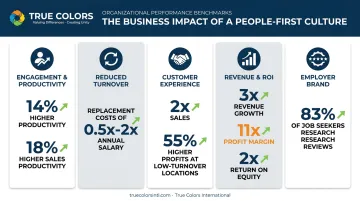
Gallup's meta-analysis of 736 studies across 183,806 business units and 3.3 million employees found that top-quartile engagement units saw 14% higher productivity and 18% higher sales productivity than bottom-quartile units. Engaged employees simply produce more, with fewer errors and less oversight required.
Reduced Turnover Costs
Replacing an employee isn't cheap. Gallup estimates replacement costs at one-half to two times the departing employee's annual salary. Work Institute uses a more conservative estimate of 33% of base wages, meaning replacing a $50,000 employee costs at least $16,500. Either way, turnover is expensive, and culture is a lever that reduces it.
Enhanced Customer Experience
The service-profit chain, first mapped by Heskett and colleagues at Harvard Business Review, connects internal service quality to employee satisfaction, employee loyalty, external service value, and ultimately, revenue growth. Taco Bell locations with the lowest employee turnover posted double the sales and 55% higher profits than high-turnover locations in the original study. Happy employees create happy customers. It's not complicated.
Higher Revenue and ROI
WTW's research on Global High-Performance Organizations found companies with strong employee experiences generated nearly 3 times the revenue growth, 11 times the profit margin, and 2 times the return on equity compared to average organizations, based on analysis of 250 million employee survey responses tied to financial performance. This is correlation drawn from a massive dataset, not a guarantee, but the pattern is consistent.
Stronger Employer Brand
Job seekers do their homework. Glassdoor found 83% of U.S. job seekers research company reviews before applying. A reputation for treating employees well isn't a nice-to-have anymore. It's a recruiting advantage.
How to Build an Employee-Centric Culture: A Step-by-Step Framework
Culture change fails when companies treat it as a one-size-fits-all initiative. Real transformation requires understanding individual temperament and communication differences across the entire workforce, then building systems around that understanding.
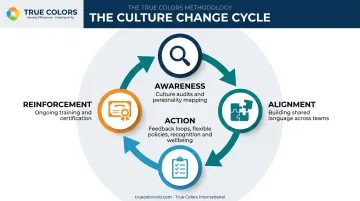
True Colors International calls this cycle the True Culture Loop: Awareness, Alignment, Action, Reinforcement. The cycle continues indefinitely, with no natural endpoint.
Step 1: Awareness
Start with a culture audit. Find out where communication breaks down, where trust is thin, and where engagement scores lag. Pair this with validated personality assessments, such as True Colors' ASI-certified assessment, to map individual temperament differences across teams.
This step reveals why current initiatives may not be landing. A recognition program built for one personality type can feel hollow to another.
Step 2: Alignment
Once you understand individual differences, align hiring, team structure, and leadership development around a shared language. True Colors' methodology gives organizations a common vocabulary, four personality color types, for discussing communication styles, decision-making, and accountability. Instead of assuming everyone processes feedback the same way, leaders learn to adapt their approach.
Step 3: Action
Awareness and alignment mean nothing without follow-through. Prioritize concrete changes:
- Structured feedback loops: regular, two-way check-ins rather than annual reviews
- Flexible work policies: built around actual employee needs, not assumptions
- Recognition programs: tailored to how different employees prefer to be acknowledged
- Wellbeing initiatives: addressing burnout before it drives turnover
Step 4: Reinforcement
Culture shifts fade without reinforcement. This is where ongoing, credentialed training matters. True Colors offers SHRM and HRCI-accredited certification programs specifically designed to help facilitators and leaders sustain the shift long after the initial rollout.
The loop then repeats: reassess, realign, act again, and reinforce again as circumstances evolve. Culture requires ongoing maintenance rather than a single fix.
Real-World Examples of Employee-Centric Culture
Some organizations have built entire operating models around employee autonomy and psychological safety.
Morning Star, a large tomato processor, operates without traditional managers. Employees negotiate their own responsibilities through a "Colleague Letter of Understanding" and can initiate hiring or spend company funds after consulting affected colleagues. Disputes go through peer mediation rather than a manager's unilateral call. A Harvard Business Review report noted the company became the world's largest tomato processor while sustaining double-digit annual growth.
Pixar takes a different approach, building psychological safety into its creative process through the "Braintrust," a group of directors who give candid, structured feedback on unfinished work. The group has no authority to force changes. The director decides what to use. That distinction, feedback without mandate, is what made it safe for people to share rough work honestly.
Organizations of all sizes rely on structured frameworks to build this same kind of alignment. True Colors International's four-stage True Culture Loop (Awareness, Alignment, Action, and Reinforcement) has helped clients such as Google, Amazon, and Marriott give diverse teams a shared language for working together.
Common Challenges When Building an Employee-Centric Culture
Culture change sounds straightforward. In practice, it runs into predictable friction points:
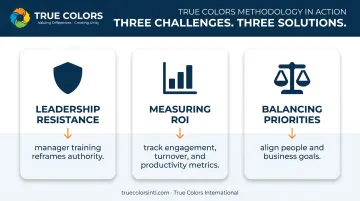
- Leadership resistance. Many managers built their careers on top-down control, and letting go feels risky. Change management and manager-specific training reframe what authority looks like: leaders who guide rather than control often earn deeper trust from their teams.
- Measuring ROI. Culture feels soft, but it doesn't have to be measured that way. Track engagement scores, turnover rates, and productivity metrics tied to specific initiatives, not vague sentiment. If a recognition program launches, measure retention in that department six months later.
- Balancing competing priorities. Employee needs and business goals can feel like they're pulling in opposite directions. They usually aren't. A structured framework that keeps people, performance, and purpose aligned prevents these from becoming a tug-of-war. When employees feel supported, business outcomes tend to follow rather than compete with that support.
Frequently Asked Questions
What are the 4 types of workplace culture?
The Competing Values Framework identifies four types: clan (collaborative), adhocracy (innovative), market (competitive), and hierarchy (structured). Employee-centricity is a philosophy that can exist within any of these, not a fifth category.
What are the 4 pillars of employee engagement?
Gallup's research organizes engagement around four levels of employee needs: basic needs, individual contribution, teamwork, and growth. Different frameworks phrase this differently, but the progression from stability to development holds consistent.
What is an example of employee centricity?
A company that redesigns its performance review process after employees flag it as demoralizing, replacing annual reviews with regular two-way check-ins, is practicing employee centricity. The action responds directly to employee input.
How long does it take to build an employee-centric culture?
Culture change is a continuous process, not a quick fix. Most organizations see measurable shifts in engagement within 6 to 12 months, with deeper cultural transformation unfolding over several years.
Is an employee-centric culture the same as employee experience?
Not quite. Employee experience refers to the touchpoints and daily interactions employees have with the organization. Employee-centric culture is the underlying philosophy and mindset that shapes those experiences in the first place.
Can small businesses or nonprofits build an employee-centric culture too?
Yes, and often with fewer resources than assumed. Culture-building tools like personality assessments and structured feedback practices scale down easily, making them just as effective for a 20-person nonprofit as a 20,000-person enterprise.