That's why the idea that "the manager's role is becoming that of a coach" has moved from buzzword to business necessity. But most leaders weren't trained for it. A 2014 study from the International Coach Federation and Human Capital Institute found that 22% of managers using coaching skills had received no coach training at all.
This article breaks down what leader-as-coach actually means, the core skills it demands, and why understanding personality differences, True Colors International's specialty, makes coaching stick.
Key Takeaways
- Coaching leadership swaps answers for questions that reveal employee potential
- Active listening, empathy, feedback, and accountability form the coaching skill set
- Strong coaching cultures deliver measurable gains in engagement and retention
- Personality awareness helps leaders tailor coaching to each person's style
- A lasting coaching culture needs psychological safety and consistent practice
What Does It Mean to Be a Leader as a Coach?
Leader-as-coach is a leadership style built on guiding, empowering, and developing people, rather than directing them. Instead of handing out solutions, a coaching leader asks questions that help employees think through problems themselves.
This shift didn't happen overnight. For decades, leadership rested on expertise: the boss knew more, so the boss decided. That model worked when change was slow and predictable. It breaks down now.
Rapid, disruptive change means no single leader can hold all the answers anymore. Companies are moving away from command-and-control leadership toward one where managers facilitate problem-solving instead of supplying every solution.
Traditional leadership vs. coaching leadership:
| Traditional Leadership | Coaching Leadership |
|---|---|
| Tells employees what to do | Asks what they think should happen |
| Solves problems for the team | Guides the team to solve problems |
| Focuses on task completion | Focuses on growth and reflection |
| Relies on hierarchy | Relies on trust and dialogue |
This isn't just theory. The Center for Creative Leadership's 70-20-10 guideline estimates that 70% of leadership learning happens through challenging experiences, 20% through developmental relationships like coaching, and only 10% through formal coursework. Most growth happens on the job, in real conversations, not in a classroom.
What Does This Look Like in Practice?
Picture an employee stuck on a client issue. A traditional manager jumps in and fixes it. A coaching leader asks instead: "What have you tried so far?" and "What would success look like here?" The employee walks away with a solution they own, plus the confidence to solve the next one alone.
The same shift applies to one-on-ones. Rather than running through task status updates, a coaching leader asks about development goals and reflection: "What did you learn this week?" That single question changes the entire tone of the conversation.
Core Skills Every Coaching Leader Must Master
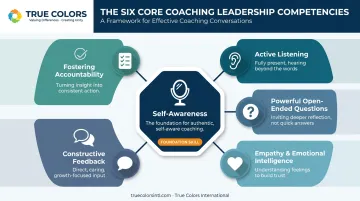
Coaching is a learnable skill set, not an inborn trait, and it breaks down into six specific competencies.
- Active listening: Being fully present, asking clarifying questions, and acknowledging emotions builds the trust that makes coaching conversations work in the first place.
- Powerful, open-ended questions such as "What options do you see?" prompt self-reflection instead of dependency on the leader for every answer.
- Empathy and emotional intelligence means understanding what actually motivates someone, not just what they say out loud, so a leader can personalize support instead of applying a generic script.
- Constructive, growth-oriented feedback balances genuine recognition with specific, timely guidance, keeping it useful instead of vague or discouraging.
- Fostering accountability happens through collaborative goal-setting rather than top-down dictation, so employees own their progress instead of performing for approval.
- Self-awareness matters most: a leader who doesn't understand their own communication style and blind spots will struggle to read anyone else's.
That last point matters more than it gets credit for. Coaching leaders who understand their own default style, direct versus indirect, detail-focused versus big-picture, catch themselves before projecting that style onto someone wired differently. Frameworks like True Colors give leaders a shared vocabulary for spotting these blind spots before they derail a coaching conversation.
Why Personality Awareness Is the Missing Piece in Coaching Leadership
Here's where a lot of well-intentioned coaching falls flat: it isn't one-size-fits-all. A question that energizes one employee can shut another down completely, because people process feedback, set goals, and handle challenges based on their underlying temperament.
This is exactly the gap True Colors International's personality-based framework was built to close. Since 1978, the company has helped organizations, including Amazon, Google, and Ford, build a shared language around communication styles using four temperament types: Orange, Gold, Green, and Blue.
A quick illustration:
- A Gold employee, detail-oriented and structure-seeking, responds well to clear timelines, specific checkpoints, and step-by-step feedback.
- A Green employee, big-picture and autonomy-seeking, tends to disengage from micromanaged coaching and instead needs space to explore options with light-touch check-ins.
- A Blue employee, relationship-focused and empathy-driven, opens up faster when coaching feels personal rather than purely task-oriented.
- An Orange employee, action-oriented and variety-seeking, engages best with hands-on challenges and quick wins instead of long, drawn-out planning sessions.
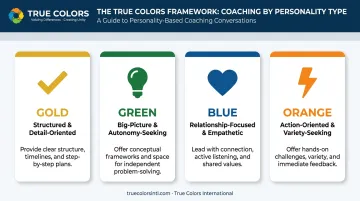
Coach both the same way, and you'll frustrate at least one of them.
True Colors solves this with the True Culture Loop, a four-step cycle:
- Build awareness of your own style and your team's styles.
- Align your coaching approach to each person's temperament.
- Act consistently, applying that approach in daily interactions.
- Reinforce the habit so it doesn't fade after a single workshop.
Backing this up is True Colors' ASI-certified assessment, which gives organizations research-validated data instead of guesswork. That shared language reduces the miscommunication that derails so many coaching conversations before they even start.
Building a Coaching Culture That Sticks
One good coaching conversation doesn't build a culture; consistency does.
The foundation is psychological safety. Employees need to know they can flag a problem or ask for help without it counting against them. Without that, coaching conversations turn into performance reviews in disguise, and people stop being honest.
A few habits separate leaders who build lasting coaching cultures from those who don't:
- Recognize effort and progress, not just final outcomes
- Model vulnerability by sharing their own learning moments and mistakes
- Make coaching a regular rhythm, not a once-a-year event
The payoff is measurable: DDI's 2024 Global Leadership Forecast found organizations with strong coaching cultures were 2.9 times more likely to report being capable of engaging and retaining top talent. The same research noted that high-potential employees who felt they weren't being coached effectively were twice as likely to say they intended to leave.
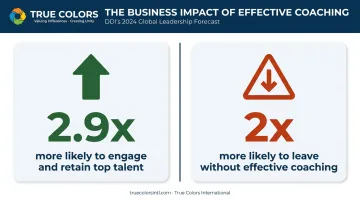
That's a retention problem hiding in plain sight for a lot of companies.
Overcoming Common Coaching Leadership Challenges
Even leaders who buy into coaching hit real obstacles. Three come up constantly.
Leaders lack natural coaching skills. Coaching doesn't come pre-installed: the 2020 ICF Global Coaching Study found that 74% of managers already using coaching skills planned to pursue additional coach-specific training within the next year. Even experienced coaches recognize there's more to learn.
Time is tight. Fast-paced environments don't leave room for hour-long coaching sessions every week. Smaller moments work just as well:
- Ask one open-ended question during a status update instead of just approving the plan
- Use the last two minutes of a meeting for a quick reflection question
- Replace a "good job" with one specific observation tied to growth
Employees resist the shift. Teams used to being told what to do can feel unsettled when a leader suddenly starts asking questions instead. Consistency solves this. Trust builds slowly, through repeated small interactions, not a single announcement that "things are different now."
Frequently Asked Questions
What does it mean to be a leader as a coach?
A leader-as-coach guides and empowers team members through questions and support instead of direct commands. The focus shifts from giving answers to helping people find and own their own solutions.
What is an example of a leader as a coach?
Instead of solving a problem directly, a coaching leader asks, "What have you tried?" or "What would success look like?" during a one-on-one, letting the employee work through their own answer.
What are the 3 C's of leadership?
Leadership experts don't agree on one official "3 C's" framework, though common versions include character, clarity, and commitment, qualities that naturally support a coaching approach.
How is coaching leadership different from traditional leadership?
Traditional leadership relies on control and top-down direction, while coaching leadership builds trust through collaboration and questions that let employees arrive at their own solutions.
What are the benefits of leading like a coach?
Coaching leadership boosts engagement and improves retention of top talent, since employees who solve their own problems build confidence and future leadership skills.
Can any leader learn to become an effective coach?
Yes. Coaching is a learnable skill set, built through training, self-awareness, and consistent practice, including personality-based training programs like those offered by True Colors International.