Introduction
Skills gaps are widening. AI is reshaping job descriptions every quarter. And most employees are learning new tools faster than most companies can train them.
Here's the problem: many leaders think a learning culture builds itself once you roll out a training platform. It doesn't.
Organizations with genuinely strong learning cultures gain a measurable edge, according to Bersin & Associates research on high-impact learning cultures:
- 46% more likely to be first to market
- 37% more likely to report higher productivity
- 58% more likely to have the skills needed for future demand
That kind of advantage doesn't come from a course catalog. It comes from deliberate leadership behavior, communication habits, and daily reinforcement.
This article breaks down exactly how to build that culture, step by step, along with the factors that determine whether it sticks and the mistakes that kill it before anyone notices.
Key Takeaways
- Learning cultures require psychological safety and leadership modeling, not just training events
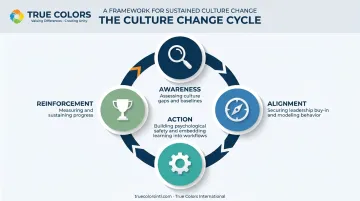
- A cyclical framework, covering awareness, alignment, action, and reinforcement, keeps the effort sustainable
- Success hinges on leadership buy-in, feedback systems, and awareness of personality differences
- Common failures trace back to optional-feeling programs and ignored psychological safety
What Is a Learning Culture (and Why It Matters)
A learning culture is an environment where learning, at the individual and organizational level, is prioritized, valued, and actively rewarded. It shows up as daily behaviors baked into how people work, not a training calendar.
Bersin's research on this topic identified 40 distinct practices that build a learning culture. Only 7 belong to the L&D department. The other 33 sit with line managers and senior leaders. That single fact explains why so many "culture initiatives" stall: they're owned by the wrong people.
Where learning culture fits organizationally:
Culture researchers Cameron and Quinn describe four broad organizational types:
- Clan: collaborative, people-focused
- Adhocracy: creative, risk-tolerant
- Market: competitive, results-driven
- Hierarchy: structured, process-driven
Learning-focused values can take root in any of them, but they tend to flourish fastest in clan and adhocracy cultures, where flexibility and people-development are already prioritized.
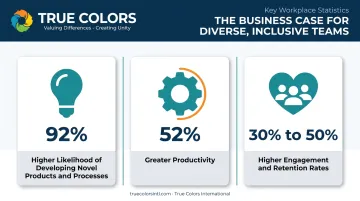
The business case is hard to ignore. According to Deloitte's research on employee engagement, companies with strong learning cultures see:
- 92% higher likelihood of developing novel products and processes
- 52% greater productivity than companies without a learning culture
- 30% to 50% higher engagement and retention rates
How to Cultivate a Learning Culture Within Your Organization
Building this kind of culture isn't a single project with a start and end date. It's a repeatable cycle. Here's how it works in practice.
Step 1: Assess Your Current Culture and Build Awareness
You can't fix what you haven't diagnosed. Before launching anything, map out:
- How information currently flows between teams and departments
- What leadership styles dominate at each level
- Whether feedback happens regularly or only during annual reviews
- How employees prefer to learn and communicate
This is the Awareness stage. Validated personality and temperament assessments, like the ones True Colors International has used across corporate, education, and healthcare clients for 45+ years, help surface these patterns quickly.
Instead of guessing why two departments keep miscommunicating, you get a shared vocabulary for what's actually happening.
Readiness check: Before moving to Step 2, confirm you have leadership sponsorship and a documented baseline of culture gaps. Skipping this step means building on guesswork.
Step 2: Secure Leadership Buy-In and Model the Behavior
Employees watch what leaders do, not what they announce in an email. If executives never admit mistakes or ask questions publicly, nobody else will either.
Leaders need to:
- Visibly pursue their own development, not just assign it to others
- Admit knowledge gaps openly instead of projecting false confidence
- Use a shared language around learning expectations, so "growth" means the same thing at every level
Change initiatives with active, visible executive sponsors are far more likely to stick. Without that sponsorship, learning programs typically lose momentum within months of launch, regardless of how well-designed the curriculum is.
Step 3: Create Psychological Safety for Risk-Taking
Learning requires risk. Asking a question in front of peers, admitting an error, sharing a half-finished idea, all of that feels risky unless the team culture explicitly protects it.
Google's Project Aristotle studied 180 internal teams and found psychological safety was the single most important factor separating high-performing teams from the rest, ahead of dependability, clarity, and even a sense of impact.
How to build it:
- Run structured after-action reviews and retrospectives where candor is explicitly invited
- Reward transparency about what went wrong, not just clean wins
- Model vulnerability first, since teams take cues from whoever holds the most authority in the room
Step 4: Embed Learning into Everyday Communication and Workflows
Formal training gets forgotten fast if it's disconnected from daily work. Learning needs to live inside one-on-ones, feedback conversations, and team check-ins, not just workshops.
Practical ways to do this:
- Give teams a shared communication language, so a "green" personality type knows how to approach feedback differently than a "gold" one
- Run recurring lunch-and-learns or peer mentoring sessions
- Make learning platforms genuinely accessible, not buried three clicks deep in an intranet
True Colors International builds this into its leadership development workshops: sessions tied to real leadership challenges employees are facing right now, rather than abstract case studies.
The non-negotiable condition: time for this has to be explicitly protected on the calendar. If learning always loses to "urgent" work, it never happens.
Step 5: Reinforce, Measure, and Sustain the Culture
This is where most initiatives stall. Early enthusiasm fades unless someone tracks what's working.
Watch these signals:
- Participation rates in optional learning sessions
- Engagement scores tied to development opportunities
- Retention trends among employees who actively use learning resources
Recognition systems matter here too. Tying career development conversations to visible learning behaviors sends a clear signal: this isn't decorative.
This step loops back to Step 1. Frameworks like True Colors International's True Culture Loop, cycling through Awareness, Alignment, Action, and Reinforcement, treat culture-building as continuous rather than a one-time rollout.
Key Factors That Determine Learning Culture Success
Outcomes depend on a handful of variables leadership can actually control.
Leadership Commitment
Leadership sets the tone. Without visible sponsorship from the top, employees treat learning initiatives as optional add-ons, and momentum disappears within a quarter or two.
Psychological Safety
This determines whether employees take the interpersonal risks learning demands. Low safety leads to silence, hidden mistakes, and innovation that never surfaces.
Communication and Feedback Systems
Continuous, quality feedback normalizes growth conversations. Weak systems create nasty surprises at annual reviews and fuel disengagement long before anyone notices.
Personality and Temperament Awareness
Understanding how people process information and prefer to learn lets leaders tailor their approach instead of applying a one-size-fits-all method. Programs like True Colors International's personality-based assessments give teams a shared language for navigating these differences, whether that's a detail-oriented "gold" employee or a big-picture "orange" one.
Mismatched communication styles cause friction that undermines engagement even when every other system is working well.
Resource Allocation and Recognition
Dedicated time, budget, and rewards signal that learning is genuinely valued, not just talked about in town halls.
Employees who receive high-quality, consistent recognition are less likely to leave their organization within two years, based on longitudinal Gallup and Workhuman research tracking nearly 3,500 employees. Recognition maturity, not just having a program on paper, is what drives the retention effect.
Common Mistakes That Undermine a Learning Culture
Even well-intentioned efforts fail in predictable ways:
- Treating learning as an event. A single workshop, no matter how good, creates a temporary spike in enthusiasm rather than lasting cultural change.
- Skipping genuine leadership modeling. If executives don't visibly learn, employees assume the program is performative.
- Ignoring psychological safety. Employees hide mistakes instead of learning from them, and problems compound quietly.
- Failing to reinforce progress. Early momentum fades within months without tracking and recognition to sustain it.
Conclusion
A learning culture takes more than a single program launch. It requires deliberate, cyclical effort: honest assessment, visible leadership modeling, real psychological safety, and daily reinforcement that doesn't fade after month three.
Even so, most failures trace back to one of two things: missing leadership buy-in or ignoring the human, communication-driven side of change. Organizations that pair a structured framework, such as True Colors International's True Culture Loop (Awareness, Alignment, Action, Reinforcement), with tools for understanding individual differences tend to be the ones where learning actually sticks.
Frequently Asked Questions
How do you learn organizational culture?
Structured assessments, employee surveys, and direct observation of daily communication and leadership behavior reveal far more than policy documents ever will. Culture lives in how people actually interact, not what's written in a handbook.
What are the 4 types of organizational culture?
The Competing Values Framework identifies clan, adhocracy, market, and hierarchy cultures. A learning-focused mindset can exist within any of these four, though it tends to emerge most naturally in clan and adhocracy environments.
What is the 70-20-10 rule for learning?
Roughly 70% of learning comes from on-the-job experience, 20% from social or peer interactions, and 10% from formal training, according to the 70-20-10 model from the Center for Creative Leadership. Treat it as a directional guideline, not a fixed formula.
What are the 5 C's of culture?
Frameworks vary, but common versions include Communication, Collaboration, Commitment, Consistency, and Care. These elements reinforce each other to make growth-oriented behavior a habit rather than an exception.
Why is a learning culture important for retention and engagement?
Organizations with strong learning cultures report engagement and retention rates 30% to 50% higher than those without one. Employees stay longer when they see a real path for growth, not just a job description.
How long does it take to build a learning culture?
There's no fixed timeline. It's a multi-year, cyclical process that depends on your starting point, leadership consistency, and how well new habits get reinforced over time rather than abandoned after the first push.