Introduction
Multidisciplinary teams show up everywhere:
- Hospital care teams — physicians, nurses, and therapists
- Product launch teams — marketing, engineering, and sales
- School leadership teams — principals, counselors, and department heads
Each group faces the same challenge: professionals trained in different disciplines, using different vocabularies, must exchange complex information fast, often when stakes are high.
Many leaders assume the fix is simple: schedule more meetings, send more updates. It isn't. Communication breakdowns are a structural problem, not a volume problem.
Consider this: CRICO Strategies analyzed 23,658 malpractice cases filed between 2009 and 2013 and found communication was a contributing factor in 30% of them — nearly 7,150 cases, almost half involving high-severity outcomes including death.
This article covers the steps, prerequisites, common mistakes, and personality-based frameworks for building communication that holds up under pressure.
TL;DR
- Communication failures contributed to 30% of 23,658 malpractice claims reviewed by CRICO, many involving severe harm.
- Structured protocols like SBAR-style handoffs cut communication-related incident reports from 31% to 11% in one clinical study.
- Strong teams build shared language and psychological safety before adding meetings.
- SBAR, closed-loop communication, and personality-based training cover structure, confirmation, and interpersonal gaps.
How to Build Effective Communication in Multidisciplinary Teams
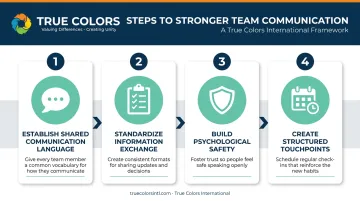
Step 1: Establish a Shared Communication Language
Different disciplines don't just use different jargon; they interpret common words differently. "Urgent," "follow-through," and "good work" mean different things to a surgeon than to an administrator, or to an engineer than to a salesperson.
Left unaddressed, this creates silent misalignment that surfaces only after something goes wrong.
Start here:
- Define shared terminology. Agree on what key terms mean across every discipline represented on the team.
- Introduce a personality/temperament framework. True Colors International's four-color model (Orange/action-oriented, Gold/organized, Green/analytical, Blue/relationship-oriented) helps teams see why colleagues communicate differently instead of assuming intent.
- Document the agreements. Put shared definitions and protocols somewhere every discipline can access, not buried in one department's files.
A Gold teammate wants direct, detailed instructions; a Blue teammate needs rapport first. Neither is wrong.
This is the foundation everything else builds on. Skip it, and every later step gets harder.
Step 2: Standardize How Information Is Exchanged
Once terminology is settled, standardize how information moves between people. Ad hoc updates work fine until someone's under pressure. Then the details that matter most are the first to get dropped.
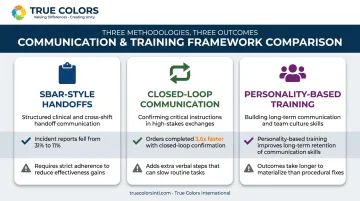
- Adopt a structured handoff model. SBAR (Situation, Background, Assessment, Recommendation) keeps handoffs consistent no matter who's involved. One prospective study found communication-related incident reports dropped from 31% to 11% after SBAR implementation in an anesthetic clinic.
- Set clear expectations for what gets communicated, in what order, and through which channel — verbal, written, or digital.
- Use closed-loop communication for high-stakes exchanges. Sender states the instruction, receiver repeats it back, sender confirms—a few seconds that eliminate guesswork.
Step 3: Build Psychological Safety and a Speak-Up Culture
Structure alone won't save a team if junior members are afraid to speak. Hierarchy is one of the most consistent predictors of silence in cross-functional settings.
- Invite input directly. "What am I missing?" surfaces more than the passive "any questions?" ever will.
- Recognize cross-disciplinary input publicly. When a team member from a different discipline raises a concern, acknowledge it visibly.
- Model non-defensive responses. One dismissive reaction to a challenge can silence someone for months. That's not an exaggeration; it's how psychological safety erodes.
Step 4: Create Regular, Structured Touchpoints
Shared language and protocols need a rhythm to stay alive.
- Run brief recurring huddles with representation from every discipline on the team — not just the loudest one.
- Assign follow-up ownership after each touchpoint. Shared information that leads nowhere is just noise.
- Revisit protocols periodically. Ask what's breaking down and adjust. A protocol that worked six months ago may not fit today's team.
Key Factors That Affect Communication Success in Multidisciplinary Teams
Outcomes depend less on effort and more on a handful of controllable variables specific to cross-disciplinary work.
Personality and Communication Style Differences
Professionals gravitate toward communication styles shaped by temperament: direct versus relational, big-picture versus detail-driven. A 2016 study of 60 healthcare teams found that task disagreement was frequently misread as personal attack or malicious intent when teams lacked a shared framework for interpreting each other's style.
High perceived team performance weakened this effect. Teams that already communicate well prove more resilient to this kind of friction.
Hierarchical Dynamics and Power Distance
Perceived rank differences discourage lower-status team members from voicing concerns. A 2024 survey of 730 nurses across 88 units found hierarchical culture and power-distance orientation were both positively associated with silence behavior, largely because staff perceived speaking up as futile.
In a separate survey of over 1,000 healthcare professionals, 37% admitted staying silent at least once when their input might have prevented an incident.
Role Clarity and Shared Goals
Each discipline often defines "success" through its own metrics. Marketing measures reach; engineering measures stability; sales measures closed deals. Without clarity on how these goals connect, teams end up with:
- Duplicated effort across roles
- Coverage gaps during handoffs
- Conflicting priorities that surface only during crunch time
Technology and Tool Compatibility
Disconnected systems create one-way or delayed information flow. As of 2023, only 43% of U.S. hospitals reported routine interoperability, even though 71% had necessary external clinical data available at the point of care. That gap slows exactly the cross-functional information sharing multidisciplinary teams depend on.
What You Need Before Strengthening Communication
Before rolling out new protocols, get three things in place:
- Leadership commitment. Leaders have to model the standards consistently across every discipline, not just their own.
- A shared read on communication styles. A validated assessment replaces guesswork with self-awareness before new protocols land.
- A baseline diagnostic. Surveys, incident reviews, or feedback sessions reveal where the real gaps are.
True Colors' ASI-certified assessment is one option teams use here. It draws on an N=10,000 validation study and meets EEOC 80% guideline standards, so the shared language is research-backed rather than informal.
The diagnostic often surfaces a surprise. Teams discover their "accountability problem" is actually a pace-and-tone mismatch: some people update frequently because they see it as responsible follow-through; others go quiet because they view independence as ownership. Neither group realizes the other is reading their silence completely differently.
Common Mistakes That Undermine Multidisciplinary Communication
Watch for these recurring patterns:
- Assuming everyone defines "communication" the same way. Expectations differ significantly by role and professional training.
- Relying on informal, ad hoc updates. Without structure, critical details get dropped precisely when pressure is highest.
- Mistaking silence for agreement. More often that silence is hierarchy-driven hesitation, not consensus.
- Treating training as a one-time event. Old siloed habits creep back within weeks if reinforcement stops.
Frameworks and Tools That Strengthen Multidisciplinary Communication
No single framework covers every need. The strongest teams combine structural tools with people-focused ones.
Structured Handoff Protocols (SBAR-Style Models)
SBAR (Situation, Background, Assessment, Recommendation) gives teams a shared script for high-stakes, time-sensitive exchanges: shift changes, urgent escalations, and status updates under deadline pressure.
The trade-off: it requires training and team-wide adoption, and it can feel rigid for casual, low-stakes conversations.
Closed-Loop Communication
Closed-loop communication has the receiver repeat back the instruction so the sender can confirm it was understood. It fits verbal instructions where misinterpretation carries real risk.
In one study of pediatric trauma activations, closed-loop orders were completed 3.6 times faster than open-loop orders. The catch: it adds a few seconds per exchange, and it only works if everyone commits. One holdout undermines the whole system.
Personality-Based Communication Training
Personality-based training builds long-term fluency. Rather than treating friction as isolated incidents, methods like True Colors International's address the root cause: mismatched communication styles that no one has named yet.
True Colors moves teams through four stages so insight becomes habit instead of fading after one workshop:
- Awareness of personal and team communication styles
- Alignment around a shared language
- Action through applied practice on the job
- Reinforcement so skills stick over time
Organizations like Fortifi Bank reported that after a True Colors workshop, staff engagement and collaboration improved noticeably. One leader described it as building "a foundation of understanding, patience, and a willingness to consider another perspective."
The trade-off is upfront investment: facilitated training takes time and buy-in. With over 45 years of cross-industry experience, True Colors reports stronger long-term retention of communication skills when teams reinforce a shared language rather than treating training as a one-off event.
Frequently Asked Questions
What are the 7 Cs of effective communication?
Clear, Concise, Concrete, Correct, Coherent, Complete, and Courteous. Applying these across disciplines reduces the odds that technical or role-specific language gets misread by teammates outside that field.
Can you give me an example of a multidisciplinary team?
A hospital care team combining physicians, nurses, and therapists is a classic example. A corporate product launch team pairing marketing, engineering, and sales works the same way: each discipline contributing separate expertise toward one project.
What makes an effective multidisciplinary team?
Shared goals, structured communication protocols, mutual respect for each discipline's expertise, and psychological safety. Teams missing any one of these tend to default back to siloed habits under pressure.
What's the difference between a multidisciplinary and an interdisciplinary team?
Multidisciplinary teams work in parallel, each discipline setting its own goals independently. Interdisciplinary teams integrate their efforts toward one shared, jointly defined goal.
How can personality assessments improve communication in multidisciplinary teams?
They build self-awareness around communication preferences such as pace, detail, tone, and decision style. Team members can then adapt instead of assuming a colleague's different approach signals disrespect or incompetence.
How often should multidisciplinary teams train on communication skills?
Not once. Reinforce it at onboarding, after team changes, and whenever recurring breakdowns surface. Communication skills fade fast without periodic refreshers tied to real team moments.