Introduction
Most strategic plans start the same way: find what's broken, then fix it. Leadership teams spend hours dissecting weaknesses, gaps, and threats, hoping the fixes will spark innovation.
They rarely do.
A growing body of research points to a better starting point: appreciative inquiry and strengths-based development. Instead of asking "what's wrong here," these approaches ask "what's already working, and how do we do more of it?"
This article breaks down what organizational strengths actually are and why building on them outperforms deficit-focused planning. From there, it covers how to identify your own strengths, plus a practical five-step framework for making them part of your everyday culture.
Key Takeaways
- Strengths-based approaches generate more engagement and innovation than weakness-focused planning
- Employees who use their strengths daily are 6x more likely to be engaged at work
- SOAR analysis offers an action-oriented alternative to traditional SWOT
- Personality assessments reveal team-level strengths that surveys often miss
- Culture change sticks when strengths shape reviews, onboarding, and daily communication
What Are Organizational Strengths?
Organizational strengths are the tangible and intangible assets that give a company its edge. Harvard Business Review describes them as collective capabilities — skills and expertise that belong to the organization as a whole, not just to individual employees.
They show up in different forms:
People and culture strengths:
- A deep bench of skilled, cross-trained talent
- Strong leadership accountability
- A shared mindset that unifies teams around common goals
Process and operations strengths:
- Speed to market on new products or services
- Operational efficiency that keeps costs predictable
- A track record of continuous innovation
Brand and market strengths:
- Recognizable brand identity that customers trust
- Deep customer loyalty paired with a strong reputation within a specific industry niche
Financial strengths:
- Healthy cash flow that funds growth initiatives
- Low leverage that reduces financial risk
- Strong liquidity ratios that support flexibility
- Consistent profitability across market cycles
Organization-wide strengths differ from individual employee strengths. A company can have a strong brand or efficient supply chain even if individual employees haven't identified their personal talents yet. Both levels matter, and we'll cover individual strengths in more depth later in this article.
Why Building on Strengths Works Better Than Fixing Weaknesses
David Cooperrider and Suresh Srivastva introduced appreciative inquiry in their 1987 paper, arguing that organizations shouldn't be treated only as "problems to be solved." Instead, they proposed generative inquiry: study what's already working, then use those patterns to build something new.
The conversation simply starts in a different place: with what's already working, not what's broken.
SOAR vs. SWOT
Traditional SWOT analysis spends half its energy on weaknesses and threats. That framing tends to narrow the range of solutions leaders can imagine, because deficit language triggers defensive thinking rather than creative problem-solving. Consider the difference: a team asked to explain missed deadlines gets defensive. A team asked what fueled its best quarter starts solving problems on its own.
SOAR (Strengths, Opportunities, Aspirations, Results) flips the script:
| Framework | Focus | Orientation |
|---|---|---|
| SWOT | Strengths, Weaknesses, Opportunities, Threats | Analytical, gap-focused |
| SOAR | Strengths, Opportunities, Aspirations, Results | Action-oriented, possibility-focused |
SOAR keeps the internal strengths and external opportunities from SWOT but replaces weaknesses and threats with aspirations and measurable results. It's built specifically for participative strategy sessions where the goal is momentum, not just diagnosis.
The Data Backs It Up
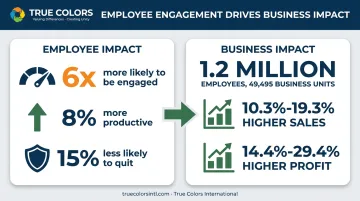
Gallup's research makes a strong case for the shift. Employees who use their strengths every day are six times more likely to be engaged at work, 8% more productive, and 15% less likely to quit their jobs.
The business impact scales up too. A Gallup meta-analysis spanning 1.2 million employees across 49,495 business units found that strengths-based interventions correlated with 10.3%-19.3% higher sales and 14.4%-29.4% higher profit.
There's a flip side worth naming directly. When employees feel they're evaluated only on what they lack, they disengage faster. Deficit-focused feedback loops rarely spark better performance — they just make people defensive and cautious.
How to Identify Your Organization's Strengths
Before you can build on strengths, you need a clear picture of what they actually are. Three complementary methods work well together.
Run an Appreciative Inquiry "Discovery" Process
Appreciative inquiry follows a 4-D cycle: Discovery, Dream, Design, and Destiny. The Discovery phase is where you surface hidden strengths by asking employees to reflect on high points, not low points.
Sample discovery questions leaders can use:
- Tell a story about the best experience you've had working here, and what made it possible?
- Name a core factor that helped this organization pull through a difficult period
- Describe a moment you felt proudest of your team's work
- Identify what you value most about your role, your colleagues, or the organization overall
These questions generate specific, memorable answers instead of vague generalities. That specificity is what turns a Discovery session into real audit data.
Audit People, Processes, and Performance
Pair the qualitative Discovery work with a structural audit across four areas:
- Talent and culture: Which roles are critical to your value creation? Where's the bench strength deep, and where's it thin?
- Operations and workflows: Where does work move fastest and with the fewest errors?
- Brand and customer relationships: Where does customer loyalty run strongest, and why?
- Financial health: What do your cash flow, liquidity, and profitability trends reveal about resilience?
No single metric tells the whole story. Combine several data points before drawing conclusions in any one area.
Use Personality and Temperament Assessments to Reveal Team-Level Strengths
Numbers alone don't capture how well a team works together. Surveys help, but they often miss collective patterns like communication habits, leadership tendencies, and collaboration styles — patterns that only surface when you look at the group, not just individuals.
This is where validated personality assessments add something surveys can't. True Colors International's ASI-certified assessment maps individual and team personality types across four color categories, giving teams a shared language for how people communicate, lead, and collaborate.
Rather than treating personality as a soft add-on, use the color framework to spot where communication strengths already exist and where friction tends to build.
5 Steps to Build a Strengths-Based Culture
Identifying strengths is only step one. Making them stick requires a structured rollout, not a single workshop that fades from memory after a few months.
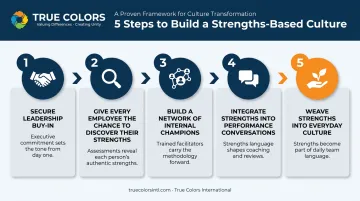
Step 1: Secure Leadership Buy-In
A strengths focus needs visible sponsorship from the top, championed as a core business strategy rather than handed off to HR as a side project. When leaders model strengths-based language in their own decisions and feedback, employees notice the shift is real.
Step 2: Give Every Employee the Chance to Discover Their Strengths
Roll assessments and strengths conversations out from the executive team down to frontline staff. Starting with leadership builds credibility; extending it to everyone builds an inclusive culture where no one feels left out of the conversation.
Step 3: Build a Network of Internal Champions
Identify advocates across departments who can keep strengths conversations alive long after the initial rollout. Certified facilitators (whether internal staff or partners trained through programs like True Colors' facilitator certification tracks) help sustain momentum without leadership having to drive every conversation personally.
Step 4: Integrate Strengths into Performance Conversations
Shift performance reviews away from a checklist of gaps to fix. Instead, ask what this person is naturally good at and how you can put more of that to work. Coaching conversations built around strengths tend to feel more constructive and less like a report card.
Step 5: Weave Strengths into Everyday Culture
Embed strengths language into onboarding materials, recognition programs, and internal communications. A one-time training rarely changes behavior. Repetition across everyday touchpoints does.
Top Employee Strengths That Drive Organizational Success
Gallup's CliftonStrengths framework groups 34 individual talent themes into four domains:
- Executing
- Influencing
- Relationship Building
- Strategic Thinking
Across most workplaces, a few strengths consistently rise to the top:
- Communication: Clearly conveying ideas across teams and levels
- Adaptability: Adjusting quickly when priorities shift
- Collaboration: Working effectively across different personality types
- Problem-solving: Finding practical paths through complex issues
- Reliability: Following through consistently on commitments
Naming these strengths is only half the battle. They translate into real performance gains only when teams have a shared way to recognize and discuss them day to day. Without a common language, managers often default to whoever's loudest in the room, missing quieter strengths entirely.
This is where a shared framework earns its keep. True Colors' four-color temperament system gives managers a fast, practical way to spot how each person on their team naturally communicates and contributes. From there, they can assign work in a way that plays to those tendencies rather than against them.
Frequently Asked Questions
What are examples of organizational strengths?
Organizational strengths include a skilled workforce, a strong brand reputation, efficient operational processes, and financial stability. Specific examples might be a fast product development cycle or a loyal customer base built over years.
What are the top 5 employee strengths?
The most commonly cited employee strengths are communication, adaptability, collaboration, problem-solving, and reliability. These show up across nearly every industry and role type.
How is a strengths-based approach different from a SWOT analysis?
SWOT analysis is gap-focused, spending significant energy on weaknesses and threats. Strengths-based models like SOAR keep the focus on internal strengths and opportunities while replacing gap analysis with aspirations and measurable results.
How often should organizations reassess their strengths?
Most experts recommend reassessing at least annually, or whenever the organization undergoes major change like a leadership transition or market shift. Treating strategy as an ongoing process, not a once-a-year event, keeps strengths assessments current.
Can a strengths-based approach reduce employee turnover?
Yes. Employees who use their strengths daily are much less likely to quit, largely because strengths-focused development builds engagement and a sense of belonging that generic performance management often misses.
What tools can help identify organizational strengths?
Appreciative inquiry discovery sessions, SOAR strategic planning workshops, and validated personality or temperament assessments (such as True Colors' ASI-certified assessment) all help surface strengths that standard employee surveys tend to overlook.