But picking the wrong style for the wrong moment carries a real cost. Managers alone account for at least 70% of the variance in employee engagement scores across business units, according to Gallup's analysis of more than 27 million employees over two decades. That's not a small lever. It's the lever.
This guide breaks down what soft and hard leadership actually mean, when each one works, and how to build the flexibility to shift between them. There's no declared winner here, just a framework for making the right call.
Key Takeaways
- Soft leadership leads through empathy and collaboration; hard leadership leads through authority.
- Complex, people-focused work favors soft leadership; urgent, high-risk tasks call for hard leadership.
- The best leaders blend both styles based on situation and team maturity.
- A personality assessment reveals your natural tendency, the first step toward flexibility.
Soft Leadership vs. Hard Leadership: Quick Comparison
Before diving deeper, here's how the two styles stack up across five core dimensions.
| Dimension | Soft Leadership | Hard Leadership |
|---|---|---|
| Decision-Making | Collaborative, consensus-driven, incorporates team input | Top-down, leader-driven, fast and directive |
| Power Source | Soft power: trust, influence, referent authority | Hard power: positional authority, formal control |
| Communication | Two-way dialogue, active listening, negotiation | One-way instructions, commands, minimal negotiation |
| Primary Focus | People-orientation, long-term culture and development | Task-orientation, short-term output and compliance |
| Best-Fit Scenario | Complex or ambiguous challenges requiring buy-in | Crises or simple tasks needing rapid, unambiguous direction |
Notice the pattern: soft leadership optimizes for buy-in over time, and hard leadership optimizes for speed right now. Both matter. The trick is knowing which one the moment calls for.
Understanding Soft Leadership vs. Hard Leadership
What Is Soft Leadership?
Soft leadership leads through empathy, persuasion, coaching, and collaboration instead of formal authority. It draws from servant leadership, transformational leadership, and democratic leadership theory, all of which treat influence as something earned rather than assigned.
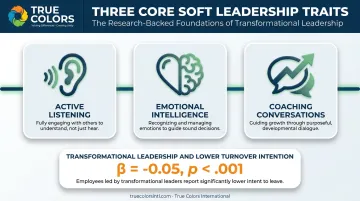
The core traits show up in daily behavior:
- Active listening that surfaces concerns before they become problems
- Emotional intelligence that reads team dynamics accurately
- Coaching conversations instead of top-down corrections
These traits aren't just feel-good extras. A study of 478 healthcare professionals across private hospitals in Turkey found transformational leadership had a statistically significant negative relationship with turnover intention (beta = -0.05, p < .001). The finding comes from research published in Behavioral Sciences. In plain terms: employees under empathetic, growth-focused leaders were less likely to plan an exit.
That said, empathy isn't automatic magic. A separate study of Indonesian nurses found empathetic leadership alone didn't directly reduce turnover intention. Self-regulation had to be present too. Soft leadership works best as a system of behaviors, not a single trait applied in isolation.
Where soft leadership fits best:
- Change management initiatives that need genuine buy-in
- Cross-functional projects requiring collaboration across silos
- Remote and hybrid teams where trust has to be built deliberately
- DEI-driven cultures where people need to feel heard, not just managed
What Is Hard Leadership?
Hard leadership leads through authority, control, and transactional exchange. It's rooted in autocratic and transactional leadership theory, going back to Lewin, Lippitt, and White's classic 1939 experiments comparing leadership-driven social climates.
Core traits include:
- Directive communication that leaves no room for ambiguity
- Clear rewards and consequences tied to performance
- Fast, leader-owned decisions without a consensus-building detour
Speed is the real payoff. In a randomized trial involving 237 medical students, teams that received brief leadership instruction before a CPR simulation started compressions faster. The median start time was 44 seconds, compared to 67 seconds for teams without that instruction. That gap was statistically significant in Critical Care Medicine (p = .018). When seconds matter, clear direction beats deliberation.
Two dominant subtypes show up in practice: autocratic leadership, where the leader makes decisions unilaterally, and transactional leadership, where performance is explicitly tied to reward or consequence.
Where hard leadership fits best:
- Crisis response where hesitation costs time or safety
- Regulatory or compliance-heavy environments with zero tolerance for deviation
- Situations demanding fast, unambiguous execution from an inexperienced team
Which Leadership Style Is Better? Choosing the Right Approach
Neither style wins outright. Effectiveness depends on the problem, the team, and the clock. A leader who defaults to one mode regardless of context is solving half the puzzle.
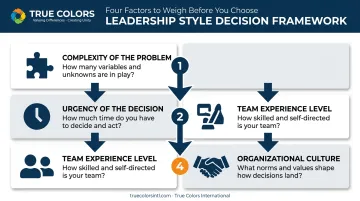
Weigh these four factors before choosing:
- Complexity of the problem: Ambiguous, multi-layered issues need input from more perspectives.
- Urgency of the decision: A five-alarm fire doesn't have time for a task force.
- Team experience level: Novice teams often need more direction; seasoned teams need less.
- Organizational culture: A culture built on trust will resist heavy-handed control, even in a pinch.
Choose hard leadership when:
- The problem is simple and the correct action is already known
- Safety or compliance leaves no margin for interpretation
- The team lacks the experience to self-direct
Choose soft leadership when:
- The problem is ambiguous and benefits from multiple viewpoints
- Long-term buy-in matters more than short-term speed
- You're managing culture change, not just a task list
This is where the idea of situational, or fluid, leadership comes in. Hersey and Blanchard's original model matched directive and supportive behaviors to a follower's competence and commitment, rejecting the idea of one permanently "correct" style. The best leaders shift gears depending on who they're leading and what the moment demands.
Getting there starts with self-awareness. Most people default to one style without realizing it, often shaped by early career experiences or personality wiring.
Tools like True Colors International's personality-based assessments help leaders see their natural tendency, whether that's a pull toward control and structure or toward collaboration and consensus. Once you can name your default, you can start consciously overriding it when the situation calls for something else.
Real-World Example: Soft Leadership in Action
Consider a common scenario in education and healthcare settings, sectors where True Colors International has worked for decades: a team led almost entirely through top-down directives. Staff feel unheard, and communication breaks down between shifts or departments.
The challenge: Staff report low morale, frequent miscommunication, and a growing sense that decisions happen to them, not with them. Leadership relies on instruction, not dialogue.
The trigger for change: Leadership adopts a personality-based training program, using a shared framework (like True Colors' four-color system) to help staff understand each other's communication preferences and decision-making styles. Instead of one-size-fits-all instructions, managers learn to adapt their approach to how each team member actually processes information.
What typically follows, based on outcomes True Colors has documented across education and healthcare clients:
- Reduces distrust and friction between staff and leadership
- Improves internal and external communication
- Builds a more supportive, collaborative day-to-day environment
One university client, for example, reported improved communication and stronger self-awareness among staff after a Personal Success Workshop. A high school client saw reduced distrust and a more supportive learning environment following the same core methodology.

The takeaway: Soft leadership tends to pay off most when the real goal is sustained culture change, not just a faster fix. If your team's biggest issue is trust, not speed, that's your signal.
That signal often starts with your own self-awareness as a leader. Curious where your own leadership style naturally sits on the soft-to-hard spectrum? Exploring a personality assessment can help you spot your default pattern and start building the range to lead effectively in any situation.
Conclusion
The goal was never to pick a permanent side. Hard leadership delivers clarity and speed when the moment demands it. Soft leadership builds the trust and long-term growth that keep good people around. Most real leadership challenges need both, applied at different times, to different people, for different problems.
Engagement, retention, and organizational resilience all trace back to the same root: leaders who understand themselves well enough to adapt. That self-awareness, more than any single style, is what actually drives results, and it's the exact skill True Colors International's leadership development programs are built to strengthen.
Frequently Asked Questions
What does soft leadership mean?
Soft leadership means leading through empathy, persuasion, and collaboration rather than positional authority. It relies on trust and influence to guide teams instead of formal commands.
What are 5 leadership soft skills?
Common leadership soft skills include communication, empathy, active listening, coaching, and emotional intelligence. These build trust and drive engagement over time.
What are the 4 leadership styles?
Common frameworks include directing, coaching, supporting, and delegating, based on team competence and commitment. These map onto the soft/hard spectrum, with directing leaning hard and supporting leaning soft.
What is hard leadership?
Hard leadership is authority- and control-driven leadership focused on tasks, rules, and clear rewards or consequences. It prioritizes speed and compliance over consensus.
Can a leader combine soft and hard leadership styles?
Yes. Effective leaders shift between styles based on the situation, a concept often called situational or fluid leadership. The best approach depends on urgency, complexity, and team readiness.
Which leadership style is better for managing organizational change?
Soft leadership works better for change management because it builds buy-in and trust over time. Hard leadership can still help enforce urgent, non-negotiable deadlines within that same change effort.