That gap matters more than most leaders realize. In a McKinsey survey of 1,440 executives, half said they only tracked direct participant feedback after training investments, and a third admitted they had no idea what return they got on the money spent (McKinsey, Building Organizational Capabilities).
Team building without a defined objective is the same problem, dressed up as fun. This article breaks down nine objectives every company should set before booking another activity — plus how to structure and measure them so the budget actually earns its keep.
Key Takeaways
- Team building without a stated objective produces inconsistent, unmeasurable results.
- Different team stages need different goals: new teams need trust; mature teams need conflict skills.
- Nine core objectives span communication, trust, collaboration, emotional intelligence, leadership, conflict, engagement, onboarding, and culture.
- SMART goals and baseline metrics turn a one-off event into a program leadership can justify.
Why Team Building Objectives Matter
Setting an objective first changes everything about how you plan the day. Instead of defaulting to trivia night or a generic escape room, leaders can choose an activity that actually targets the problem in front of them.
That problem is often more urgent than it looks. A 2024 systematic review found workplace loneliness correlates with meaningfully lower job performance and higher burnout among employees who feel disconnected from coworkers (Bryan et al., 2024). Distributed and hybrid teams feel this acutely. Fewer hallway conversations mean fewer natural chances to build the trust that used to happen automatically.
Not every team needs the same fix. Match the activity to where your team actually is:
- A newly formed team wastes time on advanced conflict-resolution training before basic trust exists
- An established team that already trusts each other doesn't need another icebreaker; it needs leadership growth or sharper conflict skills
There's also a budget argument here. "We had a fun day" doesn't survive a leadership review. "We reduced onboarding time by two weeks and saw fewer HR escalations" does. Objectives give you the language to tie soft skills work to numbers finance actually cares about: retention, engagement, and absenteeism.
The 9 Team Building Objectives Companies Should Set
Here's the full list, organized from foundational to advanced. Most organizations will find they need three or four of these at any given time, not all nine at once.
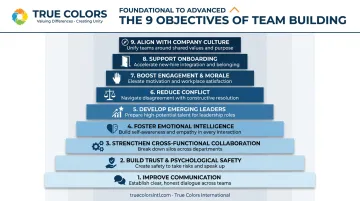
Objective 1: Improve Communication Across Teams
Unclear communication carries a real cost. Grammarly's 2024 State of Business Communication report estimates that workplace miscommunication costs U.S. businesses $1.2 trillion annually (Grammarly, 2024).
A practical starting point: pair employees with different communication styles (a direct, fast talker with a detail-oriented planner, for example) in structured exercises. Have them practice adapting their language and listening habits until they reach a shared outcome.
Objective 2: Build Trust and Psychological Safety
Psychological safety is the shared belief that it's safe to take interpersonal risks on a team: admitting mistakes, asking questions, or disagreeing with a boss. Google's Project Aristotle studied 180 teams and ranked psychological safety as the single strongest predictor of high-performing teams, ahead of dependability, structure, and even individual talent (Google re:Work).
Build this with low-stakes vulnerability, not deep therapy sessions. Sharing a personal working style, a past professional stumble, or a stress response in a facilitated setting works far better than forced trust falls.
Objective 3: Strengthen Cross-Functional Collaboration
Departmental silos form quietly. Marketing optimizes for speed, finance optimizes for accuracy, and neither group understands why the other seems slow or careless. McKinsey research on team effectiveness has found that most cross-functional teams underperform against their own stated goals, and that teams with above-average trust work more efficiently than those without it.
Rotating joint projects between departments, or simply requiring a "shadow day" where someone sits in on another team's workflow, builds the shared context that prevents this friction.
Objective 4: Foster Emotional Intelligence and Empathy
HR leaders increasingly treat emotional intelligence as a leading indicator of team success rather than a nice-to-have. A recent correlational meta-analysis covering more than 3,400 team members found a moderate, consistent link between emotional intelligence and team effectiveness across dozens of studies.
Guided perspective-taking exercises, where colleagues walk through how their personality type processes stress, feedback, or deadlines differently, help teams recognize emotional needs they might otherwise dismiss as personality quirks.
Objective 5: Develop Emerging Leaders
Leadership development shouldn't wait until someone gets a manager title. Companies with strong internal leadership pipelines consistently outperform peers on engagement and retention metrics, and manager coaching specifically has been linked to measurably higher team engagement scores.
Build this into team building through:
- Stretch assignments that put junior team members in charge of a defined deliverable
- Mentorship pairings across experience levels, not just within one department
- Peer-coaching rotations where team members practice giving and receiving feedback
Objective 6: Reduce Conflict and Build Resolution Skills
Conflict itself is not the problem. Mishandled conflict is. A widely cited CPP study found employees spend an average of 2.1 to 2.8 hours per week dealing with workplace conflict, representing hundreds of billions in paid hours industry-wide.
Role-playing realistic workplace disagreements (a missed deadline, a credit dispute, a scheduling clash) with a structured resolution framework builds the muscle memory teams need before a real disagreement shows up in a live meeting.
Objective 7: Boost Employee Engagement and Morale
Gallup's long-running Q12 meta-analysis found that top-quartile teams on engagement outperform bottom-quartile teams by roughly 18% in sales productivity and 23% in profitability. Those gains show up directly on the P&L.
Two levers move this fastest: recognizing effort publicly and in specific terms, and designing team building moments that feel genuinely enjoyable rather than mandatory. A live, interactive event that people actually want to attend does more for morale than a checkbox training session ever will.
Objective 8: Support Onboarding and New Hire Integration
The first few weeks set the tone for a new hire's entire tenure. A 2025 study of employees in private-sector SMEs found that a strong managerial welcome and early workplace wellbeing were both linked to lower intent to leave. New hires who feel integrated early are far less likely to check out within their first year.
Buddy programs and including new hires in existing team exercises within their first two weeks, rather than waiting three months, speed up that integration.
Objective 9: Align Teams with Company Culture and Values
Without intentional alignment, employees quietly default to their own assumptions about "how we work here." Those assumptions rarely match. SHRM's 2024 global workplace culture report found that 83% of employees in good-to-excellent cultures were motivated to produce high-quality work, compared to just 45% in poor cultures. Workers in positive cultures were also nearly four times more likely to stay long-term.
Shared frameworks, such as personality or temperament-based assessments, give teams a common language for discussing values and working styles instead of leaving "culture fit" as a vague, unmeasurable idea.
How to Set SMART Team Building Objectives
Vague goals like "improve teamwork" don't survive contact with a budget review. Run each objective through the SMART framework instead:
- Specific: "Reduce miscommunication-related project delays" beats "communicate better"
- Measurable: Tie it to a number: fewer escalations, faster turnaround, higher survey scores
- Achievable: A brand-new team shouldn't aim for advanced conflict mastery in one quarter
- Relevant: Connect it to a business outcome leadership already cares about
- Time-bound: "Within the next two quarters," not "eventually"
Example: "Reduce cross-department miscommunication escalations to HR by 25% within two quarters, measured by ticket volume and a quarterly pulse survey."
A strong SMART objective still needs the right target. Survey employees anonymously before you lock one in. Guessing at pain points usually gets it wrong; asking directly rarely does. Then set baseline metrics (current engagement scores, turnover rate, absenteeism) so you can track real progress.
For lasting change rather than a one-day bump, True Colors International's True Culture Loop provides a four-stage model for making objectives stick:
- Awareness: Surface how people actually communicate and where blind spots exist
- Alignment: Build shared expectations for how work gets done
- Action: Apply the new skills in real meetings and decisions, with leaders modeling it visibly
- Reinforcement: Sustain the habit with coaching and internal culture champions, so it doesn't fade after training ends
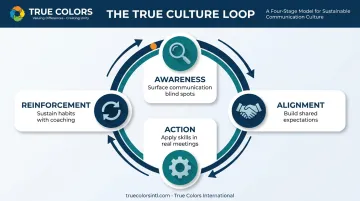
Every objective on this list should connect back to a bigger business goal (retention, performance, or culture), not exist as a standalone event that ends when the workshop does.
Measuring the Success of Your Team Building Objectives
Measurement should happen twice: right after the initiative, and again several weeks later once the novelty wears off.
Recommended approach:
- Run an anonymous pulse survey immediately after the activity to gauge sentiment shift
- Repeat that survey 4–6 weeks later to see if the change stuck
- Track hard metrics before and after (absenteeism, turnover, output data) against the specific objective you set
Watch for qualitative signals too. A jump in cross-department requests for help, faster informal conflict resolution, or fewer escalations to HR are early proof something shifted. Those signals often show up long before the change appears in a quarterly report.
How True Colors International Helps Companies Achieve These Objectives
True Colors International has spent more than 45 years helping organizations turn these nine objectives into practical, repeatable programs. The core tool is a personality-based methodology with four color types representing distinct working styles. It gives teams a shared language for communication, empathy, and conflict management instead of vague personality guesswork.
That shared language shows up directly across the objectives above:
- Communication and empathy through the Personal Success Workshop and Communication certification track
- Trust-building through low-stakes personality-spectrum sharing exercises
- Conflict navigation through a structured framework built around recognizing style-based friction, not blame
- Culture alignment through the True Culture Loop and shared color-based vocabulary used from hiring through leadership coaching
The methodology has been applied across Fortune 500 companies including Amazon, Google, Ford, Oracle, Salesforce, and Marriott, along with military, healthcare, education, and government clients. That range shows how portable the approach is across very different team cultures.
For HR decision-makers vetting a vendor, the credentials matter. The True Colors assessment is ASI-certified, exceeding EEOC 80% guideline standards for reliability and construct validity. The company is also a SHRM Recertification Provider and HRCI Approved Provider, so the training itself counts toward professional recertification credits.
Frequently Asked Questions
What are the 5 common objectives of team building?
The most frequently cited objectives are improving communication, building trust, strengthening collaboration, boosting morale, and developing leadership skills. These map closely to several of the nine objectives covered above.
What are examples of team objectives?
Concrete examples include reducing miscommunication-related project errors by a set percentage, improving new-hire 90-day retention rates, or cutting the average time it takes to resolve a team conflict.
How often should companies revisit their team building objectives?
A quarterly or biannual review works well for most organizations, timed to align with existing engagement surveys or performance review cycles so the data is already available.
Can team building objectives work for remote and hybrid teams?
Yes. Trust and communication are harder to build without in-person cues, so structured, intentional activities matter even more for distributed teams.
How do you measure ROI on team building?
Combine qualitative feedback from pulse surveys with hard metrics like retention rate, absenteeism, and productivity data, measured before and after the initiative against your original objective.
What's the difference between team building activities and team building objectives?
Objectives are the measurable goals you're trying to reach, such as reducing conflict escalations. Activities are the specific tactics — workshops, exercises, retreats — used to reach that goal.