Many organizations struggle here. Leaders write value statements, hang them on a wall, and wonder why turnover stays high and engagement stays flat. Gallup's most recent Q12 meta-analysis found that top-quartile business units see 23% higher profitability and 78% lower absenteeism than bottom-quartile units, based on 736 studies across industries.
A success culture isn't free snacks or an unspoken demand for constant hustle. It's a practical system: define shared values, assess how employees actually experience the workplace, translate those values into behaviors, and reinforce progress over time. That's the process this article walks through.
Key Takeaways
- A success culture links shared values to observable behaviors and real business priorities.
- Trust, respect, belonging, accountability, communication, and learning form the foundation of sustainable performance.
- Leaders build culture through decisions and daily behavior, not posters or one-time events.
- Combine employee feedback, behavioral signals, and business outcomes to measure and adjust culture continuously.
What Is a Success Culture? The Main Pillars of a High-Performing Workplace
A success culture is the shared values, expectations, communication patterns, and behaviors that shape how people actually work together toward organizational goals. It functions as an operating system, running beneath every meeting, decision, and daily interaction.
There's an important distinction between a high-performing culture and a high-pressure one. High performance includes clarity, support, psychological safety, sustainable workloads, learning, and accountability. High pressure demands output without those supports and burns people out in the process.
The core pillars of a success culture:
- Trust and credibility between leaders and teams
- Shared purpose and values that guide decisions
- Respect and belonging across differences
- Open, two-way communication
- Accountability that's consistent, not selective
- Learning and innovation built into daily work
- Employee well-being as a structural priority, not an afterthought

These pillars don't operate in isolation. Accountability without trust turns into control. Trust without clear expectations creates confusion. They have to reinforce each other, or the culture wobbles under pressure.
True Colors International approaches this by treating team members as people first, producers second — which sounds simple, but it changes how leaders make decisions, run meetings, and handle conflict. The company's Employee Experience Survey measures exactly these day-to-day patterns: what's working, what's at risk, and where to focus first.
Examples of Team Culture in Practice
Culture becomes visible in specific behaviors, not mission statements:
- A high-trust team shares information freely, raises concerns before they escalate, and receives autonomy alongside clear expectations. No one is guessing what "good" looks like.
- A learning-oriented team treats feedback and well-managed failure as information, not ammunition. Experiments are expected, and mistakes get analyzed instead of punished.
- A mission-focused team connects daily decisions to purpose. Whether they're serving customers, students, patients, or communities, people can explain why their work matters beyond the task list.
Assess Your Current Culture and Build a Strong Foundation
Start with a culture audit. Compare what leaders say they value against what employees actually experience: how decisions get made, how conflict gets handled, what behavior gets rewarded, and whether people feel heard. Use multiple sources of insight to avoid blind spots:
- Anonymous engagement surveys for trend data over time
- Pulse checks and stay interviews to catch friction early
- Focus groups and one-to-one conversations for context
- Turnover themes and exit feedback for retrospective patterns
- Onboarding feedback to catch early misalignment Quantitative and qualitative sources each have blind spots, so use both. SHRM's reporting on a 2022 stay interview initiative found that regular check-ins contributed to an 8% engagement increase and a 10% retention gain, though the company's chief people officer noted stay interviews were only one part of the improvement (SHRM, 2022). Exit interviews, by contrast, can produce guarded answers from people who don't want to burn bridges on the way out. Don't treat isolated complaints as the entire culture. Segment findings by team, role, work arrangement, and seniority before drawing conclusions. A pattern showing up across three departments is a culture issue. One frustrated comment in a single survey usually isn't. Define values that describe behavior, not vibes. "Excellence" means nothing without context. "We surface problems within 48 hours instead of letting them fester" is something people can actually be held to. This is where a shared framework helps. True Colors gives teams a common language for communication styles, stress responses, and decision-making preferences through four color types:
- Gold: organized and structure-driven
- Orange: action-oriented and adaptable
- Green: inquisitive and analytical
- Blue: relationship-oriented and empathetic It is not meant to label people; everyone carries a full color spectrum. Used well, it builds self-awareness and appreciation of differences. It should never be used to stereotype candidates or drive hiring decisions on its own.

Turning Values Into a Culture Action Plan
Once you've named your values, build a short action plan. For each value, define:
- The specific behavior it requires
- Who owns reinforcing it
- A realistic time frame
- An observable indicator of progress Prioritize a small number of high-impact issues first — unclear decision rights, inconsistent management behavior, weak cross-team communication, or lack of recognition tend to do the most damage. Ford's turnaround under Alan Mulally is a useful case study. Facing executive rivalries and reported losses of $10 billion, Mulally introduced a simple traffic-light reporting system: green for on track, yellow for a problem, red for serious trouble. He rewarded honest disclosure instead of punishing bad news, using the "One Ford" philosophy to break down silos. According to MIT Sloan's account, Ford later weathered the 2008 financial crisis without government assistance. One consistent meeting ritual, paired with real accountability for candor, shifted how the whole organization behaved.
Turn Culture Into Daily Behaviors, Systems, and Employee Experiences
Values only matter if they show up in the systems that touch employees' daily lives: recruitment, onboarding, goal setting, performance reviews, promotions, recognition, and offboarding.
Among those daily touchpoints, meetings reinforce culture more than people realize. Clear agendas, inclusive participation, transparent decisions, and documented follow-ups all signal what the organization actually values. So does making space for dissenting opinions instead of letting the loudest voice win by default.
Recognition deserves particular attention. Gallup and Workhuman tracked nearly 3,500 employees over two years and found that well-recognized employees were 45% less likely to have turned over, with high-quality recognition linked to 65% less active job searching (Gallup/Workhuman, 2024).
Reward both results and the behaviors that sustain them: knowledge sharing, constructive feedback, ethical judgment, and customer care.
Feedback and conflict systems need structure too:
- Encourage timely conversations instead of letting issues sit
- Separate intent from impact when addressing mistakes
- Document agreements so expectations don't drift
- Escalate serious conduct issues through a clear process
Hybrid and remote teams need that same structure, applied with more intention. Consistency matters more than presence. Evaluate people on outcomes, not visibility. Build intentional connection points, and make sure information reaches everyone equally, regardless of location.
Hiring and Onboarding for Culture Contribution
Hiring for "culture fit" often just means hiring people who feel familiar, which builds conformity and excludes different perspectives. Hire for culture contribution instead: alignment with a small set of essential values, plus varied skills, backgrounds, and ways of thinking.
- Use structured interview questions that reveal how candidates handle ambiguity, feedback, and disagreement
- Give realistic job previews instead of polished pitches
- Score every candidate against the same rubric to reduce bias
Onboarding is where culture either sticks or dissolves. MetroStar Systems used True Colors' color system during onboarding, following it with a half-day Personal Success Seminar to help new hires understand their own style and how it fit the broader team. Real stories, manager expectations, and early opportunities to contribute do far more than a values slideshow on day one.

Leadership, Communication, and Inclusion: The Conditions That Sustain Success
Leaders and managers are the most visible translators of culture. Employees don't read the values statement to understand what's expected. They watch what their manager tolerates.
That means leaders need to model transparency, follow through on commitments, admit mistakes publicly, and apply expectations the same way to everyone. Inconsistency here erodes trust faster than almost anything else.
Two-way communication should be routine, not occasional:
- Team check-ins for regular alignment
- Listening sessions where leaders ask more than they tell
- Town halls that explain what will change, what won't, and why
- Closed-loop feedback that shows employees their input led to action
True Colors' Connected Leadership Program helps leaders apply shared communication tools in real situations so consistent behavior becomes a habit, not a one-off training memory.
Those same habits shape who feels included enough to speak up. Inclusion connects directly to performance outcomes. Gallup research shows 42% of U.S. employees consider diversity and inclusion very important when evaluating a next job (Gallup, 2022). Belonging is tied to stronger attraction, retention, and innovation.
Employees need to contribute ideas, access development opportunities, and challenge decisions respectfully, not just show up.
Psychological Safety, Accountability, and Healthy Conflict
Psychological safety still requires standards and hard conversations. People can raise concerns and share ideas without fear of humiliation or retaliation.
A simple framework for healthy conflict:
- Clarify the actual issue before assigning blame
- Listen to each perspective fully
- Focus on evidence and shared goals, not personalities
- Agree on concrete next steps
- Revisit anything left unresolved
Burnout prevention belongs in this conversation too. Realistic workloads, role clarity, recovery time, and manager support all reduce the pressure that erodes psychological safety in the first place.
When culture needs repair, focus on behavior change rather than morale-boosting perks or a one-off engagement event.
Measure, Reinforce, and Adapt the Culture Over Time
Culture measurement works best as a balanced scorecard, not a single score. Combine employee sentiment, behavior-based indicators, and business outcomes:
- Engagement themes and psychological safety responses
- Retention patterns and internal mobility
- Absenteeism and turnover by team
- Collaboration feedback and innovation activity
- Customer or stakeholder experience data
Set a regular review cycle. Compare results against your original culture goals, look for gaps between teams, assign owners for each gap, and communicate the resulting actions back to employees. Skipping that last step is where most culture initiatives fail: people share feedback, see nothing change, and stop bothering.
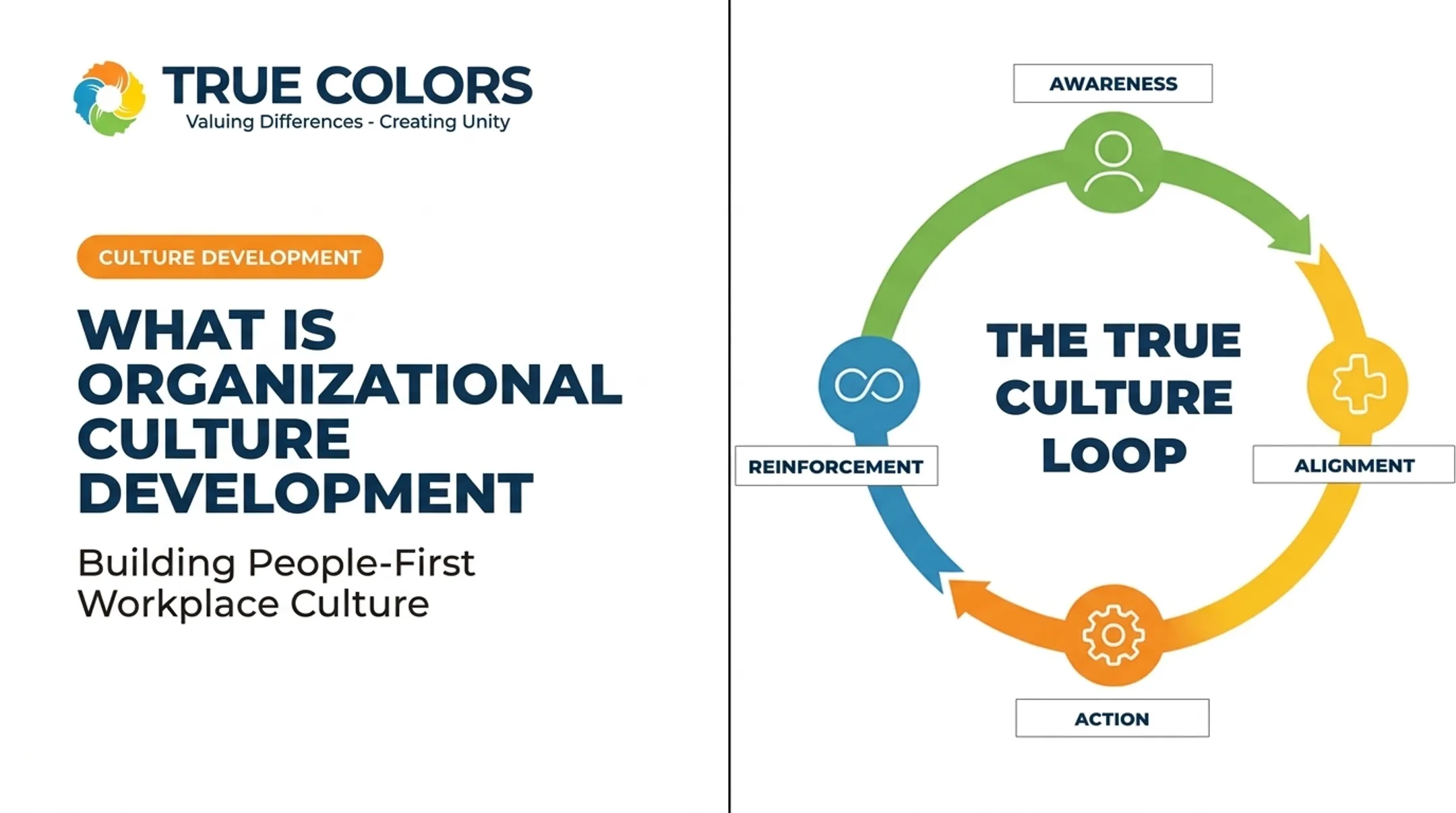
True Colors structures this as a continuous loop: Awareness, Alignment, Action, Reinforcement. Tools like the Culture Clarity Assessment and a short Culture Reality Check surface what's working and what's at risk before small issues become expensive ones. Reinforcement then happens through manager coaching, refreshed onboarding, and team retrospectives, not a single annual training day.

When Culture Needs Repair
Watch for these warning signs:
- Repeated employee concerns that go nowhere
- Inconsistent treatment across teams
- Silence in meetings
- High turnover and unresolved conflict
- A visible gap between stated values and actual decisions
Repair starts with acknowledgment and accountability, not a rebranding campaign. MIT Sloan's research on toxic workplace cultures identifies five damaging attributes: disrespectful, noninclusive, unethical, cutthroat, and abusive behavior. The same research estimates that roughly one in 10 U.S. workers experience a toxic culture (MIT Sloan, 2022).
Fixing it requires changing leadership behavior, social norms, and work design together, not separately.
Culture works like an operating system you keep updating. Preserve what's working, address harm as soon as you see it, and adjust as your people, customers, and business conditions shift.
Frequently Asked Questions
What are the main pillars of a success culture?
Trust, shared purpose, respect and belonging, open communication, accountability, learning, innovation, and employee well-being. These pillars reinforce each other and directly shape engagement, retention, and decision quality.
Can you give me some examples of team culture?
A high-trust team shares information and raises concerns early. A learning-oriented team treats feedback and failure as growth tools. A mission-focused team connects daily decisions to customer or community purpose.
What 3 to 5 words would you use to describe your company's culture?
Words like trusting, inclusive, collaborative, accountable, and growth-oriented only count if leaders can demonstrate them consistently. The words should reflect actual employee experience, not aspiration.
How do you build a success culture in the workplace?
Assess your current culture honestly, then define actionable values and model those behaviors through leadership. Align hiring and management systems with those values, gather ongoing feedback, and adjust based on what you learn.
How do you measure whether workplace culture is improving?
Combine employee feedback, behavior-based observations like meeting participation or conflict resolution, and business outcomes such as retention and internal mobility. Track all three consistently over time rather than relying on one survey score.