Introduction
Most employees dread self-assessments. Generic questions are the real culprit, turning honest reflection into a checkbox exercise that feels pointless.
"What are your strengths and weaknesses?" typically produces a shrug instead of real insight. When the questions are vague, the answers are vague. And vague answers do nothing for your career growth or your next conversation with your manager.
This guide fixes that. You'll get categorized self-assessment questions that actually prompt reflection, practical tips for answering them well, and a personality-awareness lens that helps you spot blind spots you'd otherwise miss.
Key Takeaways
- Generic self-assessment questions produce generic answers; specific, categorized questions drive real reflection
- Research directly links self-awareness to stronger workplace performance
- Personality frameworks like True Colors reveal blind spots in employees' natural tendencies
- Strong answers pair specific examples with honest, actionable growth areas
What Is an Employee Self-Assessment?
An employee self-assessment is a structured chance to reflect on and document your own performance, growth, and contributions over a set period. Instead of waiting for someone else to summarize your year, you write the first draft.
This differs from a manager review in one key way: it centers your voice. Your manager's evaluation captures what they observed. Your self-assessment captures what you know about your own work, including projects, wins, and challenges your manager may never have seen firsthand.
Self-assessments typically show up in a few places:
- Annual or biannual performance reviews: the most common format
- 360-degree feedback processes: where your self-perception is compared against input from peers, direct reports, and managers
- Development conversations: where self-assessment answers set the agenda for career planning
Self-Assessment vs. Self-Evaluation vs. Self-Appraisal
You don't need to worry about which term your company uses. Self-assessment, self-evaluation, and self-appraisal all refer to the same core activity. Most HR departments use these labels interchangeably, and the underlying expectation stays the same. You reflect. You document. You submit it before your review conversation.
Why Self-Assessment Questions Matter for Personal Growth
The questions you're asked shape the depth of reflection you're capable of. Sharp questions surface blind spots. Weak questions let you coast on surface-level answers.
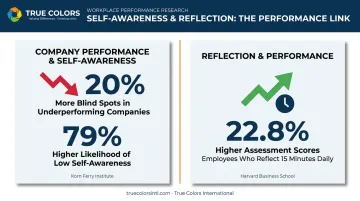
This isn't just a hunch. Korn Ferry Institute's research analyzed 6,977 professionals across 486 publicly traded companies and uncovered a clear pattern.
People at underperforming companies had 20% more blind spots and were 79% more likely to show low self-awareness than those at higher-performing companies. The correlation is striking, even though it doesn't prove self-awareness alone drives financial outcomes.
Reflection itself has measurable value too. In a Wipro training study, trainees who spent 15 minutes daily reflecting on lessons learned scored 22.8% higher on their final assessment than peers. Those peers used the same time to keep working instead, per Harvard Business School's Working Knowledge.
Good self-assessment questions do three things:
- Build self-awareness by forcing you to name specific strengths and gaps instead of generalizing
- Connect personal goals to company objectives, which increases motivation because your work feels tied to something bigger
- Strengthen manager communication by surfacing wins and struggles that might otherwise stay invisible until review time
Employee Self-Assessment Questions for Personal Growth (By Category)
Generic prompts get generic answers. These categorized questions are designed to pull out something real.
Self-Awareness and Strengths Questions
- What strengths have helped you succeed this period, and where did you use them most?
- Which piece of feedback have you received that genuinely surprised you?
- Where do you consistently outperform your own expectations?
- What's one pattern in your work that others notice before you do?
Professional Development and Skill-Building Questions
- What skill gap has slowed you down the most this period?
- What's one thing you learned that changed how you approach your work?
- Which task do you avoid because you feel underprepared for it?
- How would additional training or resources impact your growth right now?
Goal-Setting and Career Growth Questions
- Which goals did you hit, and which fell short, this period?
- What's blocking progress on your most important unfinished goal?
- Where do you want to be in your role a year from now?
- What would need to change for you to reach that next stage?
Communication and Collaboration Questions
- How has your communication style helped or hurt a recent project?
- When did you adapt your approach to work better with someone different from you?
- What's one collaboration moment you'd handle differently next time?
- How do you know when a message you sent actually landed?
Values, Culture, and Behavior Questions
- Where did you actively contribute to a positive team culture this period?
- What company value do you find easiest, or hardest, to live out?
- How have you supported a colleague beyond your formal job duties?
- What's one behavior you want to be more consistent about?
How Understanding Your Personality Type Sharpens Self-Assessment Answers
Self-assessment quality tracks directly with self-awareness. The sharper your self-awareness, the more accurate and useful your answers become. Personality and temperament frameworks speed up that process by giving you language for patterns you already sense but can't quite name.
True Colors International uses four temperament types, each with a distinct lens on self-reflection:
| Type | Natural focus when self-reflecting |
|---|---|
| Gold | Responsibility, structure, and detail |
| Blue | Relationships and harmony |
| Green | Logic and continuous improvement |
| Orange | Action and measurable results |
Here's why this matters for the "weakness" or "growth area" question that trips up almost everyone: each type tends to downplay different things.
- Gold employees often overlook communication gaps while focused on whether the task got done correctly
- Blue employees may downplay conflict to preserve group harmony
- Green employees may dismiss emotional impact while chasing the most logical solution
- Orange employees often gloss over planning weaknesses while already eyeing the next win
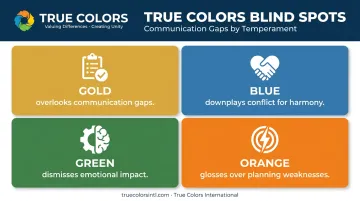
Knowing your color helps you catch the blind spot your temperament naturally hides.
True Colors' ASI-certified assessments are built on more than 45 years of research. Organizations including Google, Amazon, and Ford use this same framework to build employee self-awareness.
The assessment, paired with a personalized results report and a short consultation, gives employees a clear starting point before they ever open a self-assessment form.
Before your next self-assessment, identify your temperament color first. It won't hand you the answers, but it will help you ask better questions of yourself, which is half the battle.
Tips for Writing Strong Answers to Self-Assessment Questions
Strong answers share a few habits. Weak ones share the opposite.
- Use specific examples, not vague statements. Swap 'I improved my communication' for 'I restructured our weekly status update, cutting clarifying emails from the team by half.'
- Balance confidence with honesty. Own your wins directly. Then pair every acknowledged weakness with a concrete next step, not just an admission.
- Connect answers to team or company goals. A finished task matters less than what it enabled. Show the ripple effect of your work, not just the task itself.
Common Mistakes to Avoid When Answering Self-Assessment Questions
A few patterns undermine otherwise solid self-assessments.
- Vague answers. "I did a good job this year" gives your manager nothing to work with. Context and specifics are what make an answer credible.
- Overcorrecting in either direction. Being overly self-critical erases your real contributions. Being overly boastful without evidence damages your credibility just as fast.
- Restating your job description. Listing your duties isn't reflection. Your self-assessment should focus on outcomes and growth, not a recap of what was already expected of you.
Frequently Asked Questions
What does "employee self-assessment" mean?
It's a personal reflection process where employees document their own performance, growth, and contributions over a set period for review purposes. It's typically submitted before a formal performance review meeting.
What are some examples of employee self-assessments?
Common examples include strengths-and-weaknesses questions, goal-progress questions, and communication-style questions. Formats vary between rating scales, open-ended written responses, or a hybrid of both.
How often should employees complete a self-assessment?
Most organizations run this annually or biannually. Some add quarterly check-ins to keep growth tracking more continuous throughout the year.
How long should my self-assessment answers be?
Aim for a few focused sentences or bullet points per question. Clarity matters far more than length; a tight, specific answer beats a long, vague one.
Should I include metrics or data in my self-assessment?
Yes, when the data is available. Metrics strengthen performance-related answers. Development-focused questions, like learning goals, don't always need numbers to be effective.
How can knowing my personality type help with self-assessment?
Personality and temperament frameworks, such as True Colors, help you recognize blind spots your natural tendencies tend to hide, especially in weakness or growth-area questions. It gives you a clearer, more honest starting point for reflection.