Introduction
Bad cultural fit doesn't just create an awkward Slack channel. It drains money.
SHRM found that 1 in 5 Americans left a job in the past five years because of toxic company culture, with the total cost to U.S. organizations reaching an estimated $223 billion over that period. That's not a rounding error. That's a hiring process problem.
Skills-matching gets a candidate through the door. Cultural fit determines whether they stay, contribute, and grow into the role.
Many hiring managers treat fit as an afterthought—a quick "vibe check" at the end of an interview. That approach is exactly why so many companies keep re-hiring for the same seat.
This article covers practical ways to assess fit, how to read the signals candidates give you, and the mistakes that quietly sabotage even careful hiring processes.
Key Takeaways
- Combine structured interviews, validated personality assessments, and real team interaction; no single method catches everything
- Distinguish "culture fit" from "culture add" to avoid hiring for sameness
- Treat strong alignment, minor gaps, and red flags as distinct signals—not one pass/fail score
- Replace gut feelings and vague questions with defined criteria before interviews begin
- Standardized scorecards reduce bias and improve consistency across interviewers
What You Need to Assess Cultural Fit During Hiring
You can't measure a candidate against a culture you haven't defined. That sounds obvious, but most organizations skip this step and end up evaluating candidates against whatever the loudest interviewer personally values.
Foundational Elements Required
Before any interview happens, you need:
- A documented set of core values and behaviors that current employees can describe consistently, not just a poster in the break room
- A structured interview guide or scorecard tying specific questions to specific value-based competencies
- A validated assessment tool built on real reliability data, not marketing claims
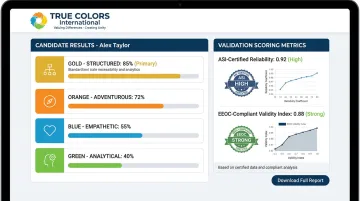
True Colors International's online personality assessment was independently reviewed by the Assessment Standards Institute (ASI) using a 10,000-person validation sample. ASI found all four personality themes scored in the "Very Good to Excellent" range for reliability.
The tool also exceeds the EEOC's 80% guideline for disparate impact. That documented validity matters when a candidate later questions why they weren't selected.
Preparing Your Hiring Team
The best tool in the world fails if the people using it are unprepared. Before running culture-focused interviews:
- Train interviewers on bias patterns, especially affinity bias (favoring people like yourself) and halo effect (one strong trait coloring the whole evaluation)
- Build a diverse interview panel so no single perspective dominates the read on a candidate
- Block dedicated time for culture conversations rather than squeezing them into the last five minutes of a skills interview
Rushed culture conversations produce rushed, unreliable conclusions.
Methods to Assess Cultural Fit During Hiring
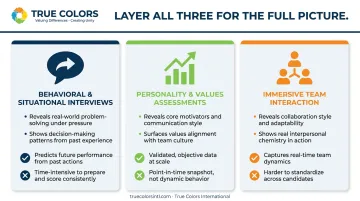
No single method gives you the full picture. Behavioral interviews reveal what candidates have actually done. Assessments reveal how they're wired. Team interaction reveals how they behave when they're not "performing" for an interviewer. Layer all three.
Method 1: Behavioral and Situational Interview Questions
This method uncovers how a candidate has actually behaved in situations tied to your values, not how they claim they'd behave hypothetically.
Sample questions:
- "Tell me about a time you disagreed with a decision your manager made. What did you do?"
- "What did you value most, and least, about your last team's culture?"
- "How would your ideal manager support you day to day?"
A large meta-analysis of 245 validity coefficients across 86,311 people found that structured interviews consistently outperform unstructured, free-flowing ones for predicting future behavior (McDaniel et al., 1994). The takeaway: write your questions in advance, and score every candidate against the same rubric.
- Pros: Rich, specific insight into real behavior
- Cons: Vulnerable to interviewer bias; strong performers can still “pass” a single 45-minute conversation
Method 2: Personality and Values-Based Assessments
Standardized instruments measure communication style, temperament, and adaptability objectively, removing some of the guesswork from gut-feeling decisions.
True Colors' ASI-certified methodology, for instance, maps candidates across four temperament dimensions:
| Style | Priority | Communication Preference | Decision Style |
|---|---|---|---|
| Orange | Action | Concise, practical, fast-paced | Move now |
| Gold | Structure | Direct, detail-oriented | Follow process |
| Green | Logic | Data-driven, no fluff | Analyze first |
| Blue | Connection | Relational, values rapport | Build consensus |
Every person carries a blend of all four, ranked from most to least dominant. This is where team-composition analysis becomes useful: if a team already skews heavily Blue, a candidate with strong Gold or Green tendencies might round out gaps rather than create friction.
Recommended steps:
- Administer the assessment early in the process, not after an offer is drafted
- Compare the candidate's profile against the team's existing composition
- Use results as a discussion point in follow-up conversations, not a standalone yes/no filter
Many practitioners weight assessment results at roughly 25% of the overall hiring decision, alongside interviews, work samples, and reference checks.
- Pros: Scalable and consistent across high interview volumes
- Cons: Must pair with human judgment—a personality label is one data point, never the whole decision
Method 3: Immersive Engagement and Team Interaction
Formal interviews are, by nature, a performance. Watching how a candidate interacts with future teammates surfaces behavior an interview room can't.
Ways to run it:
Arrange short, informal conversations with two or three future teammates
Try an office walkthrough or casual coffee chat instead of another formal Q&A
Debrief each team member separately, then compare notes for consistency
Pros: Surfaces authentic dynamics candidates can't easily stage
Cons: Time-intensive and dependent on team availability
How to Interpret the Results
Collecting signals is only half the job. Misreading them leads to either a costly mis-hire or an unfair rejection of a candidate who would have strengthened the team.
Strong alignment: Interview answers and assessment results consistently reflect core values, backed by specific, authentic examples rather than rehearsed talking points. Move forward, but still verify with reference checks.
Minor gaps: The candidate shares most core values but diverges on a secondary trait, such as communication pace or decision-making speed. That alone is not disqualifying. Probe further and ask whether the difference is a valuable culture add instead of a true mismatch.
Red flags: Stated values or the assessment profile sharply contradict what the role requires. Example: a strongly individualistic working style in a deeply collaborative team, with no evidence of adaptability. Gather more data before extending an offer. Don't rely on a single red flag from a single interviewer.
Culture fit measures alignment with existing norms. Culture add measures the new perspective a candidate brings while still sharing your core values. Treating every difference as a red flag pushes you toward hiring people who all think the same way, which creates its own risks.
Common Mistakes and Best Practices When Assessing Cultural Fit
Even well-designed processes break down when a few common habits sneak in.
Mistakes to avoid:
- Relying on gut feeling or likability instead of structured, value-based criteria. This produces inconsistent, biased decisions that vary by interviewer mood.
- Confusing "fit" with similarity. A 2012 study of elite professional-services hiring found evaluators favored candidates who mirrored their own backgrounds—even after technical screening. Roughly 40% of hiring professionals still rank similarity-based fit as their top priority, and hiring for sameness narrows team perspectives over time.
- Asking vague questions like "What's your ideal culture?" These invite generic, rehearsed answers instead of revealing genuine alignment.
Best practices to adopt:
- Standardize scorecards across every interviewer so scores mean the same thing regardless of who asks.
- Combine methods—structured interviews, validated assessments, and real work interaction—rather than relying on one approach.
- Track new-hire outcomes over the first several months to test whether your process predicts performance and integration.
- Use a research-validated methodology. Fortifi Bank, a 130-employee Wisconsin bank, used True Colors' framework to structure cultural fit assessment and improve engagement—treating fit as a discipline, not a hunch.
Conclusion
Accurate cultural fit assessment takes more than one interview question or a personality quiz. Structured interviews, validated assessments, and real interaction work best together, each covering blind spots the others leave open.
Misreading those signals leads to costly turnover. Strong interpretation helps you build teams that stay, collaborate, and perform.
Keep the focus on thoughtful, balanced decisions—especially when a candidate represents a genuine culture add rather than a reason to pass.
Frequently Asked Questions
What are the best interview questions to assess cultural fit?
Behavioral and situational questions work best. Ask about a time the candidate disagreed with a decision, or what they valued most in a past role—and skip generic prompts like "What's your ideal culture?" that invite rehearsed answers.
What is the difference between culture fit and culture add?
Culture fit looks for alignment with your existing norms and values. Culture add looks for candidates who share your core values but bring a fresh perspective, skill set, or working style that strengthens the team rather than mirrors it.
How do you avoid bias when assessing cultural fit?
Use structured interviews with standardized scorecards, diverse interview panels, and validated, EEOC-compliant assessments. Layering these reduces affinity bias and gut-feel hiring calls.
Can personality assessments really predict cultural fit?
Validated, research-backed assessments can reliably indicate communication style, adaptability, and work preferences. They work best as one data point alongside structured interviews, not as a standalone hiring decision.
Is it legal to assess candidates for cultural fit?
Yes—when you base it on job-related values and behaviors and use compliant, non-discriminatory tools validated against EEOC guidelines. It gets risky when "fit" becomes a stand-in for personal similarity.
How early in the hiring process should cultural fit be assessed?
Evaluate it alongside skills starting from the first interview stage, not as a late-stage afterthought. Waiting until an offer is nearly drafted makes it far harder to course-correct.