Heading into 2026, the research is clear: a title doesn't make someone a leader. Believing you're one does. That belief is what separates people who grow into leadership from people who just occupy it.
Here's the problem. Many professionals get handed leadership roles without ever building the internal conviction "I am a leader." The result is hesitant decision-making, disengagement, and talented people who quietly opt out of leadership altogether.
This guide breaks down what leadership identity development (LID) actually means, walks through the research-backed stage models, explains popular frameworks like the 5 C's and 4 P's, and shares practical strategies — including self-awareness tools — for building a leader identity that actually holds up under pressure.
Key Takeaways
- Leadership identity means internalizing "leader" as self-concept, not just a title
- Identity, more than skill, predicts who takes ownership and grows into leadership
- Development happens in recognizable stages, but rarely in a straight line
- Frameworks like the 5 C's and 4 P's describe behavior, not identity work
- Self-awareness tools give people language to own the identity, not just describe it
What Is Leadership Identity Development?
Leadership identity is the extent to which a person sees leadership as central to who they are, not something they step into occasionally. Rice University's Doerr Institute for New Leaders frames it as a psychological throughline connecting self-definition, felt responsibility, and openness to growth.
A mature leader identity typically includes:
- Self-definition: genuinely seeing yourself as a leader, not someone borrowing a title
- Felt responsibility: stepping up when something needs doing, assigned or not
- Opportunity recognition: noticing moments that call for leadership before anyone points them out
- Self-awareness: an honest read on your own strengths and blind spots
- Growth orientation: treating leadership as a skill you keep building, not a box you checked
Leader Identity vs. Self-Efficacy and Motivation to Lead
These three get confused constantly. Leader self-efficacy is "I can lead," meaning confidence in your capability. Motivation to lead is your desire to take on leadership roles in the first place. Leader identity runs deeper: it's "I am a leader," a piece of your actual self-concept.
Someone can want to lead and still doubt they're capable. Someone else can feel highly capable and never see leadership as part of who they are. Identity is what predicts whether a person keeps showing up as a leader once things get difficult.
Why Titles and Prestige Aren't Enough
A 2020 survey by CCL and Y20 of 10,386 young adults across 20 G20 countries found that 37% currently held a leadership role, whether formal or informal, paid or volunteer. Leadership shows up early, and often, before anyone's formally recognized it.
Yet holding a position doesn't automatically build the belief. Doerr's review found that attending an elite university, by itself, didn't increase students' leader identity during college. Prestige and access aren't identity.
Any solid leader identity measure needs to capture three things at minimum: self-definition, ownership of responsibility, and leadership that goes beyond a formal title.
The Leadership Identity Development Model: Stages and Theory
Leader identity doesn't appear overnight. Researchers have mapped it as a developmental process with recognizable stages, and, more recently, as something that shifts across career phases too.
The Six-Stage Grounded Theory Model
The foundational model comes from Komives and colleagues' grounded theory study, built on life-narrative interviews with 13 college students. It's since been replicated across diverse populations, including Latinx men and LGBT student activists, according to a later academic review.
- Awareness — you notice leadership exists and start watching how others do it
- Exploration/Engagement — you intentionally join groups and start participating
- Leader Identified — you see leadership mainly as a formal position, yours or someone else's
- Leadership Differentiated — you realize leadership is a relational process, available to anyone in the room, not just the person with the title
- Generativity — you commit to work that matters to you and take responsibility for developing others
- Integration/Synthesis — leadership becomes part of how you show up everywhere, not just at work
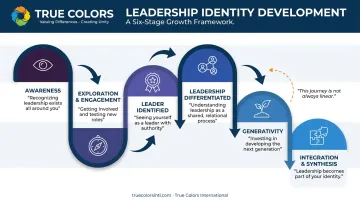
Later research suggests the final three stages may work more like overlapping dimensions than a strict sequence. Not everyone moves through them in order, and that's expected.
Career-Phase Development in the Workplace
The Center for Creative Leadership (CCL) maps a parallel model for working professionals, built around five career phases: Onramp, Early Career, Leadership Positions, Recognition, and Advancement.
Across every phase, a few themes repeat:
- Growing external support networks (mentors, sponsors, peer groups)
- Building new skills and resilience as stakes increase
- Developing confidence in decisions, not just competence
- Getting comfortable actually owning the leader identity out loud
Here's the part people don't expect: identity development isn't linear. CCL tracked leadership indicators among 3,141 students in grades 4 through 12 and found a consistent dip during middle school (grades 6-8), followed by a rebound starting around grade 9.
The same pattern shows up in adult careers — identity often dips during transitions, such as a new role, a layoff, or a return from leave, before strengthening again. A dip isn't failure. It's part of the process.
Popular Leadership Frameworks: The 5 C's, 4 P's, and 3 C's Explained
These frameworks get referenced constantly in leadership training, and they're genuinely useful shorthand. They describe what leadership looks like from the outside. What they don't do is guarantee you feel like a leader on the inside.
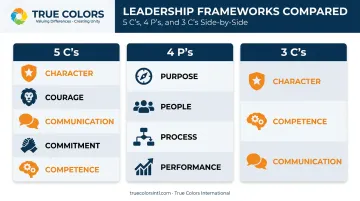
The 5 C's of Leadership
- Character — doing the right thing when no one's watching
- Courage — making the hard call despite uncertainty
- Communication — turning vision into something people actually understand
- Commitment — following through after the initial motivation fades
- Competence — having the skill to execute, not just the ability to talk about it
The 4 P's of Leadership
- Purpose — the reason behind the work
- People — how you develop and support the team around you
- Process — the systems that make good execution repeatable
- Performance — the results that prove the first three are actually working
The 3 C's of Leadership
- Character — the ethical foundation
- Competence — the capability to deliver
- Communication — the skill to align people around a shared goal
Notice the overlap between the 5 C's and 3 C's. That's not an accident; these frameworks borrow from each other constantly. But here's the catch: you can memorize every C and P on this page and still not internally believe "I am a leader." That belief requires the kind of self-awareness work personality-based tools like True Colors' assessments are built to provide.
How to Develop Your Leadership Identity: Practical Strategies
Building leader identity isn't abstract. It comes from repeated, concrete actions that force you to see yourself differently over time.
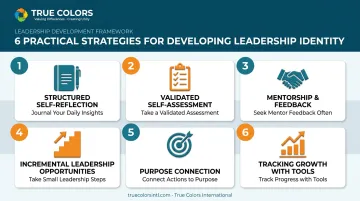
Start with structured self-reflection. Journal on specific past leadership moments: when did you step up without being asked, and what did you care about in that moment? This builds your initial self-definition.
Build self-awareness with a validated assessment. True Colors International's ASI-certified assessment, validated through a 10,000-person study and compliant with the EEOC's 80% fairness guideline, identifies your natural behavioral tendencies across four temperament styles: orange, gold, green, and blue. Knowing your strengths, stressors, and communication style gives you language for how you lead, making the identity feel earned rather than borrowed.
Seek mentorship, coaching, and consistent feedback. Leadership identity isn't built alone. Research on leadership claiming shows that when others accept your attempts to lead, the identity strengthens; when they reject those attempts, it weakens. You need reinforcement from outside yourself, not just internal effort.
Take on incremental leadership opportunities. Lead a small project. Run a single meeting. Chair a committee for one quarter. These low-stakes reps let you "try on" the identity before the pressure of a formal title.
Connect leadership to a purpose you actually care about. Tying leadership aspirations to something meaningful (a mission, a cause, a team you want to protect) improves persistence when the work gets hard. A multi-study investigation covering more than 700 employees found that a clear, relevant "future leader self" predicts more proactive development behavior in the present.
Track growth with structured tools. Use 360-degree feedback, a repeat personality or temperament assessment, or regular coaching check-ins. Making progress visible, instead of relying on a vague feeling of "getting better," is what turns identity development into something measurable.
Common Challenges in Leadership Identity Development
Even people doing everything right hit friction. Three challenges show up again and again.
Imposter syndrome and self-doubt. People with clear leadership behaviors still hesitate to call themselves leaders.
A study of 2,183 US physicians found that holding a leadership role was linked to lower odds of impostor syndrome overall. Female surgeons in leadership positions still reported it at 81.5%, compared to 54.6% of male surgeon leaders. A title alone doesn't resolve the doubt.
The positional bias trap. Many people assume leadership requires formal authority. This mirrors the "Leader Identified" stage in Komives' model (seeing leadership only as a title), which stalls identity growth for anyone without one. Moving past this means recognizing leadership as something you do, not something you're granted.
Missing organizational culture and shared language. Individual effort only goes so far. If a leadership team agrees on a priority like "stronger accountability" but each leader interprets it differently, employees get inconsistent signals and the message fragments.
Organizations that build a shared vocabulary around leadership, with clear expectations and consistent feedback systems, give identity development somewhere solid to grow. Without it, even motivated individuals stall out.
Frequently Asked Questions
What is leadership identity development?
Leadership identity development is the psychological process of internalizing "leader" as part of your self-concept. It differs from simply holding a leadership title or completing a leadership role; true development means genuinely believing that identity applies to you.
What are the 5 C's of leadership?
The 5 C's commonly referenced are Character, Courage, Communication, Commitment, and Competence. They describe leadership traits and behaviors, not a substitute for the deeper identity work behind them.
What are the 4 P's of leadership?
The 4 P's typically cited are Purpose, People, Process, and Performance. They focus on strategic leadership execution: why you lead, who you develop, how you operate, and what results follow.
What are the 3 C's of leadership?
The 3 C's usually referenced are Character, Competence, and Communication, a condensed version that overlaps heavily with the 5 C's framework above.
How long does it take to develop a leadership identity?
There's no fixed timeline. It's a continuous, non-linear process that spans career phases, complete with expected dips during transitions before it strengthens again.
Can leadership identity be measured?
Yes. Validated self-report measures track self-definition, ownership of responsibility, and leadership beyond formal positionality. These tools let individuals and organizations monitor identity growth over time instead of guessing.