Many leaders chase quarterly targets while ignoring the cracks forming underneath: miscommunication between departments, quiet disengagement, unresolved conflict that festers instead of getting resolved, and turnover that drains institutional knowledge. These aren't personality problems. They're cohesion problems.
Here's what's ahead: what team cohesion actually means (and how it differs from team building), why it matters to your results, nine actionable steps to build it, the factors that determine whether those steps stick, and the mistakes that undo progress fastest.
Key Takeaways
- Team cohesion is the emotional bond and commitment uniting a team beyond a shared Zoom link or office
- Building it requires nine deliberate steps, from establishing trust to leading by example
- Understanding personality and communication styles through validated assessments builds trust faster and reduces friction
- The biggest mistake: treating cohesion as a one-time event instead of an ongoing practice
What Is Team Cohesion (and Why It Matters)
What Is Team Cohesion?
Team cohesion is the degree to which team members feel bonded to one another, trust each other's intentions, and work consistently toward shared goals. It's a feeling and a behavior pattern, not a program.
A cohesive team produces three specific outcomes:
- Psychological safety: people speak up without fear
- Mutual accountability: no one lets teammates carry the load alone
- Consistent collective performance: results hold up over time, not just during a good quarter
Two terms get used interchangeably, but they mean different things. Team building refers to specific activities and tactics, like a workshop or an off-site. Team cohesion is the ongoing state those activities are meant to produce. You can run a great team-building event and still have a fractured team six weeks later if nothing reinforces it.
Why Team Cohesion Matters in the Workplace
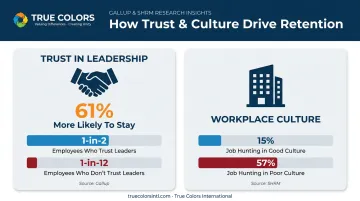
Trust between employees and leaders isn't a soft metric. Gallup surveyed over 16,000 U.S. workers and found that employees who trust their organizational leaders are 61% more likely to stay with the company and stop looking elsewhere. In that same study, one in two employees who trusted leadership were engaged, compared with one in twelve who didn't.
Without cohesion, the pattern is predictable:
- Departments operate in silos and duplicate work
- Miscommunication repeats itself in the same meetings, week after week
- Morale drops, and top performers start updating their resumes
- Turnover costs climb, often quietly, until someone runs the numbers
Culture perception directly shapes retention decisions. SHRM's global survey of over 17,000 employees found that only 15% of workers in a good or excellent culture were actively job hunting, versus 57% in a poor or terrible one.
Cohesion doesn't happen automatically because a team shares a Slack channel. It requires an intentional, shared communication framework, which is exactly what the next section walks through.
9 Steps to Build a Stronger, More Cohesive Team
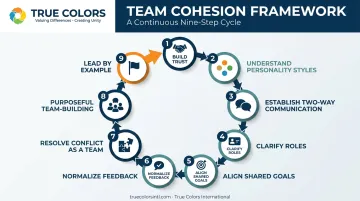
These nine steps work best in sequence, but don't treat them as a checklist you complete once. Cohesion is a loop, not a finish line.
Step 1: Build Trust as the Foundation
Trust has to come before everything else. Without it, feedback feels like criticism, and shared goals feel like corporate speak.
- Be transparent about decisions, even the unpopular ones
- Follow through consistently on commitments, no matter how small
- Never hide problems from the team. Concealed information erodes trust faster than almost any other leadership behavior
Step 2: Understand Individual Personality and Communication Styles
Teams made up of different temperaments often clash simply because they lack a shared language to describe their differences. An analytical thinker and a relationship-first collaborator aren't wrong. They're just wired differently.
This is where personality-based frameworks earn their keep. True Colors International's methodology sorts communication styles into four color types — Orange, Gold, Green, and Blue — giving teams a common vocabulary instead of vague labels like "difficult" or "too intense."
Organizations that adopt this shared language consistently report faster conflict resolution and less friction between differing work styles. Once teams share that vocabulary, differences become something to navigate, not something to blame.
Step 3: Establish Open, Two-Way Communication
Structured touchpoints keep information flowing before small misunderstandings snowball. Daily stand-ups and weekly check-ins work because they're predictable, not because they're fancy.
Communication has to move both directions:
- Leaders share updates, context, and reasoning behind decisions
- Team members raise concerns and ideas, and leaders actually listen
- Feedback loops close quickly instead of disappearing into a void
Step 4: Clarify Roles, Responsibilities, and Expectations
Overlap and confusion kill cohesion quietly. A documented responsibility framework, similar to a RACI-style matrix, removes the guesswork over who owns what.
Beyond assigning tasks, connect each role back to the bigger picture. When someone understands how their work supports the team's goal and the company's goal, friction over "whose job is this" drops sharply.
Step 5: Align the Team Around Shared Goals and Purpose
A clearly communicated, shared vision unifies effort. Without it, team members quietly compete over priorities instead of pulling in the same direction.
Purpose isn't a nice-to-have. McKinsey found that employees who feel they're living their purpose at work are 6 times more likely to want to stay with the company and 1.5 times more likely to go above and beyond for its success. Tie the team's daily work back to why it matters, not just what's due Friday.
Step 6: Normalize Constructive Feedback in Both Directions
A healthy feedback culture flows up as well as down. Leaders who ask for feedback and act on it build far more trust than leaders who only hand it out.
- Ask team members directly what's working and what isn't
- Implement feasible suggestions quickly and visibly
- Explain transparently when a suggestion can't be implemented, rather than letting it disappear silently
Step 7: Resolve Conflict as a Team, Not as Individuals
Disagreement isn't automatically a red flag. Task conflict can actually improve performance when psychological safety is high, but conflict that turns personal consistently hurts both performance and satisfaction. The distinction matters.
- Reframe conflict as a normal part of solving hard problems together
- Stay focused on the issue, not the person
- Address disagreements early, before they calcify into resentment
Step 8: Invest in Purposeful Team-Building Experiences
Team building only works when it's tied to a specific goal, like trust, cross-functional understanding, or communication, rather than entertainment for its own sake.
Examples worth considering:
- Off-site retreats built around real problem-solving, not just games
- Cross-departmental shadowing so people understand each other's daily pressures
- Structured exercises tied to actual work challenges the team is facing right now
Step 9: Lead by Example
Team behavior mirrors leadership behavior. If a leader admits mistakes, participates in hard discussions, and follows through on commitments, the team learns that's the standard.
This step loops back to Step 1. Consistent leadership action is what keeps the trust cycle alive, and it's the thread that holds the other eight steps together over the long run.
Key Factors That Influence Team Cohesion Success
Not every team builds cohesion at the same pace. A few structural factors shift the timeline:
- Team size and structure: Smaller, cross-functional teams (3-8 members) build cohesion faster than large, dispersed groups of 9 or more
- Leadership consistency: Cohesion weakens quickly if leaders stop reinforcing trust-building behaviors after the initial push
- Organizational culture alignment: A team can't sustain cohesion long-term if it conflicts with the broader company culture or contradicts existing policies
- Diversity of personality and work styles: This can strengthen or strain a team, depending on whether members have tools, like a shared color framework, to understand each other's differences
Common Mistakes to Avoid When Building Team Cohesion
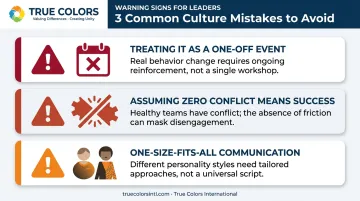
Even well-intentioned leaders undercut their own progress. Watch for these patterns:
- Treating team-building as a one-off event: A single retreat or workshop feels productive, but without follow-through, its effect fades within weeks
- Assuming cohesion means zero conflict: Healthy, respectful disagreement is a sign of trust, not its absence. Teams that never disagree are often avoiding hard conversations, not having them
- Applying a one-size-fits-all communication approach: Ignoring individual personality differences doesn't make them go away. The same misunderstandings just keep resurfacing in new situations
Conclusion
Team cohesion gets built deliberately, one step at a time. It's not something left to chance or the hope that personalities will simply click.
Sustaining it means staying committed to trust, communication, role clarity, and leadership modeling long after the initial push fades.
Organizations looking to accelerate that process often turn to proven, research-backed systems. True Colors International has spent more than 45 years helping teams build a shared communication language that outlasts any single workshop, so employees keep speaking the same language long after training ends.
Frequently Asked Questions
What does it mean to build team cohesion?
It means intentionally developing trust, communication, and shared purpose so a team functions as a unified group rather than a collection of isolated individuals. Teams build this deliberately through consistent practice, regardless of their personality mix.
What are the key elements of team cohesion?
The core elements are trust, open communication, shared goals, role clarity, and mutual respect. Remove any one of these, and the others tend to weaken over time too.
How do you improve team cohesion?
Apply consistent practices: build trust first, establish communication routines, clarify roles, normalize feedback, and have leaders model the behavior they expect. The nine-step framework above covers this in sequence.
How long does it take to build a cohesive team?
Cohesion develops gradually over months of consistent practice, not through a single event. Team size, dispersion, and leadership involvement all affect the pace, and there's no universal timeline that fits every team.
What's the difference between team building and team cohesion?
Team building refers to specific activities or tactics, like a workshop or retreat. Team cohesion is the ongoing state or quality those activities are designed to help create, and it requires continual reinforcement beyond the event itself.
Can remote or hybrid teams achieve strong team cohesion?
Yes, but it takes more deliberate effort. Remote teams need structured communication routines and intentional relationship-building since informal hallway conversations don't happen on their own, and leaders who foster a strong shared identity can help offset the distance.