Many hiring managers still default to outgoing, "Type A" personalities when spotting leadership potential. That habit overlooks quieter employees who lead just as effectively, sometimes better, depending on the team.
This guide breaks down the personality types most often linked to leadership, explains why almost any type can lead well, and introduces a simpler framework organizations use to identify and grow leaders at scale.
Key Takeaways
- No single personality type owns leadership traits like vision, decisiveness, and empathy
- ENTJ, ENFJ, INTJ, and ISFJ each bring distinct leadership strengths and blind spots
- Four-temperament frameworks like True Colors simplify leadership identification versus complex 16-type models
- Nearly any personality type can develop strong leadership skills through coaching and self-awareness
What Makes a Personality "Leadership-Ready"?
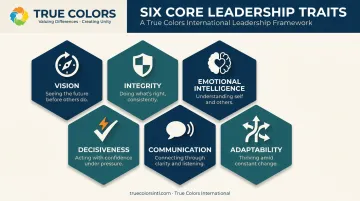
Recruiters and psychologists generally assess the same handful of traits when evaluating leadership potential:
- Vision: the ability to set direction and communicate it clearly
- Integrity: consistency between words and actions
- Emotional intelligence: reading and responding to others' emotions
- Decisiveness: making calls quickly, even with incomplete information
- Communication: translating ideas into action across a team
- Adaptability: adjusting style based on the situation
Decisiveness in particular carries weight at the executive level. A Harvard Business Review analysis of 17,000 executive assessments, including 2,000 CEOs, found decisive leaders were 12 times more likely to be high-performing.
Most organizations study these traits through two lenses: MBTI's 16-type model or simpler four-quadrant temperament models, such as Business Chemistry, DISC, or True Colors. The 16-type model offers nuance. The four-quadrant approach offers speed, which is why many companies lean on it for practical hiring and development decisions.
Next, let's look at the personality types most frequently associated with strong leadership, and what each one tends to get right and wrong.
Top Personality Types Best Suited for Leadership
This is a snapshot of how decisiveness, empathy, vision, and structure show up differently depending on personality wiring, since research supports multiple paths to effective leadership rather than just one.
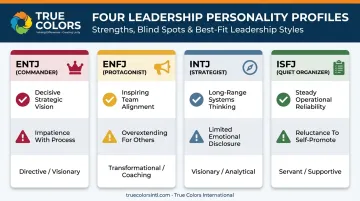
ENTJ — The Commander
ENTJs are frank, decisive, and quick to step into leadership roles. The official MBTI description notes they readily detect inefficient policies and enjoy building comprehensive systems for long-term goals. That combination is why ENTJ gets labeled the "natural leader" in so much MBTI literature.
What sets them apart: comfort with confrontation, fast decision-making, and a relentless focus on results. This makes ENTJs a strong fit for turnaround situations or high-stakes environments where hesitation costs money.
| Leadership Strengths | Growth Areas / Blind Spots | Best-Fit Leadership Style |
|---|---|---|
| Strategic thinking, confidence, efficient decision-making | Can overlook team emotions, may present ideas forcefully | Directive leadership in fast-paced, goal-driven environments |
ENFJ — The Protagonist
ENFJs lead with people first. They're warm and empathetic, with an unusual attunement to what motivates each team member. That emotional intelligence translates directly into their ability to rally a team through change.
During a crisis or reorg, ENFJs often outperform more directive types simply because people trust them. They build consensus instead of forcing it.
| Leadership Strengths | Growth Areas / Blind Spots | Best-Fit Leadership Style |
|---|---|---|
| Inspires teams, high EQ, strong communicator | Highly responsive to praise and criticism; can overextend emotionally | Transformational leadership in culture-driven, people-centric organizations |
INTJ — The Strategist
INTJs lead through vision, not volume. They think in long-range patterns, spot inefficiencies others miss, and follow through once they've committed to a plan. Introversion doesn't slow them down here; it fuels the depth of their thinking.
This makes INTJs particularly well-suited to leading complex, innovation-heavy initiatives: R&D, technology overhauls, product strategy. They don't need a crowd to be effective. They need a problem worth solving.
| Leadership Strengths | Growth Areas / Blind Spots | Best-Fit Leadership Style |
|---|---|---|
| Big-picture vision, rational decision-making, independence | High personal standards and skepticism can read as distant | Visionary leadership in R&D, tech, or transformation projects |
ISFJ — The Quiet Organizer
Here's where the "extroverts make the best leaders" assumption falls apart. ISFJs are quiet and thorough, with a consistency that builds extraordinarily loyal teams over time.
They lead through reliability. Employees know exactly what to expect, and that predictability builds trust faster than charisma ever could. ISFJs tend to thrive in operations-heavy or people-support roles, where steady follow-through matters more than bold pronouncements.
| Leadership Strengths | Growth Areas / Blind Spots | Best-Fit Leadership Style |
|---|---|---|
| Reliability, empathy, meticulous follow-through | Detail focus can crowd out big-picture strategic thinking | Supportive leadership in healthcare, education, or operations settings |
MBTI offers one lens for these patterns, but it's not the only one. True Colors International's four-color framework (Orange, Gold, Green, and Blue) maps the same core leadership behaviors using plain-language terms that teams can apply in minutes rather than months of study.
How to Identify and Develop Leadership Potential in Any Personality Type
The most common mistake organizations make? Treating leadership potential as fixed by personality type, instead of something built through self-awareness and coaching.
Type alone predicts almost nothing. What actually predicts leadership success:
- Self-awareness: leaders who understand their own patterns adjust faster, which directly improves retention
- Adaptability: flexing style to fit the situation, not forcing one approach on every team
- Communication skill: clarity reduces friction and rework across teams
- Conflict-navigation ability: how a leader handles disagreement often predicts team performance more than their "type" ever could
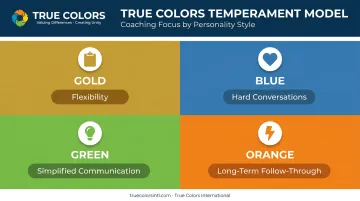
This is where simpler frameworks earn their keep. True Colors International's four-temperament model (Gold, Blue, Green, and Orange) gives organizations a faster way to spot natural leadership tendencies across a whole workforce, without wading through 16 separate profiles.
The assessment itself carries real weight: it's ASI-certified and exceeds the EEOC 80% Guideline for reliability and fairness, backed by a validation study of 10,000 participants. That makes it a defensible tool for leadership hiring and succession planning, not just a fun team-building exercise.
Just as important: True Colors' leadership and emotional intelligence training doesn't only serve the naturally outgoing. Every temperament gets targeted coaching on the specific skills it's missing most:
- Gold leaders learn to loosen rigid processes and build more flexibility into their management style
- Blue leaders learn to hold harder conversations instead of avoiding conflict to preserve harmony
- Green leaders learn to communicate vision and strategy in simpler, less technical terms
- Orange leaders learn to slow down and follow through on long-term plans
Organizations across Fortune 500 companies, healthcare systems, and government agencies use this approach to build leadership pipelines that reflect a range of personality strengths, not one single mold.
Conclusion
Leadership success depends far less on matching a single "ideal" personality type than on self-awareness, communication, and the willingness to develop weaker traits. ENTJ, ENFJ, INTJ, and ISFJ all bring something real to the table—and so does nearly every other type, given the right development path.
That range is exactly why leadership potential should be evaluated holistically. Combine personality insight with actual performance data and coaching, rather than typecasting employees based on a four-letter code.
If you're ready to build a leadership pipeline that reflects your team's real strengths, explore True Colors International's leadership development and assessment programs. Start with the foundational Personal Awareness and Success Training, or choose one of five Advanced Certification tracks.
Frequently Asked Questions
What personality type is best for leadership?
No single type "wins." ENTJ, ENFJ, INTJ, and similarly decisive or empathetic types get cited often, but leadership depends more on developed skills than fixed personality.
Can introverts be effective leaders?
Yes. INTJ and ISFJ often excel through deep listening, strategic thinking, and trust-building. According to Harvard Business School research, introverted leaders even outperform when managing proactive teams.
Is ENTJ the best personality type for leadership?
ENTJs are strong in decisiveness and vision but can struggle with empathy and team morale. "Best" depends on the situation and what your team actually needs.
Which personality type struggles most with leadership roles?
Types highly averse to conflict or rigid structure, like some INFPs or ISFPs, may find traditional leadership roles harder. With the right support and role fit, they can still succeed.
How is the True Colors assessment different from MBTI for leadership development?
True Colors uses four simplified temperaments instead of 16 types, making it faster to apply in hiring, coaching, and team-building, while remaining ASI-certified for validity.
Can any personality type learn to become a good leader?
Yes. Leadership is a skill set—built through communication, self-awareness, and adaptability—that can be coached and developed regardless of natural personality tendencies.