Many leaders are promoted because they're the best coder, the top salesperson, or the sharpest strategist in the room. Then they struggle. Difficult conversations get avoided. Conflict festers. Teams stop trusting them, not because they lack expertise, but because they never developed the emotional skills leadership actually requires.
This guide breaks down what emotional intelligence really means for leaders, why it matters more than most people realize, and how you can start building it, whether you're a first-time manager or a seasoned executive.
Key Takeaways
- Technical skill gets leaders in the door, but emotional intelligence determines who thrives.
- 71% of employers value emotional intelligence over IQ when evaluating talent
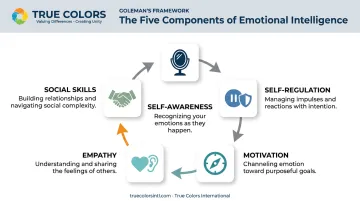
- Goleman's five-part framework (self-awareness, self-regulation, motivation, empathy, and social skills) remains the industry standard for EQ
- Emotional intelligence is a learnable skill, not a fixed trait
- Leadership rank alone doesn't guarantee EQ; deliberate development is required
What Is Emotional Intelligence in Leadership?
Emotional intelligence, or EQ, was first defined in a 1990 academic paper by researchers Peter Salovey and John Mayer. They described it as the ability to appraise and express emotion in yourself and others, regulate that emotion, and use it to guide thinking and action.
Psychologist Daniel Goleman took that research and ran with it. His books, starting with Emotional Intelligence in 1995, brought the concept into mainstream business conversation and connected it directly to leadership performance.
EQ vs. IQ: What Actually Separates Effective Leaders
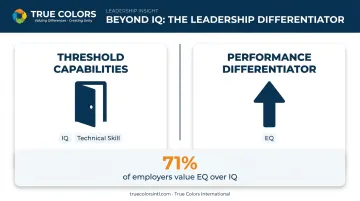
In his widely referenced Harvard Business Review piece, "What Makes a Leader?", Goleman analyzed competency models from 188 large global companies. He found something striking: IQ and technical skill matter, but only as "threshold capabilities."
In other words, they get you in the door. They don't make you an effective leader once you're inside.
What separated truly high-performing leaders in Goleman's analysis was emotional intelligence, broken into five components covered later in this guide. This isn't a fringe theory anymore. Employers have caught on.
According to a CareerBuilder survey of 2,662 U.S. hiring managers and HR professionals, 71% valued emotional intelligence over IQ when assessing candidates.
That's not a niche preference. That's the majority of hiring decision-makers telling you EQ matters more than raw brainpower.
Why Emotional Intelligence Matters for Leaders
Workplace expectations have shifted. Employees today don't just want direction from their manager, they want connection, psychological safety, and someone who notices when something's off. Leaders who can't provide that struggle to retain talent, regardless of how strategically sharp they are.
The Emotional Contagion Effect
Here's something most leaders underestimate: your mood is contagious. Literally.
Research on group dynamics shows that a leader's emotional state spreads to the people around them. A stressed, reactive leader creates a stressed, reactive team. A calm, engaged leader tends to produce more cooperative behavior and higher perceived performance within the group.
Genuine emotional regulation, not forced positivity, ripples outward every single day, shaping how your team feels and performs.
The Business Cost of Poor Management
Low-EQ leadership carries a real price tag. According to DDI's Frontline Leader Project, 57% of employees have left a job because of their manager, and 14% have left more than one job for that reason. Work-related stress, often driven by poor management dynamics, also pushes employees toward reduced productivity and thoughts of quitting.
Meanwhile, research connecting emotional intelligence to leadership effectiveness shows a real, if variable, relationship. Coworker ratings of transformational leadership correlate meaningfully with trait-based emotional intelligence measures. The takeaway: how leaders manage themselves and their relationships shows up directly in performance data.
Despite the evidence, EQ remains underdeveloped at the organizational level. A 2019 survey found that fewer than 20% of companies report having genuinely instilled emotional intelligence into their corporate culture. Most organizations know EQ matters. Few have actually built it into how they operate.
The 5 Components of Emotional Intelligence in Leadership
Goleman's five-part framework remains the most widely referenced model for leadership EQ. Each component builds on the last, moving from internal awareness to external relationship management.
Self-Awareness
Self-awareness means recognizing your own emotions, triggers, and how they affect the people around you. It's the foundation everything else is built on. You can't regulate what you don't notice.
Here's the uncomfortable part: most people think they have this figured out. They don't. Organizational psychologist Tasha Eurich's research found that 95% of people believe they're self-aware, yet only 10-15% actually meet the criteria. That gap between perception and reality is exactly what trips up leaders who assume their self-awareness is already solid.
Self-Regulation
Self-regulation is your ability to manage impulses and emotions under pressure, rather than letting them manage you. Leaders who master this create calmer, more predictable team environments.
This doesn't mean suppressing emotion. It means pausing before reacting, especially in high-stakes moments like a missed deadline or a heated disagreement. A leader who takes a beat before responding to an angry client email, instead of firing back immediately, is practicing this skill in real time.
Motivation
Internal motivation is the drive that keeps leaders resilient when things get hard. This drive comes from purpose, not from chasing bonuses or titles, and it holds steady even when the work is tedious or the outcome is uncertain.
Leaders with strong internal motivation model discipline for their teams without needing to say a word about it.
Empathy
Empathy means genuinely understanding what your team members are feeling and why. DDI has called empathy the number-one leadership skill, defining it as the ability to listen for both facts and feelings, not just one or the other.
Leaders who skip this step often make technically sound decisions that land badly, because they never accounted for the human reaction to them.
Social Skills
Social skills tie the other four components together. This is the ability to build rapport, communicate a vision clearly, and resolve conflict without letting it fester.
A leader can be self-aware, regulated, motivated, and empathetic, and still fail if they can't translate that into actual relationship management. Social skill is where EQ becomes visible in daily leadership behavior. A leader who notices tension in a meeting and adjusts their tone accordingly, rather than plowing ahead with the agenda, is applying social skill.
How to Develop and Strengthen Your Emotional Intelligence as a Leader
EQ is a set of skills you build the same way you'd build any other leadership competency: through assessment, practice, and feedback.
Start With a Self-Assessment
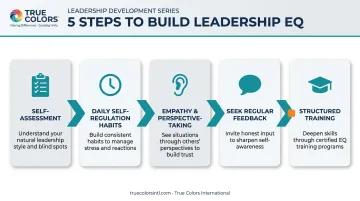
You can't improve what you can't see. That's why the first step is usually a validated self-assessment or 360-degree feedback process that surfaces blind spots.
Personality and temperament-based tools can be especially useful here. True Colors International, for example, uses a color spectrum methodology built around four personality types: Orange, Gold, Green, and Blue. The framework helps leaders understand their own communication style before they try to change how they lead others.
Each leader receives an individualized report mapping their communication preferences, natural strengths, and stress responses. That gives them a concrete starting point for self-awareness work, rather than a vague sense of "I should probably work on this."
Build Daily Self-Regulation Habits
Self-regulation strengthens through repetition, not willpower alone. Try:
- Pausing before reacting: even five seconds changes the tone of a response
- Journaling — tracking emotional triggers helps you spot patterns over weeks, not just in the moment
- Stress-management techniques: breathing exercises, short walks, or brief resets between meetings
Practice Empathy and Perspective-Taking
Active listening takes deliberate effort:
- Listen without planning your response while the other person is still talking
- Reflect back what you heard before offering your own opinion
- Ask what you might be missing, especially in disagreements
Seek Regular Feedback
Ask peers and direct reports for honest input, then look for patterns across responses rather than reacting to any single comment. One critique might be noise. The same critique from three different people is signal.
Invest in Structured Training
Individual effort helps, but structured, facilitator-led programs accelerate EQ growth across an entire leadership team, not just one person. True Colors International's network of certified facilitators delivers exactly this kind of team-wide development.
Facilitators pair the color spectrum framework with advanced training tracks in communication, conflict navigation, and team building. This gives leaders a shared language for emotional intelligence, rather than working in isolation.
Common Myths and Warning Signs of Low EQ in Leadership
Are Leaders Naturally Emotionally Intelligent?
No. Authority and EQ are not the same thing. Plenty of people rise into leadership positions through technical merit, tenure, or seniority, without ever developing the emotional skills the role demands. A title doesn't install self-awareness.
Red Flags to Watch For
Low-EQ leadership tends to show up in predictable patterns:
- Avoiding difficult conversations until problems become unavoidable
- Reacting impulsively in meetings or under deadline pressure
- Failing to notice burnout building on the team
- Applying the same leadership style to everyone, regardless of what they actually need
EQ Is a Skill, Not a Fixed Trait
Here's the good news: emotional intelligence isn't hardwired. A meta-analysis covering nearly 2,000 adults across 24 studies found that EQ training produced a moderate, measurable improvement, and that improvement held up months later at follow-up. It works like a muscle. Feedback, practice, and intentional habits build it over time.
Frequently Asked Questions
Are leaders emotionally intelligent?
Not automatically. Position and authority don't guarantee EQ. Research shows a real gap between leadership rank and genuine emotional intelligence, which is why deliberate development matters at every level.
What are the 5 components of emotional intelligence in leadership?
Daniel Goleman's framework includes self-awareness, self-regulation, motivation, empathy, and social skills. Each builds on the others, moving from internal awareness to external relationship management.
What are the 7 qualities of a leader?
Commonly cited qualities include integrity, self-awareness, communication, empathy, decisiveness, accountability, and adaptability. Several of these overlap directly with emotional intelligence competencies.
Can emotional intelligence be learned or developed?
Yes. EQ is a dynamic, learnable skill, not a fixed trait. It develops through structured feedback, coaching, and consistent practice over time.
How is emotional intelligence different from IQ in leadership?
IQ reflects cognitive and technical ability, the kind of thinking that gets you hired. EQ governs self-management and relationship skills, and it more strongly predicts leadership effectiveness once you're in the role.
How can I assess or measure a leader's emotional intelligence?
Options include validated EQ assessments, 360-degree feedback from peers and direct reports, and temperament-based tools like True Colors International's ASI-certified assessment, which reveal communication and behavioral patterns tied to EQ.