Introduction
Walk into any struggling school, and you'll usually find the same root cause: weak leadership at the top. Walk into a thriving one, and a strong principal is almost always behind it.
Research backs this up. Leadership accounts for about one-quarter of a school's total effect on student achievement, according to a Wallace Foundation-commissioned synthesis of decades of research. That's second only to teaching quality itself.
Yet principals are expected to be instructional experts, data analysts, culture-builders, and crisis managers, often without formal training in most of these areas. Many step into the role having mastered a classroom, not a district-wide balancing act.
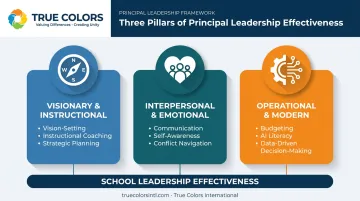
This guide breaks down the essential skills principals need into three categories: visionary/instructional, interpersonal/emotional, and operational/modern, plus how to build each one over a career.
Key Takeaways
- A principal's effectiveness is the second biggest factor in student success, after teacher quality.
- The best principals combine instructional leadership with high emotional intelligence.
- Strong communication and self-awareness are foundational to all other leadership skills.
- Modern principals must master DEI, AI literacy, and crisis management as core competencies.
- Continuous learning through coaching and training is essential for career-long improvement.
Why Leadership Skills Define a Principal's True Impact
Numbers tell the story better than platitudes here. A synthesis of 219 studies found that a one standard deviation increase in principal effectiveness raises achievement by 0.13 SD in math and 0.09 SD in reading — meaningful gains at scale.
Replacing a principal at the 25th percentile of effectiveness with one at the 75th percentile produced achievement gains of 0.18 SD in math and 0.12 SD in reading per year.
None of this happens by accident. The Wallace Foundation's research identifies five core practices that separate effective principals from the rest:
| Practice | What It Looks Like |
|---|---|
| Shaping a vision | Setting clear, nonnegotiable academic goals for every student |
| Creating a hospitable climate | Building a school culture people want to work and learn in |
| Cultivating leadership in others | Sharing decision-making instead of hoarding it |
| Improving instruction | Coaching teachers toward better classroom practice |
| Managing people and data | Using resources and information to drive improvement |
Here's the part that should keep every superintendent's attention: there are virtually no documented cases of a troubled school turning around without a strong leader driving that change. Curriculum changes help. New programs help. But without leadership skill behind them, they rarely stick.
That's the foundation for everything below. Principal leadership skills generally sort into three buckets: visionary and instructional, interpersonal and emotional, and operational and modern. Each type plays a distinct role in whether a school thrives or stalls.
Instructional & Visionary Leadership Skills
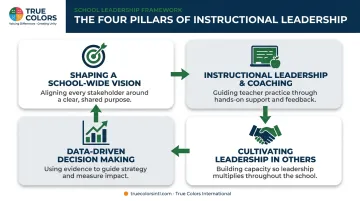
Shaping a School-Wide Vision
Effective principals don't just write a vision statement and hang it in the lobby. They translate it into daily decisions.
A nonnegotiable standard of high expectations for every student should show up in:
- Building the master schedule around student needs
- Addressing behaviors immediately instead of letting them slide
- Allocating resources across grade levels and programs
- Celebrating specific wins in staff meetings
Teachers buy into a vision when they see it reflected in real decisions, not when it stays a poster on the wall.
Instructional Leadership & Teacher Coaching
Principals can't coach what they don't understand. Effective instructional leaders know what strong teaching looks like in the classroom, and they use that knowledge to give teachers frequent, specific feedback rather than generic praise.
The payoff is substantial. Moving from a 25th-percentile to a 75th-percentile principal was associated with an estimated 2.9 additional months of math learning and 2.7 months of reading learning per year at the elementary level.
Classroom observation paired with real, actionable coaching conversations drives far more improvement than a quick walkthrough with a checklist.
Data-Driven Decision Making
Test scores, attendance patterns, discipline referrals, and program participation rates all tell a story, if a principal knows how to read them.
Strong principals use data to:
- Identify which student groups are falling behind and why
- Evaluate whether an intervention program is actually working
- Adjust staffing and scheduling based on measurable need
- Justify budget decisions to district leadership and school boards
Data without action is just a report nobody reads.
Cultivating Leadership in Others
Here's a finding that surprises a lot of new principals: schools don't need one all-powerful leader to succeed. In fact, they often perform better when leadership gets shared.
One study of 90 schools found collective leadership correlated with student achievement at r = 0.34, with a path model explaining 20% of the variation in outcomes. A separate four-year longitudinal study of 195 elementary schools found that growth in distributed instructional leadership directly strengthened schools' academic capacity over time.
The evidence isn't unanimous. Other studies found no significant relationship, which means distributing leadership isn't a magic fix on its own. But the overall pattern is clear: this isn't a zero-sum game. Empowering teacher leaders expands a school's capacity without diminishing the principal's authority.
Interpersonal & Emotional Intelligence Skills
Communication and Relationship-Building
Every principal is a communicator first, whether they signed up for that or not. Staff meetings, parent emails, hallway conversations, crisis announcements. It's a constant stream, and how it's handled determines whether people trust what comes next.
Clear, consistent communication across speaking, writing, and listening is the tool principals use most to align staff, students, and families around shared goals. Miss this, and even a great vision falls flat.
That same skill extends into relationship-building. Principals sit at the center of a web that includes students, teachers, support staff, parents, and community partners, making them the school's lead relationship builder whether the job description says so or not.
Social awareness matters here just as much as strategic planning. A principal who reads a room well, picks up on a struggling teacher's body language, or notices a parent's frustration before it escalates, builds trust daily in ways that never show up on a resume.
Conflict Resolution and Self-Awareness
Conflict is inevitable in any building with hundreds of people and competing priorities. What separates strong principals is how they handle it.
Active listening and creative problem-solving allow principals to resolve disputes between staff, students, and parents in ways that leave everyone feeling heard, not just managed. This ability can be practiced and sharpened over time.
Handling conflict well starts with understanding yourself. Self-awareness has become one of the most cited, and most overlooked, foundations of effective leadership. Principals who understand their own communication style and temperament make better decisions under pressure and recognize how their default reactions land on people who process things differently.
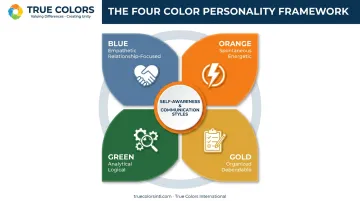
This is where personality-based tools can help. True Colors International uses a four-color framework (Orange, Gold, Green, and Blue) to help leaders identify their own personality strengths, stressors, and communication tendencies, then adapt their approach for different staff members.
The methodology's staying power in education comes in part from Dr. Bill Behrens, President of True Colors International, who spent 33 years as a teacher, principal, and district administrator before moving into organizational development.
That background matters — the framework wasn't built in a lab and handed to schools. It was shaped by someone who ran a building.
Capacity to Delegate
Self-awareness also shapes how principals delegate. Trying to control everything personally creates a bottleneck, not effective leadership.
Mature principals recognize:
- Which tasks genuinely require their direct involvement
- Which staff members have strengths suited to specific responsibilities
- When holding onto a task signals distrust rather than diligence
- How delegation builds leadership capacity in others, not just relieves their own workload
Operational & Modern-Day Leadership Competencies
Every principal needs baseline operational competence: budgeting, resource allocation, and compliance with state and federal education regulations. These skills don't make headlines, but a principal who mismanages a budget or misses a compliance deadline undermines everything else they're trying to build.
Beyond the basics, two areas now demand serious attention.
DEI leadership has moved from optional to expected. This means creating inclusive policies, ensuring equitable access to quality instruction across student populations, and practicing critical self-reflection about how bias shows up in daily decisions.
Principals of color are especially likely to have positive effects on students and teachers of color, which makes equitable hiring and retention its own leadership priority.
Ed-tech and AI literacy, along with crisis management, round out the modern skill set:
- 60% of principals report using AI for administrative tasks, but only 18% say their school or district has provided guidance on using it, according to EdWeek Research Center findings
- 70% of school leaders reported being physically or verbally threatened or attacked during a recent school year. Crisis readiness can't be an afterthought
- More than 90% of public schools now maintain written emergency procedures covering everything from natural disasters to active threats
Principals who ignore these areas leave their staff and students exposed to unnecessary risk.
How to Develop and Strengthen These Skills as a Principal
The Traditional Path
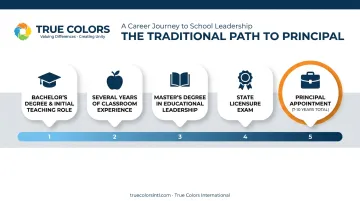
Most principals still follow a fairly standard route: a master's degree in educational leadership or administration, state licensure, and several years of classroom teaching experience first.
The specifics vary by state. Texas requires at least two years of classroom teaching plus an approved preparation program. California requires five years of qualifying experience under its Administrative Services Credential. Check your state's specific requirements before assuming a national standard applies.
Most candidates spend seven to ten years moving from first teaching assignment to principal appointment. Many states also require passing a school leadership licensure exam before districts will consider a candidate for the role.
Mentorship, Coaching, and Practicum Experience
Formal education only goes so far. Real leadership judgment gets built through practice, with support.
- Only 46% of principals nationally report having an internship that let them take on real leadership responsibility
- Principals in high-poverty schools are less than half as likely as those in low-poverty schools to have access to an on-the-job mentor
- Districts using structured principal pipelines saw new principals outperform comparison schools by 6.22 percentile points in reading and 2.87 percentile points in math after three years
Mentorship delivers a measurable advantage, though access to it remains unevenly distributed.
Ongoing Professional Development
Leadership skills don't stay sharp on their own. They require continued investment, especially the interpersonal and self-awareness skills covered earlier in this guide.
This is where certified training programs fill a gap that a single graduate degree can't. True Colors International's SHRM and HRCI-approved training helps working principals strengthen communication, emotional intelligence, and self-awareness without pausing a career to go back to school.
For a principal juggling budgets, staff conflicts, and instructional coaching in the same week, that kind of accessible, ongoing development often matters more than another credential on a wall.
Frequently Asked Questions
What are the qualities of a good principal leader?
Strong principals combine instructional expertise, clear communication, empathy, and self-awareness. They also know how to distribute leadership across their staff rather than holding all decision-making themselves.
What is the most important skill for a school principal to have?
Research consistently points to instructional leadership paired with strong communication as the combination most tied to student outcomes. Neither works well without the other.
How can school leaders develop stronger interpersonal skills?
Practice active listening, regularly seek feedback from staff, and use personality or temperament-based tools, such as the True Colors framework, to better understand your own communication style and how it lands on others.
What qualifications are needed to become a school principal?
Requirements vary by state but typically include a state-issued administrative license, a master's degree in educational leadership, and several years of demonstrated teaching and leadership experience.
How does emotional intelligence impact school leadership?
Emotionally intelligent principals build more trust, resolve conflict more effectively, and create school cultures where staff and students feel safe and motivated to do their best work.
Can personality assessments help principals become better leaders?
Yes. Personality-based assessments, such as True Colors, help principals recognize their own leadership tendencies and communication style, making it easier to adapt their approach for different staff members, students, and high-pressure situations.