Introduction
A nurse discharges an elderly patient with instructions to "take this twice daily with food." The patient nods, smiles, and goes home.
Three days later, she's readmitted with a dangerous drug interaction. She never fully understood the instructions. She was too embarrassed to ask.
This scenario plays out in hospitals every day. Communication is the invisible infrastructure of healthcare. When it breaks, everything downstream breaks with it.
Patient safety, HCAHPS scores, malpractice exposure, staff burnout. All of it traces back to how well people talk to (and listen to) each other. Hospitals and clinics are under mounting pressure to fix this, not just for compliance, but for survival.
This article breaks down the most common communication barriers in healthcare, what they actually cost organizations, and practical strategies, including personality-based training, that help teams close the gaps.
TL;DR
- Communication breakdowns drive medical errors, malpractice claims, and preventable patient harm across U.S. healthcare.
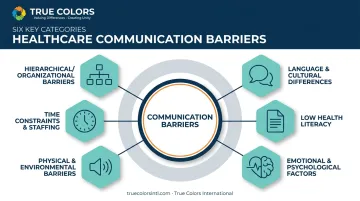
- Barriers span language and cultural gaps, health literacy, emotional factors, physical environments, staffing pressure, and organizational hierarchy.
- The cost is measurable: readmissions, turnover, and legal exposure all rise when communication fails.
- Fixing it takes training, technology, structured protocols, and a shared organizational language.
- Personality-based training helps clinical teams collaborate better across roles, shifts, and leadership levels.
Understanding Communication Barriers in Healthcare
A communication barrier in healthcare is any factor (human, environmental, or organizational) that blocks clear, accurate, timely information exchange between patients, providers, and care teams.
These barriers show up at three levels:
- Patient-provider: during exam room conversations, discharge instructions, or informed consent
- Provider-provider: during shift handoffs, referrals, and interdisciplinary rounds
- Organizational: across departments, facilities, and leadership tiers
Healthcare carries higher stakes than most industries. A missed detail in retail costs a sale. A missed detail in a patient handoff can cost a life.
These barriers are identifiable. They are concrete problems with concrete fixes, not an unavoidable cost of practicing medicine.
Top Barriers to Effective Communication in Healthcare
Barriers rarely show up alone. A rushed 15-minute visit, a patient with limited health literacy, and a language gap can stack in a single encounter. Understanding each barrier individually is the first step toward targeting the right solution.
Language and Cultural Differences
Differing languages, limited interpreter access, and clashing cultural beliefs about illness and treatment often lead to misunderstanding and mistrust.
More than 25.7 million people in the U.S., or 8% of those age five and older, had limited English proficiency in 2021. That's a substantial share of patients navigating a system already difficult to understand in their native language.
The consequences are concrete:
- A New Jersey study of over 424,000 hospital discharges found limited English proficiency was linked to 33% higher odds of 7-day readmission
- The Agency for Healthcare Research and Quality notes adverse events affecting LEP patients tend to be more frequent and cause more serious harm
Cultural beliefs about pain, mental health, and treatment adherence compound the issue further, especially when providers assume a shared framework that doesn't exist.
Low Health Literacy and Medical Jargon
Even well-educated patients get overwhelmed by clinical terminology. "Hypertension" and "myocardial infarction" mean nothing to most people outside a hospital.
A landmark national assessment of more than 19,000 U.S. adults found only 12% had proficient health literacy, while 14% scored "Below Basic." That leaves the vast majority of patients working with partial understanding at best.
It gets worse after the visit ends. Research shows patients forget 40% to 80% of medical information immediately after leaving an appointment — and nearly half of what they do remember, they remember incorrectly.
That gap reflects how information is delivered, not a shortcoming on the patient's part.
Emotional and Psychological Barriers
Fear changes how people communicate. Patients facing a scary diagnosis, an unfamiliar hospital, or a perceived power gap with their provider often stay quiet rather than ask questions or disclose symptoms.
Research backs this up: across two large surveys, 81% and 61% of respondents admitted withholding medically relevant information from a clinician. The top reason, cited by roughly two-thirds to four-fifths of respondents, was fear of judgment.
Providers carry their own barrier: burnout. In 2023, 45.2% of physicians reported at least one burnout symptom. A review of 21 studies found most linked burnout to declining patient safety outcomes.
Exhausted clinicians and anxious patients rarely communicate well with each other. Without support on both sides, critical details stay unsaid.
Physical and Environmental Barriers
Hospitals are loud, chaotic, and rarely private. A systematic review of 33 studies found daytime hospital noise levels regularly ranged from 37 to nearly 89 decibels — well above WHO's recommended threshold.
Add PPE into the mix:
- Word-recognition scores drop to 78% with a surgical mask
- They fall to 61% with an N95, compared to 87% with no mask at all
For older patients, this compounds fast. Among adults 65 and older, nearly 27% report some hearing difficulty. Combine noise, masks, and hearing loss, and a simple bedside conversation becomes a guessing game.
Time Constraints and Staffing Shortages
Short visits leave little room for real conversation. A study of more than 8 million primary care visits found the median physician spent just 18.9 minutes per visit.
Staffing shortages make it worse. A study across five hospitals found each additional patient assigned to a nurse increased the odds of missed care tasks, which in turn correlated with more reported adverse events.
Fewer minutes, more patients, less bandwidth for the conversations that actually build trust and catch problems early.
Hierarchical, Interprofessional, and Organizational Barriers
Rigid hierarchies discourage junior staff from speaking up, even when they see something wrong. A review of 45 studies found 62% to 80% of healthcare professionals had at least one unvoiced safety concern in the past month. An earlier survey found 40% of clinicians stayed quiet rather than question an intimidating colleague.
Beyond hierarchy, teams simply communicate differently:
- Some clinicians want fast, bottom-line updates
- Others need full context before acting
- Some prioritize data; others prioritize the human story behind it
Fragmented EHR systems make this harder. One review found 18% of EHR-related safety events traced back to interoperability problems, and information gets lost between the people who need it most.
The Real Cost of Poor Communication in Healthcare
The financial and human toll of poor communication is documented, quantifiable, and consistent across studies.
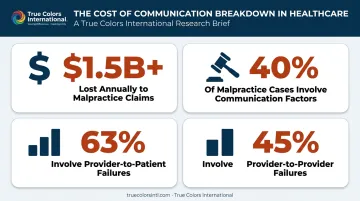
Malpractice exposure is significant. Communication factors appeared in 40% of asserted malpractice cases analyzed over a decade by CRICO/Candello. Within those cases, provider-to-patient failures showed up 63% of the time, and provider-to-provider failures 45% of the time.
The financial scale matches the frequency. More than $1.5 billion is lost annually from the U.S. healthcare system through malpractice claims tied to communication breakdowns, according to CRICO's analysis of over 137,000 cases.
Beyond dollars, trust erodes. Patients who don't understand their care plan, or don't trust the person delivering it, are far less likely to follow through with treatment. That shows up later as:
- Missed medications
- Skipped follow-up appointments
- Preventable readmissions
Staff pay a price too. Nearly a third of surveyed U.S. registered nurses say they're considering leaving direct patient care — a number tightly linked to the daily friction of miscommunication, understaffing, and burnout.
None of this lands evenly. Patients with limited English proficiency, lower income, or limited health literacy absorb the worst of these breakdowns. Nonelderly LEP individuals are uninsured at more than three times the rate of English-proficient patients, which deepens gaps in access and outcomes.
How to Overcome Communication Barriers in Healthcare
Fixing this requires more than good intentions. It takes specific, evidence-backed tools applied consistently.
Start with plain language and teach-back. Instead of asking "Do you understand?" (a question almost everyone answers "yes" to regardless of comprehension) ask patients to repeat instructions back in their own words. One study found this method dropped 30-day readmissions for cardiac surgery patients from 25% to 12%.
Standardize provider-to-provider handoffs. Structured protocols close gaps that occur when information moves between shifts or specialists:
- SBAR (Situation, Background, Assessment, Recommendation) reduced communication-breakdown incidents from 31% to 11% in one study
- I-PASS, tested across nine pediatric residency programs and 10,700+ admissions, cut medical errors by 23% and preventable adverse events by 30% (NEJM study)
Invest in professional interpreters, not ad hoc solutions. A review of 27 studies found patient satisfaction with professional interpreters hit 96%, versus just 24% with informal interpretation. Clinically significant errors dropped from 77% to 53%.
Address the hierarchy problem head-on. Protocols alone won't fix style friction. A physician may want a fast, bottom-line update while a nurse needs more context before acting. A data-driven specialist and a relationship-focused administrator often talk past each other. Closing those gaps takes teams learning each other's communication styles and temperaments.
This is where True Colors International's personality-based training has shown value in clinical settings. Working with a diverse nursing staff through the L.A. County Workforce Program, True Colors delivered an interactive Live Show where actors portrayed four distinct personality types in scenarios pulled directly from nursing challenges.
Nurses then identified their own styles and recognized why colleagues, doctors, and even patients communicated the way they did.
A nursing instructor involved in the program noted that the approach "became the standard" after a trial period, not a one-time workshop, but an adopted practice. One healthcare leader summed up the outcome directly: "When our teams are aligned, we are better equipped to care for our patients."

Layer in technology last, not first. Secure messaging, interpreter apps, and patient engagement platforms extend the reach of good communication. They don't replace it. A well-designed app can't repair a hierarchy where junior staff feel afraid to speak up. People-first training remains the foundation everything else is built on.
Conclusion
Communication barriers in healthcare are layered — language, literacy, emotion, environment, staffing, and hierarchy all play a part, often at once. Trying to fix all of it with one policy or one tool rarely works.
A stronger path is to identify which barriers show up most in your organization, then apply the right mix of training, protocol, and technology to address them directly.
Lasting change starts with people and culture at the center of the strategy, reinforced across every shift, department, and leadership level. When teams share a common language for how they communicate, those barriers lose their grip—and patient care gets clearer, safer, and more consistent as a result.
Frequently Asked Questions
What are the most common barriers to communication in healthcare?
The most common barriers include language and cultural gaps, low health literacy, and emotional or psychological factors. Environmental noise, time and staffing pressures, and hierarchical breakdowns also rank high.
What are the 5 C's of communication in healthcare?
The five C's are Clear, Concise, Complete, Correct, and Compassionate. Use them as a quick checklist to judge whether an exchange truly served the patient or team member.
What is the biggest barrier to communication in healthcare?
It varies by setting, but patient handoff failures and time constraints are consistently cited among the most damaging, since they directly precede medical errors and missed information.
How does poor communication affect patient safety?
Communication failures during handoffs, discharge, and diagnosis directly contribute to medical errors, misdiagnosis, and delayed treatment. Structured protocols like SBAR and I-PASS have measurably reduced these errors.
How can healthcare organizations improve communication among staff?
Structured handoff protocols, regular communication training, and personality-style awareness programs all strengthen staff-to-staff communication. Programs that build a shared communication language across roles tend to see the most consistent results.
What role does technology play in reducing communication barriers in healthcare?
Secure messaging, interpreter apps, and patient engagement tools help close specific gaps, but they work best alongside strong interpersonal training. Technology amplifies good communication habits; it cannot replace them.