Introduction
Ask most sales reps what makes buyers say yes, and you'll hear a lot about rapport, charm, and "connecting." Research on industrial buying behavior tells a different story.
A landmark study of 210 industrial purchasing managers found that likability and similarity help form trust, along with how often a rep stays in touch. Trust in the salesperson and the supplier is what actually predicts whether a buyer returns for the next purchase.
That reliance on trust only grows as sales models shift toward subscriptions and multi-year partnerships, where buyers have grown warier. Forrester's research on B2B trust found that 43% of buyers make defensive purchasing decisions, meaning decisions driven by risk-avoidance rather than opportunity, more than 70% of the time.
This article breaks down why trust matters in everyday sales conversations, as a concrete driver of pipeline, retention, and margin rather than an abstract virtue.
TL;DR
- Trust, not likability, predicts whether buyers commit and come back
- It shortens sales cycles, boosts retention and referrals, and cuts price sensitivity
- Without trust, deals stall, price becomes the only lever, and churn climbs
- Transparency, active listening, and kept promises build trust fastest
- Reinforce trust at every touchpoint, not just at the close
What Is Trust in Sales Communication?
Trust in sales communication is the buyer's confidence that a salesperson is honest, competent, and working in the buyer's interest, not just chasing a commission.
That's a higher bar than being liked or knowing the product inside out. A rep can be knowledgeable and charming and still lose the deal if the buyer suspects they're being managed rather than helped.
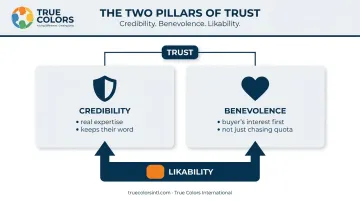
Research on buyer-seller relationships breaks trust into two components: credibility and benevolence. Credibility is the buyer's belief that the rep has real expertise and will keep their word. Benevolence is the buyer's belief that the rep genuinely has their interests in mind, not just their quota.
Likability feeds into both, but it's an input, not the outcome. Think of trust as a tool with a job to do: it lowers the buyer's perceived risk and speeds up the decision. Once a buyer trusts a rep, they stop routing every claim through a verification process and start taking them at their word.
Key Advantages of Trust in Sales Communication
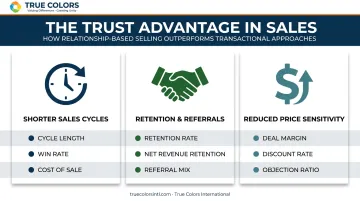
These advantages show up directly in numbers sales leaders already track: cycle time, deal value, retention, and margin. Pull your CRM data and you'll likely see the fingerprints of trust, or its absence, at every stage of the pipeline.
Trust Shortens the Sales Cycle and Accelerates Decisions
Trusted reps skip a step most salespeople never notice: the buyer's internal validation loop. When a prospect trusts you, they take your claims at face value instead of routing every statement through procurement, legal, or a competitor's deck.
In practice, this looks like:
- Fewer defensive, "gotcha" questions in discovery calls
- Earlier disclosure of real budget and timeline, without the usual deflection
- Less demand for third-party proof points before moving forward
Every one of those friction points adds days, sometimes weeks, to a deal. Recall that 43% of buyers default to risk-avoidant decision-making most of the time. Reduce that defensiveness and you eliminate entire steps from the buying process rather than merely speeding up what remains.
Faster cycles also mean lower cost of sale. A rep who closes in 45 days instead of 90 runs twice as many deals through the same pipeline on the same base salary. That's cost-per-acquisition math, the kind that shows up directly on a P&L.
KPIs impacted: sales cycle length, win rate, cost of sale, touchpoints to close.
When this matters most: Complex B2B sales with multiple stakeholders, long consideration cycles, or high-value, high-risk purchases feel this hardest. A committee decision doesn't move through six approvers without trust carrying it.
Trust Increases Retention, Expansion, and Referrals
Trust doesn't clock out when the contract is signed. It shows up again at renewal, at the upsell conversation, and in whether a customer picks up the phone when a competitor cold-calls them.
Trusted reps get pulled into next year's budget conversation before a competitor even knows the opportunity exists. That's relationship equity in action: warmer introductions, earlier visibility into expansion opportunities, faster access to decision-makers, and a customer who defends the vendor internally.
Peer-reviewed relationship-marketing research backs this up. Morgan and Hunt's widely cited commitment-trust theory found that trust and commitment drive cooperation and reduce uncertainty in ongoing supplier relationships. Similar research on professional-service clients found trust and commitment predict a client's intent to keep investing in the relationship over time.
KPIs impacted: customer retention rate, net revenue retention, referral mix, customer lifetime value.
When this matters most: Subscription and as-a-service models feel this constantly, since renewal isn't a one-time event. A buyer who trusts you renews without a competitive bid. One who doesn't will shop alternatives before your contract even nears its end date.
Trust Reduces Price Sensitivity and Objection Volume
Buyers who trust a rep's intent stop treating price as the only variable that matters. They start weighing value and long-term fit instead of just the number on the quote.
This works best when reps get ahead of pricing rather than avoiding it. Naming the cost, trade-offs, limitations, and risk upfront defuses objections before they surface. Buyers who feel pricing was softened or hidden react with heightened scrutiny.
A study of 454 US industrial buyers found that seller credibility positively affected buyers' willingness to pay a price premium, largely because credible sellers built stronger identification with the buyer's own long-term goals. Buyers pay more when they believe the seller is invested in their long-term success rather than chasing a single sale.
This shifts the conversation from cost justification to value justification, protecting margin and reducing how many discounting rounds a deal goes through.
KPIs impacted: average deal margin, discount rate, objection-to-close ratio.
When this matters most: Competitive markets with comparable offerings feel this most acutely. When the spec sheet looks the same across three vendors, the relationship becomes the tiebreaker.
What Happens When Trust Is Missing or Ignored
Skip trust-building, and the symptoms show up fast. They also compound:
- Deals stall in "maybe." Buyers who don't trust the pitch go looking for third-party validation or simply delay the decision indefinitely.
- Sales gets commoditized. Without relationship equity, price becomes the only lever left to pull.
- Churn rises. Customers leave for the first marginally better offer because no relationship holds them in place.
- Reps lean harder on pressure tactics. Urgency-based closing might work once, but it erodes credibility further and feeds a cycle of growing skepticism.
- Forecasts get distorted internally. Reps who aren't candid with their own managers about deal health mirror the same trust deficit they're creating externally.
None of this is coincidence. It's what happens when every interaction requires the buyer to verify rather than simply believe.
How to Build and Sustain Trust in Sales Communication
Trust isn't built in one great call. It's built, and just as easily lost, across every touchpoint, reinforced by whether you follow through on what you said you'd do.
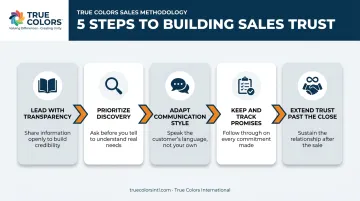
Lead with radical transparency. Address pricing, limitations, and realistic timelines upfront, even when the answer isn't what the buyer wants to hear. Studies on buyer-seller relationships consistently show that transparency directly increases trust. Avoiding an uncomfortable topic doesn't make it disappear; it just means the buyer finds out later, from someone else.
Prioritize discovery over pitching. Ask questions that surface actual constraints, not just stated wants. A buyer who feels heard shares more honest information earlier, which is exactly what lets you build a proposal that survives internal scrutiny instead of getting picked apart later.
Adapt your communication style to the buyer. An analytical, data-driven buyer needs a different approach than a relationship-first decision-maker, and pitching both the same way guarantees friction with one of them. This is where personality-based frameworks earn their place in a sales conversation.
True Colors International's assessment, built around four temperament styles (Gold, Blue, Green, and Orange), helps reps read a prospect's communication preferences and adjust tone, pacing, and level of detail before the conversation stalls. This principle anchors True Colors' Consultative Selling certification track, which trains sales teams to recognize a buyer's style in real time instead of running every prospect through the same script.
Keep promises, and track them. Small, kept commitments compound into a credibility track record buyers notice more than any single interaction:
- A follow-up email sent exactly when promised
- A demo scheduled at the agreed time
- A proposal revision delivered within the turnaround you committed to
Extend trust-building past the close. Renewals and referrals come from credibility earned after the signature, not before it. Proactive check-ins and showing up when there's nothing to sell reinforce that the relationship was never just about the transaction.
Conclusion
Trust in sales communication comes from being credible, reliable, and consistently transparent, even when the truth is inconvenient. Likability has little to do with it.
The advantages compound the longer a relationship holds: shorter cycles now, higher retention next year, reduced price sensitivity across every renewal after that. None of it shows up overnight, and none of it survives a broken promise left unaddressed.
This is why sales teams that treat trust as a communication practice, not a trait only a few gifted reps possess, build it consistently across the entire team. They stop relying on one best-connected rep to carry every deal.
Frequently Asked Questions
What is the trust-based sales process?
It's a customer-centric approach, popularized by Charles H. Green in The Trusted Advisor, that prioritizes transparency and the buyer's best interest over hard-selling tactics. The pitch only comes after a genuine need has been confirmed.
What is the 3-3-3 rule in sales?
There's no single authoritative definition, but the term commonly describes structuring prospecting or follow-up in sets of three, such as three touchpoints across three channels within three days, to build familiarity without overwhelming the buyer.
What are the 5 C's of trust?
Different sales authorities define this differently. One version from banking sales trainer Jack Hubbard names conversation, curiosity, collaboration, customization, and coaching, while Charles Green's Trust Equation instead uses credibility, reliability, and intimacy, divided by self-orientation.
How long does it take to build trust with a new customer?
There's no fixed timeline. Trust builds incrementally through consistent, kept promises across multiple interactions rather than one great meeting. Complex, high-value deals typically need more touchpoints than simple transactions.
Can trust be rebuilt after it's broken in a sales relationship?
Yes. It requires transparent acknowledgment of what went wrong, consistent corrective action, and smaller, verifiable promises delivered over time. Rushing back to big commitments before smaller ones are proven tends to backfire.
How does understanding personality styles help build trust faster in sales?
Recognizing a prospect's communication style lets a rep adjust pace, tone, and detail level immediately. That reduces friction and speeds up the feeling of being understood, the goal behind frameworks like True Colors' four-color model.