Introduction
Picture this: the marketing team spent three weeks building a campaign that sales already tried (and abandoned) last quarter. Nobody told them.
Meanwhile, two people on that same marketing team keep butting heads because one wants quick decisions and the other wants every detail nailed down first.
Same organization. Two different communication breakdowns.
Many companies pour resources into team-building days for individual departments while ignoring the gaps between departments. Others obsess over cross-functional alignment and forget that the people sitting three feet from each other still don't understand how to talk to one another.
Both failures cost real money and real trust. This article breaks down what intra-team and inter-team communication actually mean, why organizations need to master both, and what practical, personality-informed strategies close these gaps.
Key Takeaways
- Intra-team and inter-team communication serve different jobs—one builds cohesion inside a group, the other aligns separate teams on shared goals
- Gaps in either direction drive duplicated work, missed deadlines, and disengaged employees
- Strong collaboration rests on three habits: clear Communication, willing Cooperation, and deliberate Coordination
- Shared frameworks for understanding personality and communication styles close gaps faster than generic team-building exercises
What Is Inter-Team vs. Intra-Team Communication?
The prefixes tell the story. "Intra" means within, the same root you see in intramural sports played inside one school. "Inter" means between, as in international relations between separate countries. In the workplace, that same logic separates talk inside one team from talk across teams.
Intra-Team Communication: Within a Single Team
Intra-team communication is the exchange of information, ideas, and feedback among people on the same team working toward a shared goal. It's the daily operational glue that holds a team together.
Common examples include:
- Daily stand-up meetings
- Internal team chat channels (Slack threads, dedicated group messages)
- One-on-one check-ins between manager and employee
- Sprint retrospectives and post-project debriefs
This is where trust and accountability take shape—and where day-to-day execution actually happens. When intra-team communication breaks down, it usually shows up as friction between individuals, not confusion about company direction.
Inter-Team Communication: Between Different Teams or Departments
Inter-team communication is the flow of information between separate teams, departments, or business units working toward a broader organizational objective. This is boundary-spanning work, not internal team chatter.
Typical examples include:
- Marketing-to-sales lead handoffs
- Cross-functional project syncs between product and engineering
- Leadership cascading strategic updates across multiple departments
- Shared status reporting across operations, finance, and customer success
Inter-team communication is what prevents silos. It keeps a company aligned on big-picture goals instead of every department optimizing for its own metrics in isolation.
| Dimension | Intra-Team | Inter-Team |
|---|---|---|
| Scope | Members of one team | Two or more interdependent teams |
| Primary goal | Shared understanding, trust, execution | Aligned goals, resource coordination |
| Common failure point | Unspoken tension, mismatched styles | Guarded information, fragmented ownership |
Strong organizations invest in both. Intra-team habits drive execution; inter-team habits keep the wider business moving in the same direction.
Why Strong Communication and Collaboration Matter
Communication problems aren't just an annoyance. They show up on the balance sheet.
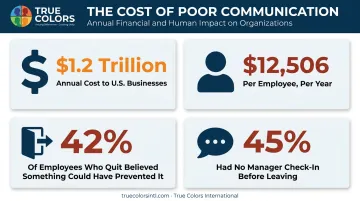
Grammarly and The Harris Poll's 2023 State of Business Communication report estimated that poor communication costs U.S. businesses $1.2 trillion annually, or roughly $12,506 per employee per year—a figure Grammarly's 2024 follow-up still cites.
Communication gaps also drive people out the door. Gallup's research on voluntary turnover found that 42% of employees who quit believed something could have prevented their exit. Even more telling: 45% said no manager or leader had proactively discussed their satisfaction, performance, or future with them in the three months before they left.
Here's the pattern worth remembering:
- Poor communication compounds financial waste through duplicated effort
- Silence on career and performance pushes good employees toward the exit
- Clear communication and real collaboration speed decisions—fewer meetings wasted re-explaining context
- Teams that talk and work well together catch small misunderstandings before they calcify into conflict
None of this requires a massive cultural overhaul. It takes consistent attention to how information moves—and how people actually work together—across the organization.
Common Barriers to Effective Team Communication
Communication problems look different inside a team than they do between teams. The barriers—and the fixes—aren't the same.
Information silos are the primary inter-team barrier. Departments protect information, whether intentionally or through sheer habit, and fail to share updates across functional lines.
Research on organizational silos describes them as "pockets of interaction and knowledge" that block resource sharing and breed reluctance to cooperate. McKinsey's work on cross-functional collaboration points to the same roots: fragmented process ownership, guarded information, and roles defined too narrowly for clean handoffs.
Personality and communication-style clashes are the primary intra-team barrier. Two people can share identical goals and still clash constantly if their styles don't mesh. A few patterns show up repeatedly in workplace training:
- A fast-moving, results-driven team member clashing with a colleague who needs process and structure before acting
- Someone who wants concise, big-picture updates getting frustrated with a teammate who insists on exhaustive detail
- A logic-first communicator dismissing a relationship-first communicator's need for rapport before diving into a task
These aren't competence problems. They're style friction problems that go unnamed and unaddressed until they erode trust.
Remote and hybrid work amplify both problems. Without casual hallway contact, silos harden faster and style clashes go unnoticed longer.
A large-scale study of Microsoft employees published in Nature Human Behaviour found that firm-wide remote work made collaboration networks more static and siloed, with roughly a 25% drop in cross-group collaboration time. Fewer informal check-ins mean fewer chances to catch a misunderstanding before it becomes a real problem.
The 3 C's of Collaboration (And Why a 4th Matters)
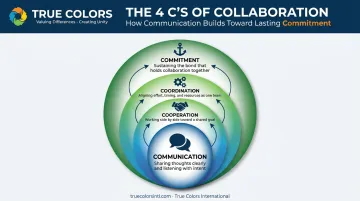
Organizational researchers have long organized collaboration around three interlocking components, originally proposed by Ellis, Gibbs, and Rein in 1991 and later refined by Fuks and colleagues in 2008. The model is simple and durable:
- Communication — the clear, two-way exchange of information and expectations between individuals and teams. Without it, nothing else functions.
- Cooperation — the willingness of team members to support one another and prioritize shared goals over individual agendas.
- Coordination — the alignment of actions, timelines, and resources so effort doesn't get duplicated or wasted.
These three pieces work together. Communication without coordination just produces well-informed chaos. Coordination without cooperation produces a schedule nobody actually follows.
Many organizational development practitioners add a fourth element: Commitment. The first three C's can get a team through a single project. Commitment is what keeps people showing up for the culture long after the initial excitement fades.
Insight alone doesn't sustain that commitment. Knowing a colleague processes decisions differently than you do only helps if it changes how you work together day to day.
Sustained collaboration needs repeatable habits and ongoing reinforcement, not a one-time workshop filed away and forgotten. Personality and temperament awareness supports those habits: it gives people a practical reason to keep choosing cooperation after the novelty wears off.
Strategies to Strengthen Both Intra- and Inter-Team Communication
Fixing communication gaps takes more than good intentions. It takes structure.
Set Clear Protocols for Each Context
Intra-team and inter-team communication need different rhythms:
- Intra-team: structured daily or weekly check-ins, clear channels for quick questions, and defined escalation paths
- Inter-team: scheduled cross-functional syncs, documented handoff processes, and a single source of truth for shared projects
Build a Shared Language for Communication Styles
Active listening training helps, but it works better when people understand why colleagues process information differently in the first place. True Colors International's personality-based methodology organizes communication tendencies into four styles:
- Orange communicators want pace and practical information; they disengage when conversations get overly procedural
- Gold communicators need clear expectations, structure, and specific action items before they feel confident
- Blue communicators prioritize relationship and rapport before engaging fully with the message itself
- Green communicators want direct, logic-based exchanges and tune out redundancy or emotional framing
No one is only one color. But naming these tendencies gives teams a shared vocabulary instead of vague complaints like "he's difficult" or "she never listens." That vocabulary is what allows a fast-moving Orange salesperson and a process-driven Gold supervisor to work through friction productively instead of quietly resenting each other.
Treat Culture as a Loop, Not a One-Time Event
A single workshop rarely changes behavior for good. True Colors structures its approach around a continuous True Culture Loop:
- Awareness — surfacing how people communicate through assessments and personal awareness training
- Alignment — applying that awareness to reduce day-to-day friction and clarify expectations
- Action — embedding new behaviors into how leaders manage and teams operate
- Reinforcement — sustaining progress through ongoing coaching and internal culture champions
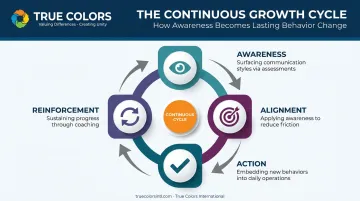
Organizations that treat this as an ongoing cycle see the shift stick. Those that treat it as a one-off training day usually watch old habits creep back within a few months.
Leaders set the pace of that loop. When they ask for cross-team feedback and publicly recognize collaborative behavior, they make the new norms visible—and enforceable—for everyone else.
Tools should support that work, not replace it. Collaboration software has a role, but you can't scale trust or coaching through a chat app. A tidy Slack channel won't fix a style clash between a detail-obsessed Gold analyst and a big-picture Orange manager. The people work has to come first.
Frequently Asked Questions
What is the difference between inter-team and intra-team communication?
Intra-team communication happens within a single team, covering day-to-day exchanges among people working toward the same goal. Inter-team communication happens between separate teams or departments working toward shared organizational objectives.
What is inter-team communication?
Inter-team communication is the exchange of information and collaboration between different teams or departments within an organization. It's what breaks down silos and keeps functions aligned on broader company goals.
What is intra-team communication?
Intra-team communication is the daily exchange of information among members of the same team, including stand-ups, check-ins, and feedback loops. It builds the trust and accountability that day-to-day execution depends on.
What are the 3 C's of collaboration?
The 3 C's are Communication, Cooperation, and Coordination. Communication shares information, cooperation aligns priorities and willingness to help, and coordination keeps actions and timelines from working against each other.
What are common barriers to inter-team collaboration?
Information silos, misaligned goals between departments, and a lack of shared communication protocols top the list. Remote and hybrid work environments tend to make these barriers worse by reducing informal cross-team contact.
How can personality assessments improve team communication?
Personality-based assessments give individuals and teams a shared vocabulary for describing how they process and share information. That shared language reduces the guesswork behind misunderstandings, both within a team and across departmental lines.