Introduction
A leader looks at her team roster and feels good. The mix of backgrounds, ages, and perspectives finally reflects the community she serves. Then the engagement survey comes back, and the story changes.
Employees say they don't feel heard. Ideas get raised in one-on-ones but never make it into team decisions. Meetings stay quiet, even when people have real concerns.
This is the gap many organizations hit after investing heavily in diversity hiring: the roster looks different, but the culture doesn't feel different. Diversity gets people in the room; inclusion determines whether anyone actually listens to them once they're there.
That distinction matters. Inclusion requires ongoing daily practice, not a one-time initiative you check off during onboarding.
This guide breaks down what inclusion actually means, why it matters for retention and performance, and how leaders can build it using a practical, repeatable framework.
Key Takeaways
- Inclusion means leaders actively invite participation, not passively allow diversity to exist
- Perceived inclusion drives engagement and turnover risk, and it varies by role and seniority
- Real inclusion combines communication awareness, fair systems, and consistent leadership behavior
- Understanding personality and communication differences is a foundational, often-skipped step toward inclusion
What Does Inclusion Mean in the Workplace?
Inclusion is an environment where employees feel valued, respected, and empowered to bring their authentic perspectives to work, without softening who they are to fit in.
It's not passive. Inclusion requires active participation and real influence: employees don't just occupy a seat at the table, their input shapes what happens next.
A team can be demographically diverse and still be exclusionary. Watch for these warning signs:
- Only certain voices get airtime in meetings
- Only certain people receive stretch assignments
- Feedback flows in one direction, from the top down
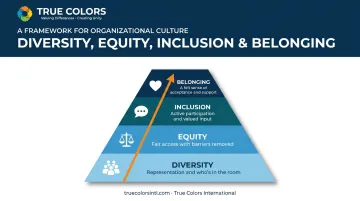
Leaders sometimes conflate three related but distinct concepts. Here's how they differ.
Inclusion vs. Diversity
Diversity is about representation: who is present in the workforce across dimensions like gender, race, age, ability, and background, according to McKinsey's framework on diversity, equity, and inclusion.
Inclusion is what happens after people arrive. It's whether their perspectives get valued, integrated into decisions, and reflected in how the team actually operates. You can hire for diversity and still fail at inclusion.
Inclusion vs. Equity
Equity means fair access to opportunities, resources, and advancement, plus actively removing the barriers that have historically blocked certain groups from participating fully.
Equity is structural. Inclusion is experiential. A company can have equitable pay bands and promotion criteria while individual employees still feel excluded from informal decision-making or day-to-day team dynamics. Equity supports inclusion, but it doesn't guarantee it.
Inclusion vs. Belonging
Belonging is the deeper emotional payoff of sustained inclusion. Catalyst frames it this way: inclusion is the set of workplace practices and actions organizations take, while belonging is the personal, felt sense of acceptance and security an employee develops over time.
Employees who belong don't just contribute in meetings. They feel safe being their full selves without performing a version of themselves for approval.
Why Inclusion Matters for Leaders
Inclusion isn't a soft metric. It shows up in burnout rates, innovation output, and whether employees trust leadership at all.
Inclusion isn't experienced equally, either. The numbers make the stakes concrete:
- Burnout drops sharply: BCG's 2024 survey of 11,000 workers across eight countries found that burnout was roughly half as likely among employees who felt included compared to those who didn't.
- Financial performance improves: Deloitte's research found that organizations with inclusive cultures are six times more likely to innovate and twice as likely to meet or exceed financial targets.
- Gaps show up by identity and role: BCG's global BLISS research found that LGBTQ+ employees who were out to all coworkers, and employees who felt they could be authentic at work, scored notably higher on inclusion measures than those who didn't.
A senior director and a frontline hourly employee are often living in two different cultures under the same roof.
Then there's the trust problem: talk without action backfires. Catalyst found that 75% of employees doubted the sincerity of their organization's racial-equity efforts, a say-do gap that erodes credibility fast.
None of this happens in a vacuum. Leaders set the tone. Their daily behavior (who they call on in meetings, whose ideas get credited, who gets stretch opportunities) either accelerates inclusion or quietly blocks it, regardless of what the culture deck says.
How to Build an Inclusive Workplace: Strategies for Leaders
Building an inclusive workplace requires layered, ongoing habits, not a single initiative.
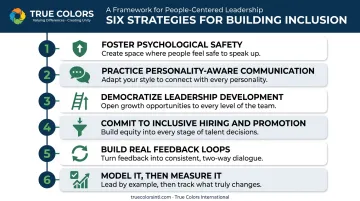
1. Foster psychological safety before decisions get made, not after. Actively solicit input from a range of voices while a decision is still open, not once it's finalized. Asking "does anyone disagree?" after the fact is a formality, not genuine inclusion.
2. Practice personality-aware communication. Employees don't all process information, feedback, or recognition the same way. This is one of the most overlooked building blocks of real inclusion, and it's where personality-based tools come in.
True Colors International has spent over 45 years helping organizations, including Amazon and Google, apply the True Colors personality spectrum so leaders can recognize how team members prefer to communicate and receive feedback.
A direct, task-focused employee and a relationship-driven employee need different management approaches. Treating them identically overlooks a real opportunity to make both feel heard.
3. Democratize leadership development. Don't reserve mentorship and training for a small "high-potential" list. Widening access to development opportunities signals that advancement isn't reserved for people who already look like leadership.
4. Commit to inclusive hiring and promotion. Widen the talent pipeline and audit promotion criteria for structural bottlenecks that disproportionately affect underrepresented employees.
5. Build real feedback loops. Pulse surveys, listening sessions, and employee resource groups only matter if they change something. Feedback without follow-through is worse than not asking at all.
6. Model it, then measure it. Set transparent, trackable goals for inclusive behavior, and hold leadership accountable to them the same way you'd track revenue targets.
Common Barriers to Inclusion (and How to Overcome Them)
Even well-intentioned leaders run into predictable obstacles. Three come up constantly.
Unconscious bias in daily decisions. A resume study of nearly 5,000 applications found that applicants with White-sounding names received 50% more callbacks than identical candidates with Black-sounding names.
- Fix: Structured bias-awareness training paired with defined evaluation rubrics — not vague, open-ended criteria that leave room for stereotypes to creep in.
One-size-fits-all engagement. Assuming every employee wants the same recognition, communication style, or feedback cadence ignores real personality and temperament differences.
- Fix: This is exactly where personality-spectrum training earns its place. Understanding that some employees want public recognition and others prefer a quiet note changes how leaders actually reach people.
Performative "checkbox" inclusion. Policies without budget, follow-through, or leadership accountability erode trust faster than doing nothing at all — echoing that 75% credibility gap Catalyst identified.
- Fix: Tie every inclusion commitment to a measurable action and a named owner. Untracked commitments rarely turn into real change.
What Does Inclusion Look Like? Real-World Examples
Inclusion shows up in specific, tangible decisions leaders make every day.
- Flexible policies that fit real lives. Floating holidays let employees observe personally meaningful dates instead of one default calendar. Prayer and meditation rooms, lactation spaces, and accessible facilities let employees show up without hiding a need.
- Active ERGs and mentorship pathways. AT&T's Black employee resource group, The NETwork, has grown to roughly 11,000 members, according to HBR, alongside a strong retention rate among Black employees. ERGs paired with real advancement pathways build genuine employee voice and long-term engagement.
- Leaders who adapt person-by-person. A manager who adjusts recognition and communication style for each employee, rather than running one script for the whole team, models inclusion daily. Personality-based training aims for exactly this outcome: teams that communicate across real differences instead of forcing everyone into the same mold.
Frequently Asked Questions
What is cultural inclusion in the workplace?
Cultural inclusion means respecting and actively integrating diverse cultural backgrounds, traditions, and communication styles into everyday practices and decisions, not just tolerating their presence. It shows up in policies, meeting norms, and how recognition is handled.
What are the five C's of culture?
Frameworks vary by source, but common versions reference Communication, Collaboration, Commitment, Consistency, and Care as pillars organizations use to build a unified culture. Some practitioner models swap in Celebration or Community instead.
What is a good example of inclusion in the workplace?
A manager adjusting their communication or recognition approach based on individual employee preferences, and actively involving diverse voices before finalizing a decision, is a strong, everyday example. It's specific and repeatable, not a one-time gesture.
What is the difference between diversity and inclusion?
Diversity is about representation, meaning who's in the room. Inclusion is about whether those different perspectives are actually valued, heard, and integrated into decisions once people arrive.
How is inclusion different from belonging?
Inclusion is the practice of involving people in decisions and daily work. Belonging is the emotional outcome employees feel once that inclusion has been sustained consistently over time.
How can leaders measure inclusion in their organization?
Use pulse surveys, listening sessions, and employee resource group feedback, then break the results out by role, tenure, and demographic group. Averages hide gaps that disaggregated data can reveal.