That gap is where culture breaks down. Only 26% of U.S. employees strongly agree that their company always delivers on its promises, and just 4 in 10 feel their organization's mission makes their job feel important, according to Gallup's research on company values. Culture isn't intangible. It's measurable — you just need to ask the right questions.
Employee survey questions about culture are the most direct way to find out where leadership's intent and employees' lived reality diverge. This article covers 10 essential questions to include, how to select and roll them out, and what to do with the results once they land on your desk.
Key Takeaways
- Culture surveys reveal the gap between stated values and daily employee experience
- Positive culture correlates with employees being nearly 4x more likely to stay
- Mix scaled and open-ended questions to capture both trends and root causes
- Anonymity, cadence, and visible follow-through determine whether feedback stays honest
- Survey data diagnoses problems; a behavior-change framework is what actually fixes them
Why Employee Culture Surveys Matter
A culture survey does one job well: it exposes the distance between what leadership says about communication, teamwork, and values, and what employees experience day to day. That distance matters more than most executives realize.
Organizations with strong cultures see it in the numbers. Employees who rate their culture positively are nearly 4x more likely to stay with their employer, according to SHRM's research on workplace culture and retention. The same research found:
- 57% of employees in poor cultures were actively job hunting, versus 15% in strong cultures
- 83% of employees in good cultures felt motivated to do high-quality work, compared to 45% in weak ones
- Executives rated their own culture highly 82% of the time, while only 47% of individual contributors agreed
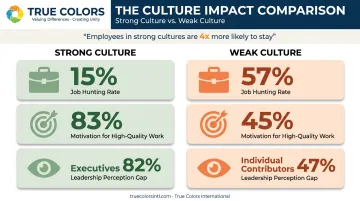
That last stat is the real story. Leaders and frontline employees are often looking at two different companies.
Here's what surveys don't do on their own: fix anything. Most of what a culture survey uncovers, from miscommunication and low recognition to disconnects between managers and their teams, traces back to something simpler than "bad culture." People are wired differently in how they communicate, process feedback, and lead.
A survey tells you where the friction is. What you do next is a separate problem entirely, one we'll come back to.
10 Essential Employee Survey Questions About Culture
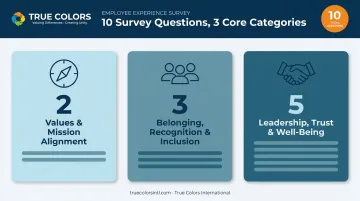
A good culture survey doesn't need 50 questions. It needs the right 10, organized around the areas where misalignment most commonly hides: purpose, belonging, leadership trust, and overall culture health.
Values & Mission Alignment Questions
These two questions test whether employees can connect their daily work to something bigger than a task list.
"Do you understand our company's mission and how your role contributes to it?" This measures whether employees see a clear line between what they do at their desk and why the organization exists. A "no" here usually means poor onboarding or muddled internal communication, not a lack of caring.
"How closely do your day-to-day experiences align with our stated company values?" This is the espoused-versus-lived culture question. If your values page says "transparency" but employees rarely hear from leadership, this question will surface it fast.
Belonging, Recognition & Inclusion Questions
Belonging isn't a soft metric. High workplace belonging is associated with a 56% increase in job performance, 50% lower turnover risk, and 75% fewer sick days, according to Harvard Business Review's analysis of workplace belonging.
"Do you feel a genuine sense of belonging within your team?" Belonging predicts retention and psychological safety more reliably than most engagement metrics.
"Do you feel recognized and appreciated for your contributions?" Recognition gaps are one of the most common reasons employees quietly check out, then leave.
"Do you feel the perspectives of people with different backgrounds and working styles are respected here?" This one does double duty, capturing both DEI sentiment and something often overlooked: whether communication-style differences are respected or steamrolled.
Leadership, Trust & Well-Being Questions
These five questions test whether trust in leadership extends to psychological safety, flexibility, and overall culture health.
"Do you feel leaders and managers communicate openly and transparently?" Transparency is the foundation everything else rests on. Without it, trust doesn't get built; it gets assumed and eventually disproven.
"How comfortable are you approaching your manager or leadership with concerns or new ideas?" This signals psychological safety at the manager level, not just the company level, which is where most trust actually lives or dies.
"Do you feel psychologically safe sharing ideas and taking risks at work?" This is non-negotiable. Teams that can't safely disagree or admit mistakes stop innovating and start covering themselves.
"Does your work schedule support a healthy work-life balance?" Flexibility, when designed well, reduces burnout and turnover. When designed poorly (unclear boundaries, always-on expectations), it doesn't help at all.
"Would you recommend this organization to others as a great place to work?" A single-item pulse check, similar to an employee Net Promoter Score. It's not a complete diagnosis on its own, but it's a fast way to track directional change over time.
How to Choose the Right Culture Survey Questions for Your Organization
Copying a generic 40-question template off the internet is the fastest way to get generic, unusable data. Start with your business goals first.
- Tie questions to specific outcomes. If retention is the concern, weight questions toward belonging and trust. If you're scaling fast, focus on mission alignment and communication.
- Combine scaled and open-ended formats. A 1–5 rating shows what's wrong; open text explains why. You need both to find root causes.
- Avoid jargon and leading phrasing. "Do you feel empowered to leverage synergies across teams?" will get blank stares. Plain language gets honest answers.
- Use your own language. If your company says "ownership" instead of "accountability," write it that way; employees notice when wording doesn't match how the company actually talks.
Best Practices for Implementing Your Culture Survey
Getting the questions right is half the job. How you run the survey determines whether people tell you the truth.
- Guarantee anonymity, and mean it. Employees need to believe there's zero chance a manager can trace an answer back to them, especially on sensitive questions.
- Pick a cadence and stick to it. Pair a deep survey every six months with short quarterly pulse checks for steady signal without survey fatigue.
- Close the loop, every time. Most surveys fail here: employees hear nothing after submitting feedback, so participation drops next round. Share what you learned, what you're doing about it, and by when.
- Protect small groups. Never report results from a team of fewer than 10 people. It's an easy way to accidentally de-anonymize someone.
True Colors International's Employee Experience Surveys build this cadence and closed-loop reporting into every engagement, so your team sees both the data and the follow-through.
Turning Culture Survey Insights Into Lasting Change
A survey is a diagnostic tool, nothing more. It tells you where trust is low, where recognition is missing, and where communication is breaking down. It does not tell you why, and it definitely doesn't fix it.
Here's the pattern we see constantly: the same 10 questions above keep surfacing the same root cause. Trust issues, recognition gaps, leadership disconnects, and inclusion problems almost always trace back to one thing.
People on the same team are wired to communicate, lead, and receive feedback in fundamentally different ways, and nobody's ever named that difference out loud.
That's the piece a survey alone can't fix. It's also the piece True Colors International has spent more than 45 years working on, using a personality-based framework trusted by organizations including Google, Amazon, Ford, and Marriott.
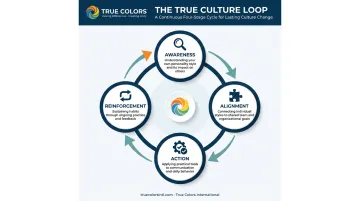
The approach centers on what we call the True Culture Loop, a four-stage cycle:
- Awareness: Employees and leaders learn their own communication and working style, often for the first time in a structured way.
- Alignment: Teams connect individual styles to the specific gaps a survey uncovered, whether that's low transparency scores or weak belonging scores.
- Action: Leaders adjust how they communicate, recognize, and manage based on what they now understand about their team's makeup.
- Reinforcement: The organization builds shared language and habits that outlast the initial training, so the next survey shows movement instead of the same complaints.
A survey score tells you transparency is low. Pairing that data with a personality-based framework tells you why: maybe your leadership team communicates in big-picture terms while half the workforce needs specifics and step-by-step clarity. That's a translation problem, not a leadership failure, and it's fixable once you can name it.
Frequently Asked Questions
What is an employee culture survey?
An employee culture survey measures how employees perceive and experience company values, leadership style, and the day-to-day work environment. It's designed to expose gaps between stated culture and lived experience.
How often should a company conduct a culture survey?
A quarterly-to-biannual schedule works well for most organizations. It provides enough frequency to catch emerging issues without overwhelming employees with constant surveys.
What's the difference between a culture survey and an employee engagement survey?
Culture surveys assess alignment with values, leadership, and work environment. Engagement surveys measure emotional commitment and motivation. They overlap but answer different questions.
How can we get honest feedback from employees on a culture survey?
Guarantee true anonymity, clearly explain why the survey matters, and visibly follow through on results. Employees answer honestly when they trust their input leads somewhere real.
What should we do if culture survey results reveal serious problems?
Prioritize the two or three most urgent issues rather than tackling everything at once. Build an action plan with clear ownership and timelines, then share it transparently with employees.
How many questions should a culture survey include?
Aim for roughly 10 to 20 questions, mixing scaled ratings with open-ended prompts. This captures meaningful data without pushing employees into survey fatigue.