Many HR and business leaders sense something is off. Turnover feels high. Training spend seems bloated. Engagement scores look flat. But without comparative data, "something feels off" never becomes "here's exactly what to fix." That's the gap benchmarking closes.
This guide covers what organizational benchmarking actually means, the different types you can run, a practical six-step process, what to measure, and the mistakes that derail most benchmarking efforts before they start.
Key Takeaways
- Benchmarking compares your metrics against internal units or external peers to reveal actionable gaps
- Five types exist: internal, competitive, functional, performance, and practice—each answers a different question
- Effective benchmarking runs as a repeatable cycle requiring focused scope and leadership buy-in
- Leading organizations now benchmark culture alignment and communication style alongside turnover and spend
What Is Organizational Benchmarking?
The American Society for Quality defines benchmarking as the process of measuring products, services, and processes against those of organizations known to be leaders in one or more areas of their operations. SHRM frames it similarly: measuring processes, practices, and results against competitors or peer companies to improve performance.
Notice both definitions go beyond raw numbers. They include processes and practices, not just metrics.
Benchmark vs. Benchmarking
These two words get used interchangeably, but they mean different things:
- A benchmark is a fixed reference point, a specific number or standard you're comparing against (for example, a 12% turnover rate)
- Benchmarking is the ongoing process of measuring, comparing, and acting on that comparison
Two Building Blocks: Quantitative and Qualitative
Every credible benchmarking effort rests on two pillars:
- Quantitative comparison: hard KPIs like cost per hire, turnover rate, or training spend
- Qualitative comparison: how leading organizations actually structure their workflows, decision-making, and communication practices
A number alone tells you that a gap exists. The practice side tells you why.
This dual focus isn't new. Benchmarking has deep roots in manufacturing and quality management, dating back to Xerox's well-documented efforts in the 1980s. HR and learning functions adopted it much later, and many people-focused programs still lack the comparison discipline that operations and finance teams have used for decades.
That's changing quickly. Organizations that treat benchmarking as a core practice, rather than an occasional side project, make sharper, faster decisions.
Why Organizational Benchmarking Matters
Organizations improve over time regardless. Teams tweak processes, train new hires, and upgrade tools. But without benchmarking, that improvement happens slowly and without knowing which levers actually move the needle.
Benchmarking provides laser focus. Instead of improving everything a little, you find the two or three areas where the gap between you and top performers is widest, and you fix those first.
Core benefits include:
- Identifying specific performance gaps instead of vague dissatisfaction
- Building a data-backed case for change that leadership can't easily dismiss
- Validating practices that are already working, so you don't fix what isn't broken
- Setting realistic, evidence-based goals rather than arbitrary targets
The Rise of Soft-Metric Benchmarking
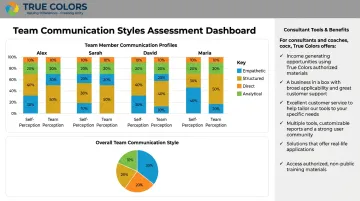
Turnover and cost per hire have always been benchmarked. What's shifting is the growing attention to softer, harder-to-quantify areas. Now, benchmarking looks at how teams communicate, whether leadership style matches team temperament, and how aligned culture actually is versus how it feels on paper.
This is where personality-assessment firms like True Colors International come in, using validated instruments to map how teams actually communicate versus how they think they communicate. Understanding whether a team leans heavily toward one communication style, or is badly mismatched with its manager's style, is now treated as seriously as staffing ratios. You can't fix a culture gap you haven't measured.
Types of Organizational Benchmarking
Most organizations don't pick one type and stop. According to APQC's research on benchmarking approaches, the comparison set (internal vs. external) and the evidence type (performance vs. practice) combine in different ways depending on your goal.
| Type | What It Compares | Best For |
|---|---|---|
| Internal | Departments, units, or teams within your own organization | Surfacing best practices you already have but haven't scaled |
| Competitive/External | Direct competitors or similarly sized industry peers | Understanding your market position |
| Functional/Industry | Leaders in any industry, not just yours | Adopting transferable ideas (a hospital learning from a hotel's service model) |
| Performance | Hard KPIs and quantitative data | Sizing the gap precisely |
| Practice (Best-Practice) | How leading organizations structure workflows and methods | Understanding why the gap exists |
| Strategic | Long-term strategic choices and business models | Informing higher-level planning decisions |
Caution: Broad industry averages can mislead smaller or niche organizations. A 500-person regional firm comparing itself to a national average built from Fortune 500 data will chase the wrong targets almost every time.
Match your comparison group by size and sector, not just industry label.
Key Steps in the Organizational Benchmarking Process
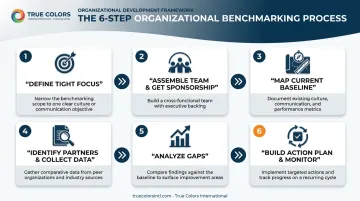
Benchmarking works best as a repeatable cycle. APQC's methodology boils down to Plan, Collect, Analyze, and Adapt. Here's that same logic broken into six practical steps:
- Define a tight focus. Pick one issue that's genuinely critical, like onboarding time or manager turnover, not a vague "improve HR" mandate.
- Assemble a cross-functional team and get leadership sponsorship. Benchmarking without management buy-in stalls the moment findings require change.
- Map your current baseline. Document exactly where you stand today before you compare against anyone else.
- Identify partners and collect data. Use surveys, interviews, site visits, or established bodies like APQC and SHRM.
- Analyze the gaps. Look for both the size of the difference and the root cause behind it.
- Build an action plan and monitor it. Implement changes, then keep measuring. This step is where most efforts collapse.
Benchmarking is a continuous process, not a one-time study. Skip the monitoring step, and you're left with an interesting report and no lasting change.
What to Benchmark: Common Areas and Metrics
Some metrics show up in nearly every HR benchmarking study. According to SHRM's 2025 CHRO benchmarking data brief, based on responses from over 2,300 HR leaders, current medians include:
| Metric | Median Benchmark |
|---|---|
| Voluntary turnover | 12% annually |
| HR staffing ratio | 1.98 HR staff per 100 employees |
| HR spend | $2,479 per FTE |
| L&D direct spend | Roughly $1,054 per employee (ATD, 2024 data) |
Frequently benchmarked areas also include:
- Organizational structure and span of control
- Compensation levels by role and market
- Employee engagement scores
- Training and L&D hours per learner
Raw totals mislead more than they inform. A 50-person company and a 5,000-person company will never have comparable raw HR spend, so always normalize per employee, per FTE, or per learner. APQC warns that consolidating units with very different roles can make comparisons meaningless.
Benchmarking Culture and Communication
Hard numbers only tell part of the story. Increasingly, organizations want a measurable baseline for softer areas: team communication styles, collaboration patterns, and culture alignment. This is exactly where validated personality and temperament assessments earn their place in a benchmarking strategy.
True Colors International's ASI-certified assessment methodology, built on a research population of 10,000 respondents and compliant with the EEOC's 80% guideline for adverse impact, brings that same rigor to communication and collaboration. Organizations get a defensible baseline for how teams interact, benchmarked with the same standards HR leaders expect from turnover or compensation data.
Challenges and Best Practices for Successful Benchmarking
Most benchmarking efforts fail for predictable, avoidable reasons.
Common pitfalls:
- Scoping studies too broad to act on ("improve engagement" instead of "reduce first-year turnover in sales")
- Relying on generic industry-wide averages that don't match your size or niche
- Lacking resources or missing leadership commitment
- Treating benchmarking as a one-time study instead of a recurring cycle
Best practices that fix them:
- Keep each study narrowly scoped to a single, decision-relevant question
- Source data from peers matched by size and sector, not broad averages
- Pair quantitative performance data with qualitative practice insights: numbers explain what, practices explain why
- Build monitoring into the plan from day one, not as an afterthought
For harder-to-measure areas like culture and communication, partnering with a credentialed provider matters. True Colors International brings 45-plus years of organizational development experience, with credentials recognized by SHRM, HRCI, and the International Coaching Federation. This gives culture-focused benchmarking the same research grounding that financial and staffing benchmarks already have.
Frequently Asked Questions
What are the types of organizational benchmarking?
The main types are internal, competitive/external, functional, performance, and practice benchmarking. Strategic benchmarking is sometimes added for long-term planning comparisons. Most organizations combine two or three types depending on their goal.
What are the key steps in organizational benchmarking?
The cycle involves defining a focused subject, building a cross-functional team, measuring your baseline, collecting partner data, analyzing gaps, and implementing an action plan with ongoing monitoring. Skipping the monitoring step is the most common failure point.
What is the difference between internal and external benchmarking?
Internal benchmarking compares units, teams, or departments within one organization. External benchmarking compares your organization against outside peers, competitors, or industry leaders. Both are useful; internal is faster to start, external reveals bigger opportunities.
How often should an organization conduct benchmarking?
Benchmarking works best as a recurring cycle, annually or tied to major initiatives like a restructuring or culture overhaul, rather than a single one-off project. Continuous monitoring after implementation matters just as much as the initial study.
What tools or resources can help with organizational benchmarking?
Industry associations like SHRM and APQC publish factbooks and open-standards data useful for HR metrics. For culture and communication benchmarking, ASI-certified personality and temperament assessments, like the True Colors framework, provide a comparable qualitative baseline.
Is organizational benchmarking only useful for large companies?
No. Benchmarking scales to any organization size, but comparisons only work when you match against similarly sized peers. A 50-person firm should never benchmark against Fortune 500 medians.