This scene plays out in offices everywhere, and it rarely gets named for what it is. Personality-driven friction is one of the most common sources of workplace tension, yet it's often the least addressed.
Left unmanaged, this kind of clash quietly drains productivity, morale, and retention. Employees in a 2022 Myers-Briggs Company study reported spending an average of 4.34 hours per week dealing with workplace conflict — more than double the 2.1 hours reported in a similar 2008 study.
This guide breaks down why certain personality types clash, which pairings need extra care, and what managers can actually do about it.
Key Takeaways
- Personality conflict comes from differences in pace, communication, and decision-making—not personal incompatibility
- Organized types and spontaneous types often clash over deadlines and process
- Logic-driven and emotion-driven types frequently misread each other's intentions
- Early, structured conversations prevent friction from turning into resentment
- Shared frameworks like True Colors give teams a neutral language for talking about differences
Why Personality Differences Trigger Conflict at Work
Here's the thing most people get wrong about workplace conflict: it's rarely about personality itself. It's about mismatched values, pace, communication style, and decision-making priorities colliding without anyone realizing what's actually happening.
Someone who needs three days to think through a decision isn't being difficult when paired with a coworker who wants to decide in three minutes. They're just wired differently, and without a shared vocabulary for naming that difference, both people assume the worst about each other.
The Psychology Behind Predictable Friction
The Myers-Briggs framework calls the last two letters of a personality type the "conflict pairs." Thinking/Feeling describes how someone prefers to make decisions; Judging/Perceiving describes how they organize their world. According to MBTI's research on type and conflict, these combinations predictably shape how people engage during disagreements:
- TJ types often focus on authority, process, and decision chains
- FJ types attend closely to relationships and shared beliefs
- TP types weigh trust and credibility, sometimes viewing conflict as a waste of time
- FP types hold values strongly and want to hear every side before settling
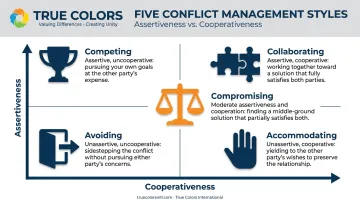
The Thomas-Kilmann Conflict Mode Instrument adds another layer, mapping behavior across assertiveness and cooperativeness into five modes: competing, collaborating, compromising, avoiding, and accommodating. These aren't fixed personality traits. They're situational responses people default to under pressure, and different temperaments tend to favor different modes instinctively.
Self-Awareness Changes Everything
People who understand their own tendencies are less reactive when friction shows up. That's the entire premise behind validated personality assessments: they don't eliminate differences, they make differences visible before they become personal.
The stakes are real. In the UK, Acas estimated workplace conflict costs organizations £28.5 billion annually—more than £1,000 per employee.
Nearly 900,000 people took time off because of workplace conflict, and close to 500,000 resigned. Even accounting for regional differences in how conflict gets measured, the pattern holds: ignored friction has a price tag.
Common Conflicting Personality Types in the Workplace
True Colors International's four-temperament framework offers a practical lens for spotting where clashes originate. Each color represents a distinct set of instincts around pace, detail, and decision-making:
| Temperament | Pace | Decision Priority | Communication Focus |
|---|---|---|---|
| Gold | Deliberate | Structure and rules | Details, context, clear expectations |
| Orange | Fast | Action and opportunity | Concise, outcome-focused |
| Green | Research-driven | Logic and evidence | Direct, no implied meanings |
| Blue | Relational | Connection and alignment | Rapport before message |
No one is purely one color. Everyone carries a full spectrum, usually with one or two dominant traits. But certain pairings surface friction more predictably than others.
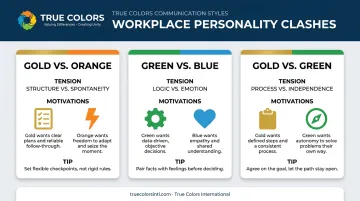
Gold vs. Orange: Structure vs. Spontaneity
Golds crave plans, precedent, and predictability. Oranges crave flexibility and quick wins. Put them on the same deadline and you'll see it immediately: the Gold wants a documented process; the Orange wants to skip ahead and adjust later.
Both approaches pursue the same goal through different strategies. A fast-moving Orange is often trying to create momentum. A careful Gold is often trying to protect quality.
Quick tip: Frame conversations to hit both needs: lead with the outcome (what the Orange cares about), then lay out the structured plan (what the Gold needs to buy in).
Green vs. Blue: Logic vs. Emotion
Greens prioritize data and objectivity. Blues put feelings and relationships first. Where a Green may tune out emotion and miss non-verbal cues, a Blue needs rapport before engaging with facts at all.
The result: Greens read as cold, Blues read as overly sensitive, and neither read is accurate.
Quick tip: Greens should acknowledge the relationship briefly before presenting data. Blues should translate feelings into concrete, problem-focused language before bringing concerns to a Green colleague.
Gold vs. Green: Process vs. Independence
Golds want adherence to established procedure. Greens want the autonomy to solve problems their own way. Picture a Gold supervisor who expects a Green data analyst to follow a fixed workflow, when the analyst's real value comes from thinking outside it.
What drives the friction is whether established rules leave room for independent judgment.
Quick tip: Define which processes are non-negotiable and where genuine latitude exists. Ambiguity, not disagreement, is usually what erodes trust between these two.
Which Personality Types Are Least Compatible?
"Incompatible" is the wrong word here: no two temperaments are doomed to conflict. Certain pairings (highly detail-oriented with highly spontaneous, or highly logical with highly emotional) simply require more intentional communication.
The MBTI conflict-pairs research (TJ, FJ, TP, FP) shows how opposite decision-making and organizing preferences create predictable friction points. The research has clear limits, though: there is no reliable statistical ranking proving that any specific pairing is objectively "worst." The available studies describe patterns of attention and behavior, not a compatibility scorecard.
What the evidence does support:
- Thinking/Feeling differences correlate with conflict-handling scores (Thinking types trend toward higher competing, lower accommodating)
- No four-group pairing has been tested or validated as more conflict-prone than another
- Teams that understand each other's temperament report smoother collaboration, regardless of which types are on the roster
The real solution isn't avoiding certain coworkers or reshuffling teams to dodge friction-prone combinations. It's building awareness of why the friction happens in the first place, so it stops feeling personal.
Practical Strategies to Manage Conflicting Personalities
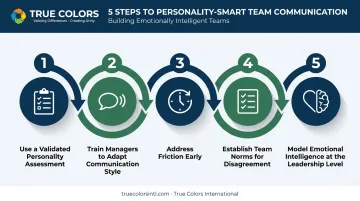
Awareness alone does not resolve conflict. These five practices turn personality insight into day-to-day habits:
Use a validated personality assessment. Tools like True Colors' ASI-certified assessment give teams a shared vocabulary for discussing differences without judgment. The assessment was validated in a 10,000-person study, giving teams a research-backed baseline they can trust.
Train managers to adapt their communication style. Data and structure land better with Greens and Golds; big-picture framing and quick wins resonate with Oranges; personal reassurance matters most to Blues. One universal move: match pace, detail, tone, and decision style to the listener, not your own default.
Address friction early, before resentment builds. UK workplace research from Acas found that conflicts reaching formal procedures cost more than three times as much as those resolved informally. Try a short structured pause: "Can we take 10 minutes to name what's happening, then agree on the next step?" That approach respects people who want to resolve things immediately and people who need time to process.
Establish team norms for disagreement. Set clear expectations for how meetings run, how feedback gets delivered, and how decisions get made. Ambiguity is what turns a style mismatch into a grudge.
Model emotional intelligence at the leadership level. Active listening, validating other viewpoints, and separating the person from the behavior should be everyday practice. Leaders who frame friction as a style mismatch, not a character flaw, set the tone for everyone below them.
Building a Conflict-Resilient Culture Through Personality Awareness
One workshop won't fix a culture. That's why True Colors International built the True Culture Loop: a four-stage framework moving organizations from one-time training toward lasting change:
- Awareness: surfacing individual styles and blind spots through assessments and surveys
- Alignment: translating self-knowledge into shared communication practices and hiring standards
- Action: embedding the shared language into daily meetings and decisions
- Reinforcement: sustaining the culture through coaching and internal culture champions
Organizations that build a shared temperament language see stronger cross-team collaboration. That pattern shows up across True Colors' 45-plus years with teams at Google, Ford, Marriott, and others.
HR leaders who want facilitator-led depth can take True Colors' Conflict Navigation Certification, a two-day program offered in person or virtually. Participants learn to identify root causes of conflict and run conflict-navigation workshops inside their own organizations.
Fortifi Bank's IT management team, for example, moved through the foundational Personal Success Workshop and then the Conflict Navigation Workshop as a structured sequence rather than a one-off session.
Frequently Asked Questions
What are common conflicting personality types?
Structured, organized types (Gold) often clash with spontaneous, flexible types (Orange), while logic-driven types (Green) often clash with emotion-driven, relationship-focused types (Blue). The friction usually centers on pace, process, and decision-making style.
What personality types are not compatible?
No types are truly incompatible. Temperaments with opposite decision-making and organizing preferences, like highly analytical versus highly emotional, simply require more intentional communication to avoid recurring friction.
How do you handle conflict between coworkers with different personalities?
Start by identifying each person's temperament and communication preferences. Adapt your approach to match their style, and address the issue early through a structured, low-pressure conversation rather than letting it simmer.
Can personality assessments really reduce workplace conflict?
Validated assessments like True Colors build self-awareness and give teams a shared vocabulary for naming differences without blame. That shared language cuts miscommunication and makes collaboration easier.
What is the best way to communicate with a difficult coworker?
Adapt your tone and format to their temperament: direct and brief for results-driven types, warm and personal for relationship-focused types. Match their preferred pace and detail level to lower friction fast.
How can managers mediate personality-based conflicts on their team?
Managers should facilitate neutral conversations using a common framework, like the True Colors system, rather than taking sides. Setting clear team norms for resolving disagreements before conflict arises makes mediation far easier when it's needed.