That's a problem. Sixty-six percent of C-suite and board members told PwC that culture matters more to performance than strategy or operating model — but few of them measure it with any rigor. PwC's 2021 Global Culture Survey, which polled 3,243 leaders across 42 countries, found this gap everywhere.
Running a culture assessment sounds simple. Send a survey, read the results, done. In practice, outcomes swing wildly depending on which tools you pick, how you word questions, when you launch, and whether anyone acts on what comes back.
This guide walks through the exact steps, the best tools available, timing considerations, common pitfalls, and how to turn raw data into culture that actually changes.
Key Takeaways
- Culture assessments compare real behaviors against your stated vision, not just employee morale
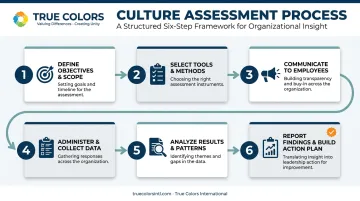
- The core process: define objectives, select tools, gather data, then build your action plan
- OCAI, the Denison Model, and personality-based assessments each answer different questions
- Most assessments fail from unclear goals, biased questions, or zero follow-through
- 69% of leaders at resilient organizations call culture a genuine advantage, per PwC's 2021 Global Culture Survey
How to Perform an Organizational Culture Assessment (Step-by-Step)
Step 1: Define Your Objectives and Scope
Before choosing a single tool, leadership needs to agree on what's actually being measured. Communication? Engagement? Values alignment? Trust between departments?
Every objective should connect to a business outcome: lower turnover, tighter cross-team collaboration, or stronger leadership consistency during a growth phase. Vague goals like "improve culture" produce vague, unusable data. Decide the scope, too: is this company-wide, or limited to a division that's showing warning signs?
Step 2: Select the Right Assessment Methods and Tools
Not every organization needs the same instrument. Match your tool to the depth of insight required:
- Quantitative surveys (OCAI, Denison, pulse checks, or True Colors' Employee Experience Survey) for broad, comparable data across teams
- Qualitative methods (focus groups, one-on-one interviews) for context numbers can't capture
- Observation to compare what leadership says the culture is against what employees actually experience
SHRM's culture audit guidance recommends combining an anonymous survey with interviews and direct observation whenever you need to explain, not just measure, a gap. A quick quarterly pulse check calls for a lighter tool than a full-scale transformation initiative.
Step 3: Communicate the Process to Employees
Participation rates and honesty both climb when people understand why they're being asked, how their answers will be used, and whether responses are truly anonymous.
Be specific. Explain who sees the raw data, how results will be reported, and what happens next. This matters most on sensitive topics like leadership trust, inclusion, and psychological safety, where employees are quick to sense a survey with no real intent behind it.
Step 4: Administer the Assessment and Collect Data
Give employees enough time to respond without letting the window drag on so long that momentum fades. Offer multiple channels: survey links, QR codes at team meetings, or in-person sessions for employees without regular desk access.
There's no universal "perfect" survey window, but shorter, well-communicated cycles tend to outperform open-ended ones. A commonly cited practitioner benchmark from SHRM shows a two-week response period, followed by several weeks for analysis and reporting.
Step 5: Analyze Results and Identify Patterns
Averages hide the story. Segment findings by department, tenure, and role to surface subcultures that differ meaningfully from the company-wide profile.
Gallup's guidance supports slicing data by team, region, and department, but proceed carefully with small groups. Never report results for teams under 10 respondents; it risks exposing individual answers and destroying trust for the next round.
Step 6: Report Findings and Build an Action Plan
Raw data isn't a deliverable. Translate it into 3-5 prioritized recommendations leadership can commit to within a defined timeframe, whether that's 90 days or two quarters.
Share findings transparently, even the uncomfortable ones. HBR's research on employee feedback identifies a persistent "feedback-action gap" as one of the biggest reasons culture work stalls: teams share input, then hear nothing back.
Best Tools and Methods for Assessing Organizational Culture
Choosing a tool depends on your goal: diagnosing your dominant culture type, tracking engagement over time, or helping teams understand how communication styles shape daily interactions.
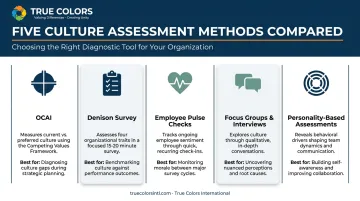
Organizational Culture Assessment Instrument (OCAI)
Built on Cameron and Quinn's Competing Values Framework, OCAI scores your organization across four types: Clan, Adhocracy, Market, and Hierarchy. Respondents split 100 points across options for six culture dimensions, once for "current" culture and again for "preferred" culture. The gap between the two profiles becomes your change roadmap.
Denison Organizational Culture Survey
The Denison model measures four traits: Mission, Adaptability, Involvement, and Consistency, each linked to specific performance outcomes. A landmark 1995 study of 764 organizations found involvement and adaptability predicted growth, while consistency and mission predicted profitability. The survey typically takes 15-20 minutes per employee to complete.
Employee Surveys and Pulse Checks
Likert-scale surveys and short pulse checks track ongoing sentiment on leadership, communication, and belonging between larger assessments. Gallup recommends monthly or quarterly pulses paired with semiannual deeper dives — but only if you can actually act on each round of results.
Focus Groups and One-on-One Interviews
Numbers tell you what is happening. Conversations tell you why. Focus groups and interviews surface nuance around trust and psychological safety that a five-point scale simply can't capture, especially in teams where survey fatigue has already set in.
Personality and Temperament-Based Assessments
Personality-based tools take a different approach: rather than only measuring sentiment, they reveal why communication breaks down between teams in the first place. True Colors International's assessment, for example, is ASI-certified through 2027, built on an N=10,000 validation study, and meets EEOC 80% guideline standards for reliability and construct validity.
Organizations like Amazon, Ford, and Marriott have used the framework across more than 45 years of cross-industry work, pairing it with traditional culture surveys to explain behavioral patterns that engagement scores alone leave unanswered.
When Should You Conduct an Organizational Culture Assessment
Certain moments make assessments especially valuable:
- Leadership transitions: new executives need a clear read on the organization before deciding what to change
- Mergers and acquisitions: cultural compatibility often determines whether the deal succeeds
- Rapid growth: fast headcount increases create gaps between stated values and daily behavior
- Declining engagement or rising turnover: these are classic signals that culture has drifted without anyone noticing
For steady-state monitoring, Gallup recommends semiannual deep-dive assessments paired with monthly or quarterly pulse surveys for targeted issues. That said, more frequent isn't always better. Surveying constantly without acting on what you learn breeds survey fatigue and erodes trust — employees stop answering honestly once they sense nothing changes.
Common Mistakes to Avoid During a Culture Assessment
Even well-intentioned assessments go sideways. Watch for these:
- Skipping objective-setting — without a clear goal, you collect data nobody can act on
- Leading or biased questions: wording and order both shift responses; keep phrasing neutral, especially when tracking change over time
- Broken anonymity promises — reporting team results with fewer than 10 respondents risks exposing individuals and shutting down honest feedback for good
- Collecting data without a follow-up plan — SHRM is direct on this: leadership should commit to acting before launching the survey, not after seeing the results
One underrated risk is interpersonal friction masquerading as a "communication problem." Research suggests that 60-80% of organizational difficulties trace back to strained employee relationships — a statistic worth keeping in mind when your survey data points to vague "communication issues" without explaining the root cause.
Turning Assessment Results into Lasting Culture Change
Data without action is just an expensive PDF nobody reads twice. Share findings transparently with employees, including what leadership will address immediately and what will wait.
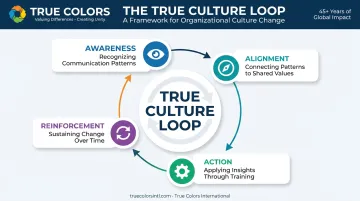
Once results are shared, treat the assessment as the start of a cycle, not a one-time event. True Colors International's True Culture Loop framework structures this as four ongoing stages:
- Awareness — help teams recognize their own communication and behavioral patterns
- Alignment — connect those patterns to shared organizational values
- Action — apply insights through targeted training or leadership development
- Reinforcement — revisit and sustain the changes so they don't fade after 90 days
Pairing assessment data with training gives insight somewhere to go. A survey might reveal that two departments clash constantly; a personality-based team-building workshop can show why those clashes happen and give people practical language to navigate them differently.
Whether it's a communication workshop, a leadership development series, or a hands-on team-building session, personality-based training turns a static report into behavior that actually shifts.
Frequently Asked Questions
How do you assess organizational culture?
Define your objectives, then choose survey and interview tools that match your goals. Collect honest employee input, analyze patterns by department or role, and build a prioritized action plan based on what you find.
What are the 4 types of organizational culture?
The Competing Values Framework identifies Clan, Adhocracy, Market, and Hierarchy cultures. Clan favors collaboration, Adhocracy pushes innovation, Market prioritizes results, while Hierarchy centers on structure.
What are the 4 C's of cultural assessment?
Some practitioners use Communication, Collaboration, Consistency, and Commitment as informal dimensions of cultural health. No single standardized framework owns this term, so definitions vary across consultants and organizations.
What is the OCAI used for?
OCAI (Organizational Culture Assessment Instrument) identifies your current culture type versus your preferred future state, giving leadership a clear gap analysis to guide targeted change efforts rather than generic culture initiatives.
How long does an organizational culture assessment take?
Individual surveys typically take 10-20 minutes to complete. A full assessment cycle, including data collection, analysis, and reporting, usually spans 4-8 weeks depending on organization size.
How often should a company assess its culture?
Run a full assessment annually or bi-annually, supplemented with quarterly pulse surveys to track progress and catch emerging issues between the larger reviews.