A workplace culture assessment is a structured process for measuring the beliefs, behaviors, and daily experiences that actually shape how work gets done — not how leadership assumes it gets done.
This guide is written for HR leaders, executives, and consultants who need objective insight before making people, hiring, or culture-change decisions. "Culture assessment" gets used constantly in HR strategy conversations, but rarely explained at an operational level. Below, you'll find what it is, why it matters, and exactly how to run one — plus the methods and tools that make results reliable.
Key Takeaways
- Effective assessments combine quantitative surveys with qualitative methods like interviews, focus groups, and policy audits
- Culture assessments measure deeper values and systemic patterns—beyond the snapshot sentiment engagement surveys capture
- A strong assessment needs clear objectives, transparent communication, honest analysis, and committed follow-through
- The biggest risk is collecting insights and never acting on them
What Is a Workplace Culture Assessment?
A workplace culture assessment is a diagnostic process that maps the values, beliefs, and behaviors shaping day-to-day work. It combines employee surveys, interviews, focus groups, and policy or process reviews.
Its purpose is to reveal the gap between the culture leadership believes exists and the culture employees actually experience.
That gap is often bigger than executives expect.
Culture assessments also differ from engagement surveys. Gallup frames organizational culture as how a company turns purpose into action. Engagement measures whether employees have what they need to perform at their best right now. Engagement is a snapshot. Culture is the operating system underneath it.
The strongest assessments don't rely on one data source. They blend:
- Quantitative data — survey scores, turnover rates, eNPS
- Qualitative insight — interviews, focus groups, policy audits, direct observation
Skip either half, and you get an incomplete picture. Numbers without context tell you that something's wrong but not why. Interviews without data give you anecdotes that may not represent the broader workforce.
Why Workplace Culture Assessments Matter
Culture is a retention lever, whether or not leadership treats it like one. A 2024 SHRM report found that 57% of employees who rated their culture poorly said they were actively job hunting or would be soon. Among those in poor cultures, the top reasons for leaving included a bad manager, unfair treatment, and inadequate pay — each cited by 54% of respondents.
Without a formal assessment, most leaders rely on:
- Anecdotal feedback from a handful of vocal employees
- Exit interviews (which only capture people already leaving)
- Assumptions based on their own experience, not the workforce's
None of that reflects the full picture. A structured assessment catches engagement gaps, communication breakdowns, and value misalignment before they turn into turnover or performance problems.
When an Assessment Becomes Essential
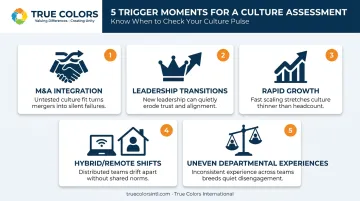
Certain moments make a formal diagnostic non-negotiable:
- M&A integration — merging two cultures without a compatibility review is a common cause of failed deals
- Leadership transitions — new executives often unintentionally shift unspoken norms
- Rapid growth — fast-scaling companies risk a divide between early employees and newcomers
- Hybrid or remote shifts — distributed teams often lose shared norms and day-to-day connection to culture
- Uneven experiences across departments — when one team thrives while another struggles silently
Run at these moments, a culture assessment gives HR and leadership hard signal on where alignment is breaking—early enough to fix it before turnover and performance costs pile up.
How to Run a Workplace Culture Assessment: Step-by-Step
Running a culture assessment takes six practical steps, from setting objectives to monitoring whether change sticks.
Step 1: Define Clear Objectives
Before choosing any tool, leadership and HR need to agree on what they're actually measuring: trust, inclusion, communication, values alignment — and which teams or locations are in scope. Skipping this step is why so many assessments produce data nobody knows how to use.
Step 2: Choose the Right Mix of Methods
Layer quantitative surveys with qualitative interviews, focus groups, and policy audits. Each method fills a gap the others leave open. Surveys tell you what people feel; interviews and focus groups tell you why.
A personality and communication-based methodology, such as True Colors International's proprietary assessment, adds a layer surveys often miss: how people communicate, make decisions, and respond to stress. That insight explains friction that shows up in interviews but never gets diagnosed at the root.
Step 3: Communicate Transparently with Employees
Before launching anything, HR needs to explain three things clearly: why the assessment is happening, how confidentiality works, and what anonymity actually protects. Skip this, and response rates drop along with honesty. Employees who fear retaliation simply say what they think leadership wants to hear.
Step 4: Administer the Assessment
This is the practical rollout:
- Distribute surveys with a defined, communicated deadline
- Schedule interviews and focus groups across departments and seniority levels
- Set a response window (typically a few weeks, depending on organization size)
- Send reminders without pressuring participation
Step 5: Analyze the Data and Build a Report
Raw survey scores mean nothing without context. Synthesize findings into a report that highlights:
- Patterns across teams, departments, and demographics
- Gaps between current culture and desired culture
- Specific, quotable themes from qualitative interviews
Avoid burying the report in jargon. Executives need clear, actionable patterns — not a 40-page data dump.
Step 6: Take Action and Monitor Progress
An assessment without action is worse than no assessment at all. It tells employees their input doesn't matter. This step should end in prioritized recommendations, a visible roadmap, and ongoing pulse checks to confirm changes are working.
True Colors International structures this follow-through with the True Culture Loop:
- Awareness: Assessment and surveys surface the real culture
- Alignment: Teams build shared expectations and language
- Action: Culture shows up in day-to-day behavior
- Reinforcement: Coaching and cultural champions help habits stick
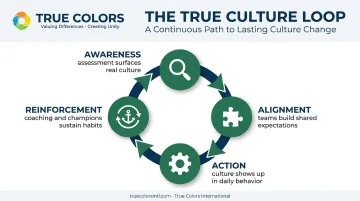
Culture work is circular, not a one-time project with a finish line.
Types of Culture Assessment Methods and Tools
Different tools answer different questions. Matching the tool to the goal matters more than picking whatever's popular.
Common assessment methods
- Employee surveys and pulse checks
- Focus groups
- One-on-one interviews
- Policy and process audits
- Performance metrics like turnover rates and eNPS
Validated frameworks worth knowing
| Framework | What It Measures | How It Works |
|---|---|---|
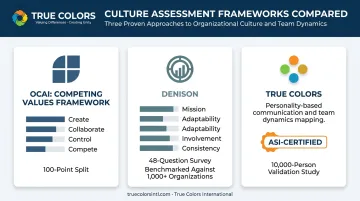
| OCAI (Competing Values Framework) | Four culture types: Create, Collaborate, Control, Compete | Respondents split 100 points across dimensions for current vs. preferred culture |
| Denison Organizational Culture Survey | Mission, Adaptability, Involvement, Consistency (12 indexes) | 48-question survey benchmarked against 1,000+ organizations |
| True Colors personality assessment | Individual communication styles and team dynamics | Maps how people communicate, decide, and collaborate; ASI-certified (N=10,000) |
The OCAI methodology is especially useful for visualizing the gap between where culture stands today and where leadership wants it to go. The two-round scoring format makes that gap concrete rather than abstract.
For personality-based systems, True Colors International's assessment is ASI-certified against a 10,000-person validation study and meets EEOC 80% guideline standards for disparate impact. That matters when results inform hiring or promotion decisions, because it confirms the tool does not disproportionately disadvantage protected groups.
How to choose
- Need ongoing engagement tracking? Pulse surveys and eNPS work well.
- Need a full culture diagnostic? Combine OCAI or Denison with interviews and audits.
- Need hiring or team-fit insight? Personality-based tools (such as True Colors) fit better than broad culture surveys.
Common Mistakes to Avoid When Running a Culture Assessment
Even well-designed assessments fail when execution goes wrong. Watch for these three traps:
No follow-through after the survey. Nothing damages trust faster than employees pouring honest feedback into a survey that never gets addressed. Always pair results with a visible action roadmap, even if it only names what you're tackling first.
Sentiment data alone. Pulse scores feel actionable, but they rarely reveal why morale dipped. If policies, benefits, or management practices are the real issue, a happiness score won't catch it—pair sentiment data with a genuine policy and process audit.
Running everything in-house. Internal teams often get sugarcoated feedback because employees hesitate to be fully honest with the same HR staff who handle reviews and raises. A trained third-party facilitator, such as a certified Master Trainer, surfaces more candid input.
Frequently Asked Questions
What is a culture assessment?
A structured diagnostic process that measures workplace values, behaviors, and experiences to guide culture-building decisions. It combines surveys, interviews, and observation rather than relying on a single data source.
What are some examples of culture assessments?
Common examples include the OCAI, the Denison Organizational Culture Survey, employee engagement surveys, focus groups, and personality-based communication assessments used to map team dynamics.
What are the best tools for culture assessments?
Match the tool to the goal: survey platforms for ongoing pulse tracking, validated frameworks like OCAI or Denison for full diagnostics, and personality-based systems for hiring and team-fit insight.
How long should a workplace culture assessment take?
Surveys and basic analysis typically take a few weeks. Full diagnostics involving interviews, focus groups, and detailed reporting often take a couple of months, depending on organization size.
Who should conduct a workplace culture assessment?
Internal HR or organizational development (OD) teams can run smaller assessments effectively. For larger or more sensitive diagnostics, a certified third-party facilitator improves neutrality and encourages more honest employee feedback.
How often should organizations run a culture assessment?
Annually is a common baseline. Beyond that, schedule them around major inflection points: leadership changes, mergers, rapid growth, or a shift to hybrid work.